
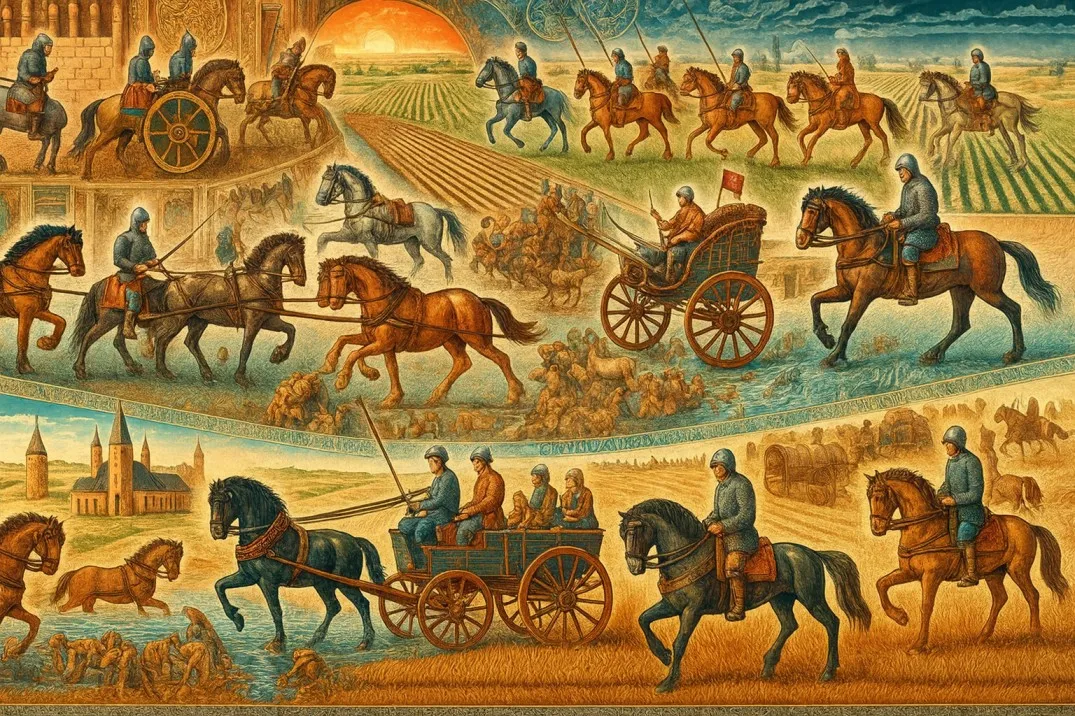
The horse changed human history, but when did people start to control it? A 2024 genetic study suggests that people brought the horses we now call domestic under breeding control only around 2200 BCE, much later than the earliest signs of horse keeping on the Kazakh steppe. For Optional Paper I, this is a clean example of genetics and archaeology answering one question together.
Source: Pablo Librado et al., “Widespread horse-based mobility arose around 2,200 BCE in Eurasia”, Nature 631, 6 June 2024.
What the genomes show
The team analysed 475 ancient horse genomes. They found signs that people began to control the breeding of the modern domestic lineage, called DOM2, around 2200 BCE. These signs include close-kin mating and shorter generation times. Soon afterwards, DOM2 spread across Eurasia and replaced almost every local horse lineage.

This timing matters because it separates two ideas that people often mix together. Keeping horses is one thing. Building a horse population that spreads widely and carries riders, chariots and trade is another. The authors argue that the spread reflects the rise of widespread horse-based mobility. They also say it does not fit the older view that large horse herds moved with steppe migrations into Europe around 3000 BCE or earlier.
Where Botai fits
Botai in Kazakhstan, around 3500 BCE, is the earliest site with strong evidence of horse husbandry. The 2024 study reports shortened generation times there, which it reads as local horse management. However, an earlier genome study (Librado et al., Nature, 2021) found that modern domestic horses do not descend from the Botai horses. Botai therefore shows early human-horse relations, but not the start of the lineage that spread across the world.
How far the evidence goes
A genome can show who bred with whom and when a lineage expanded. It cannot show, on its own, whether people rode, drove or ate the animals. That needs archaeological evidence such as bit wear, burials, chariots and bone injuries. Dates also carry error ranges, and new genomes may shift them.
Using it in UPSC Mains
Use the study when a question asks how archaeology and biological anthropology work together, or how domestication changed society. A good answer defines domestication as a long relationship, not a single event. It then separates early management (Botai), genetic control (DOM2) and the social effects: faster movement, wider trade and new forms of warfare. Close with the limits of ancient DNA.
The related PYQ, a conceptual connection to the Indian microlithic context rather than to horse domestication, is the 2022 Paper I question on animal domestication in the Indian microlithic context. More questions on the theme are under Prehistoric Archaeology PYQs. For the wider farming transition, see new research on the origins of agriculture, and for the syllabus map see the Anthropology Optional complete guide.
Sources
Librado et al. (2024), Nature 631, 819-825, DOI 10.1038/s41586-024-07597-5 (abstract checked through institutional repository records); Librado et al. (2021), Nature 598, 634-640, on the Western Eurasian steppe homeland and Botai.