
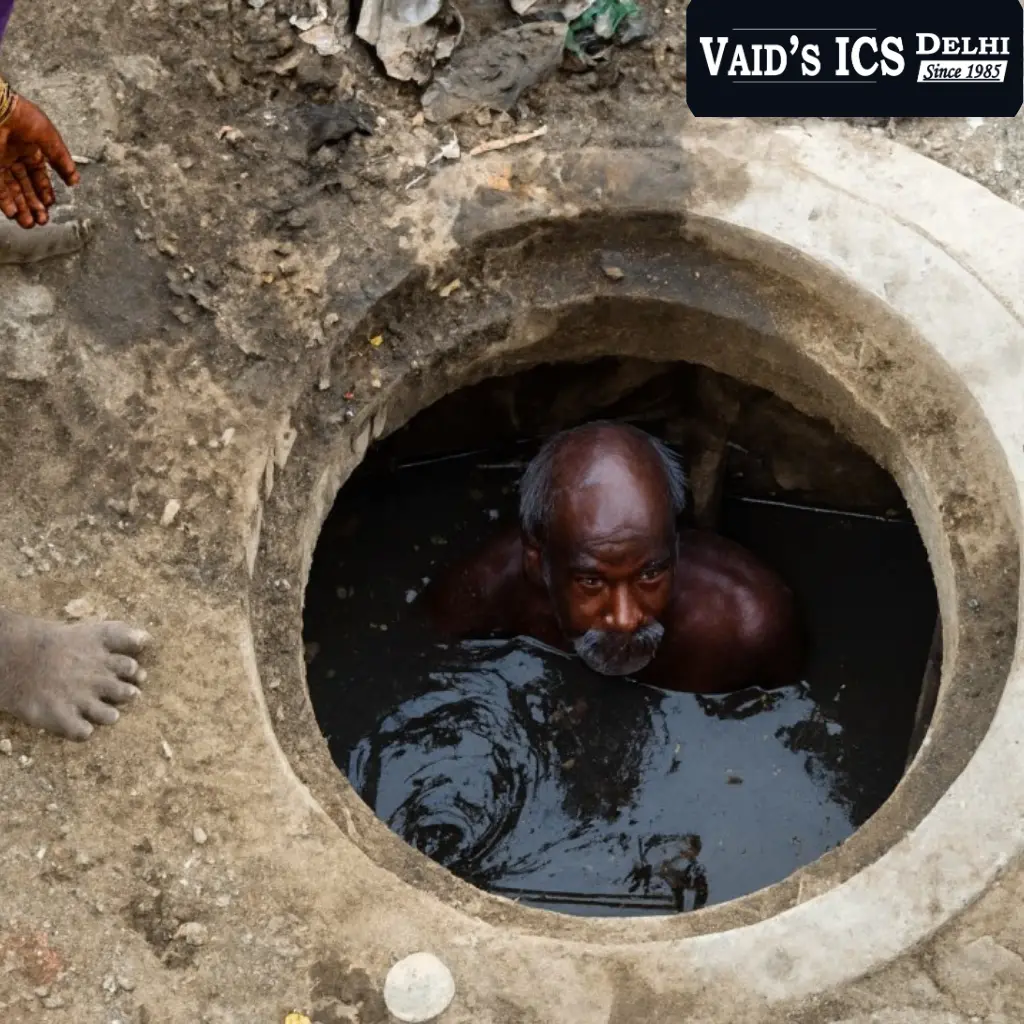
Based on Ministry of Social Justice & Empowerment replies in the Rajya Sabha (2024–2025).
Manual scavenging in India remains one of the sharpest contradictions between constitutional ideals and social reality. Government data showing hundreds of deaths in sewers and septic tanks over five years — alongside the official position that no deaths were due to “manual scavenging” — opens a powerful anthropological debate on caste, occupation and structural violence, directly useful for UPSC Anthropology Paper 2 and GS Paper 2 (social justice).
Why this matters: a live social-justice issue links caste, occupation and structural violence — high-value for Paper 2 and GS ethics.
Syllabus relevance: Anthropology Paper 2 — caste, social stratification, Indian social problems; also GS Paper 2: Social Justice.
Best use in answers: use to apply purity-pollution (Srinivas) and the ideals-vs-reality gap (Béteille) to a current issue.
Background
Successive replies in Parliament have recorded a steady toll from hazardous sewer and septic-tank cleaning. The Minister for Social Justice and Empowerment, Ramdas Athawale, informed the Rajya Sabha that 377 people died while cleaning sewers and septic tanks between 2019 and 2023, even as the government maintained that no deaths were recorded specifically due to “manual scavenging”. A later reply put deaths from such hazardous cleaning at 315 between 2021 and 2025. Whatever the exact window, the toll runs into the hundreds — while the “no manual scavenging deaths” position raises deep ethical and definitional concerns.

State-wise pattern
The deaths are concentrated in a handful of states. In the 2021–2025 figures, Maharashtra recorded the most (53), followed by Haryana (43), Tamil Nadu (38) and Uttar Pradesh (35), with other states also reporting significant numbers. The pattern reveals the persistence of hazardous, caste-linked occupations, often disguised as contractual sanitation work.
An anthropological insight
Anthropologically, the issue reflects the continuing intersection of caste, occupation and structural violence. As M.N. Srinivas observed, the ritual hierarchy of purity and pollution translates into an occupational hierarchy of dignity and degradation. Despite legal abolition under the Prohibition of Employment as Manual Scavengers and their Rehabilitation Act, 2013, the practice persists through informal labour arrangements — showing how cultural patterns of inequality adapt to economic modernisation.
This is a classic instance of what André Béteille called the contradiction between constitutional ideals and social realities. Persistent deaths underscore how social stratification and symbolic pollution continue to structure India’s labour economy, revealing the limits of legislation unaccompanied by social transformation.
Conclusion
The death of hundreds of sanitation workers within a few years is not merely a statistic — it mirrors India’s unfulfilled promise of equality and dignity. The denial of “manual scavenging deaths” reflects an epistemic blindness rooted in caste denialism. A meaningful response must move beyond a mechanical idea of “Swachh Bharat” to a moral and anthropological understanding of cleanliness — one that includes the dignity of those who clean.
Why this matters for UPSC Anthropology
This links Paper 2 themes of caste, social stratification and Indian social problems with GS social-justice content — see the Paper 2 syllabus on Indian society, review question trends in the Anthropology PYQ analysis, and use the complete optional guide to weave theorists like Srinivas and Béteille into answers.
Use in Answer Writing
Syllabus topic: Caste, social stratification & Indian social problems (Paper 2); GS Paper 2: Social Justice.
Key concepts to apply: Purity-pollution (M.N. Srinivas); constitutional ideals vs social reality (André Béteille); structural violence.
How to use it in answers: cite parliamentary data (hundreds of deaths during sewer and septic-tank cleaning) with these theorists to show the gap between legal abolition and social practice.
Anthropological concepts to cite
- Purity and pollution (M.N. Srinivas)
- Constitutional ideals vs social reality (André Béteille)
- Structural violence; cultural lag; social stratification
FAQ
Is manual scavenging legal in India?
No. It is prohibited under the 2013 Act, but hazardous cleaning persists through informal and contractual arrangements.
Which anthropological concepts apply?
Purity–pollution (Srinivas), the gap between constitutional ideals and social reality (Béteille), and structural violence.
Where is this useful in the exam?
Anthropology Paper 2 (caste, Indian social problems) and GS Paper 2 (social justice), plus ethics case studies.
Preparing Anthropology Optional for UPSC?
Connect theory and contemporary issues in high-scoring Paper 2 answers with VAID SIR at VAID’S ICS. Explore the Anthropology Optional programme →
VAID’S ICS has mentored Anthropology-optional rankers across years, including AIR 3 (2023) and AIR 1 (2020). See the full results.
Sources
- “377 died cleaning sewers in five years, but no instance of manual scavenging reported, says Centre,” Scroll.in (Rajya Sabha reply, Athawale): scroll.in
- “315 workers died while cleaning sewers or septic tanks in last 5 years…,” The Tribune (2021–2025 data): tribuneindia.com
- Prohibition of Employment as Manual Scavengers and their Rehabilitation Act, 2013.