
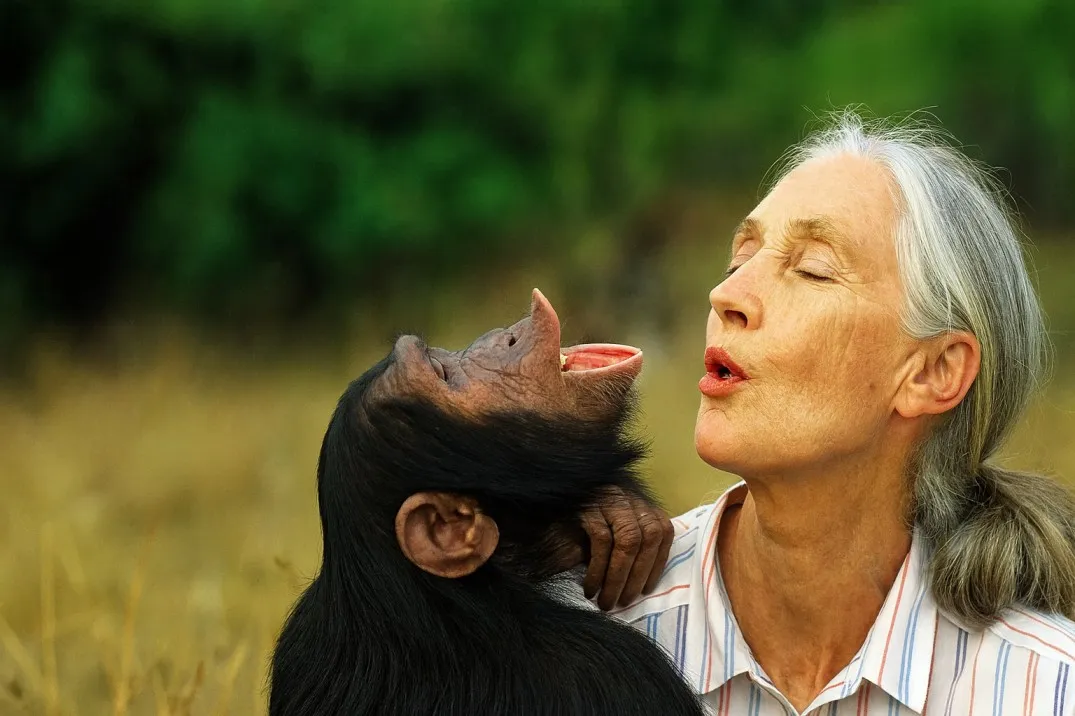
Jane Goodall died on 1 October 2025 at the age of 91. She changed primatology by sitting patiently among wild chimpanzees at Gombe and writing down what she saw. For an Anthropology student she is more than a famous name: she is the standard example of long-term, naturalistic field study of a living ape.
A childhood built around animals
Goodall was born in London on 3 April 1934. Her favourite childhood companion was Jubilee, a toy chimpanzee. She preferred watching worms, birds and insects to playing with dolls, and she filled notebooks with what she observed. As a child she is said to have hidden for hours in a henhouse to find out how hens lay eggs. Long before she reached Africa she had already imagined a life spent among animals.

From waitress to Gombe
After school she worked as a waitress to save for a trip to Africa. There she met Louis Leakey, the archaeologist and palaeoanthropologist. He valued her patience and curiosity and took her on as an assistant at Olduvai Gorge. In 1960, at the age of 26 and without a university degree, she began studying wild chimpanzees at Gombe Stream in Tanzania. She later completed a doctorate at Cambridge. Her 1965 thesis, The Behaviour of Free-living Chimpanzees in the Gombe Stream Reserve, became a cornerstone of the field.
The finding that redefined "human"
Goodall was the first researcher to record chimpanzees making and using tools, stripping twigs to fish termites out of mounds. Until then, scientists had thought this skill uniquely human. She also documented family bonds, emotions, dominance and conflict, and she gave the animals names rather than numbers. Overall, her work argued that the gap between humans and other animals is one of degree, not kind.
Use with a limit
Gombe is evidence of what living apes can do, not a template for early humans. Chimpanzees are not our ancestors, and some critics have argued that occasional food provisioning at Gombe may have influenced behaviour. However, critics also called the naming of animals anthropomorphism, although her records stayed rigorous.
Why Gombe matters for primate behaviour
Today, Gombe is still a standard reference for long-term observation. Its value for anthropology is comparative: records of cooperation, hierarchy and conflict made chimpanzee societies a point of comparison for models of early hominin social life. The comparison is useful only when its limits are stated, which is what examiners reward.
Family, loss and persistence
She married the wildlife photographer Hugo van Lawick in 1964, and they raised a son, Grub, in the Tanzanian bush. However, the marriage ended in 1974. In 1975 she married Derek Bryceson, director of Tanzania’s national parks, who died in 1980. In an era when women scientists were rare, media attention often dwelt on her appearance more than her discoveries, yet she let the work speak.
From research to conservation
By the late 1970s she concluded that research alone could not protect chimpanzees. She founded the Jane Goodall Institute in 1977 for wildlife conservation, habitat protection and education, and launched Roots & Shoots, a youth programme, in 1991. Even in her nineties she kept travelling and speaking about deforestation and climate change, and her central message stayed constant: individual action counts.
Using it in UPSC Mains
Goodall belongs under Paper I, Section 1.5, where the syllabus lists primate behaviour. First, open with the Gombe tool-use finding, connect it to culture-like behaviour in apes, mention the long-term field method, and close with one limit: provisioning, or the fact that chimpanzees are not ancestors. As a result, the answer stays balanced and avoids a purely biographical response.
Practise with the PYQ Jane Goodall and Primate Behaviour (2020). More questions are in the Human Evolution and Primatology PYQs. For related reading, see chimpanzee play and the origins of culture and great apes under human disturbance. To plan the surrounding revision, use the Anthropology Optional complete guide.
Sources
Goodall, J. (1965), The Behaviour of Free-living Chimpanzees in the Gombe Stream Reserve, Cambridge doctoral thesis. Her death on 1 October 2025 was reported by the Jane Goodall Institute and by news agencies worldwide.