
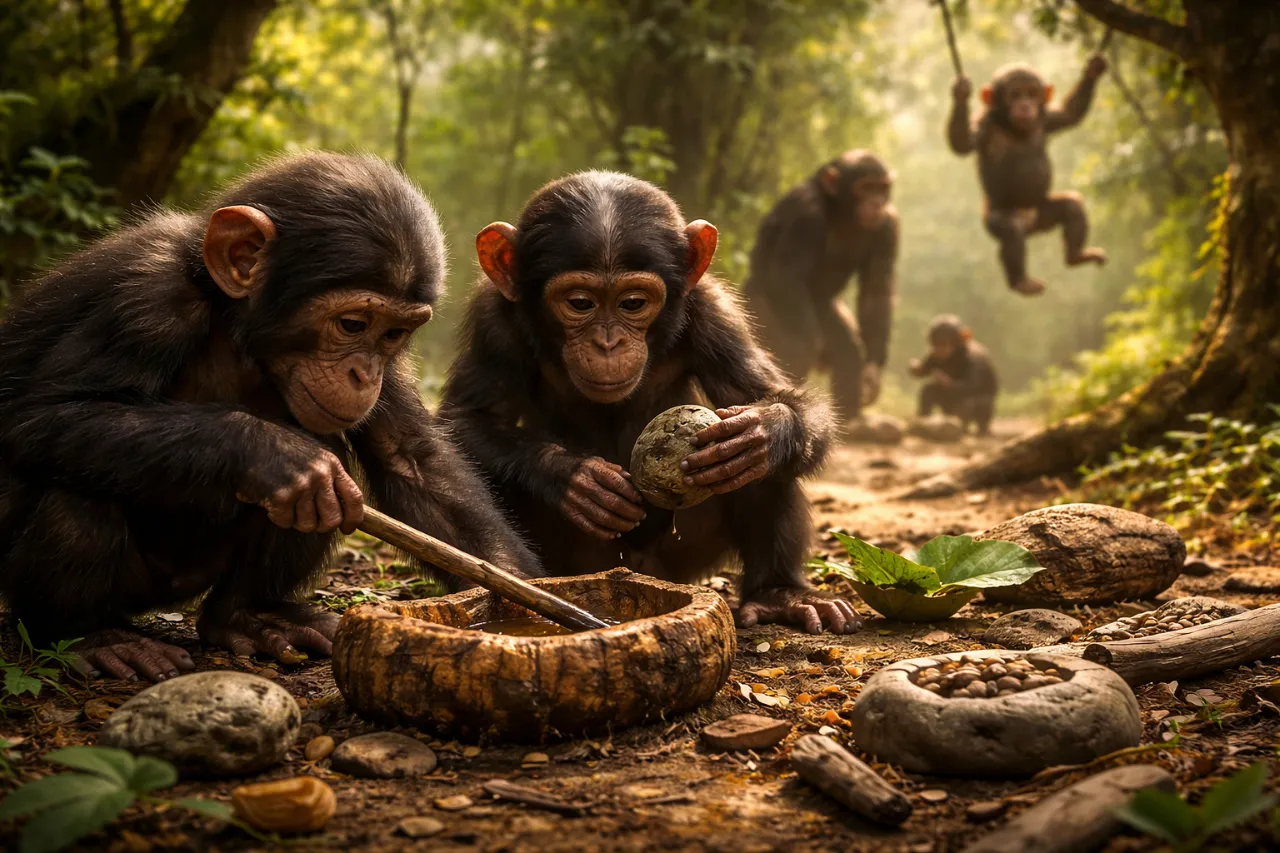
We usually picture chimpanzee cultural evolution as something that clever, experienced adults start. A 2025 study from Ngogo in Uganda suggests that infants and juveniles may be an important source of new behaviours. Play and exploration may help explain why. The link from play to culture is a proposal, not a proven chain.
Source: Iulia Bădescu et al., Scientific Reports (17 October 2025), "Atypical tool and object use in wild immature chimpanzees reveals developmental pathways to innovation."
Why young chimpanzees matter
Most research on how new behaviours arise in wild chimpanzees has looked at adults. The authors point to a gap. Immature animals spend much of the day in play, exploration and handling objects. They also live through a period when social rules are relatively relaxed. As a result, they have room to try things adults may not.

What the researchers did
The researchers worked at Ngogo in Kibale National Park, Uganda, home to one of the largest known chimpanzee communities. According to coverage of the paper, the team followed 36 infants and juveniles across fieldwork periods in 2013 to 2014 and 2018. They recorded 67 different uses of objects. Nearly half of these departed from typical adult practice, and most were new uses or modifications of existing ones. Examples reported include using moss as a sponge to collect drinking water and clipping leaves to signal. These counts come from press coverage of the paper.
From curiosity to tradition
The authors propose a developmental view of innovation. Play and exploration generate variation. If a new technique proves useful and others copy it, social learning can carry it through the group and it may become part of local tradition. In turn, that challenges the picture in which novelty begins with dominant or experienced adults.
What this does and does not show
It shows that immature chimpanzees produce many unusual object uses. However, it does not show that these innovations later became group traditions, or that early hominin children drove tool traditions. That step is an interpretation.
What it may tell us about human evolution
Chimpanzees share enough with us to be useful models for thinking about how culture evolves. If juvenile exploration is a source of variation, the same could have been true for early human groups, feeding tool-use traditions, social transmission and the slow build-up of more complex cultural systems. Treat this as a hypothesis that fits the data, since chimpanzees are not stand-ins for early hominins.
Using it in UPSC Mains
Use it under Paper I, Section 1.5, which lists primate behaviour, as a current example of social learning and culture-like behaviour in apes. The most useful sentence in an answer is the cautious one: young apes are a likely source of novelty, but the evidence for later spread comes from other work.
The closest exam question is Biological Changes That Made Culture Possible (2018); the play study adds a current example of innovation and learning. The 2020 question Jane Goodall and Primate Behaviour is also relevant. More questions are in the Human Evolution and Primatology PYQs. For related reading, see apes, gestures and the origins of language and Jane Goodall and the study of chimpanzee behaviour. The wider syllabus map is in the Anthropology Optional complete guide.
2 thoughts on “Young Chimpanzees and Cultural Evolution: How Play Drives Innovation in Primates”
Comments are closed.