
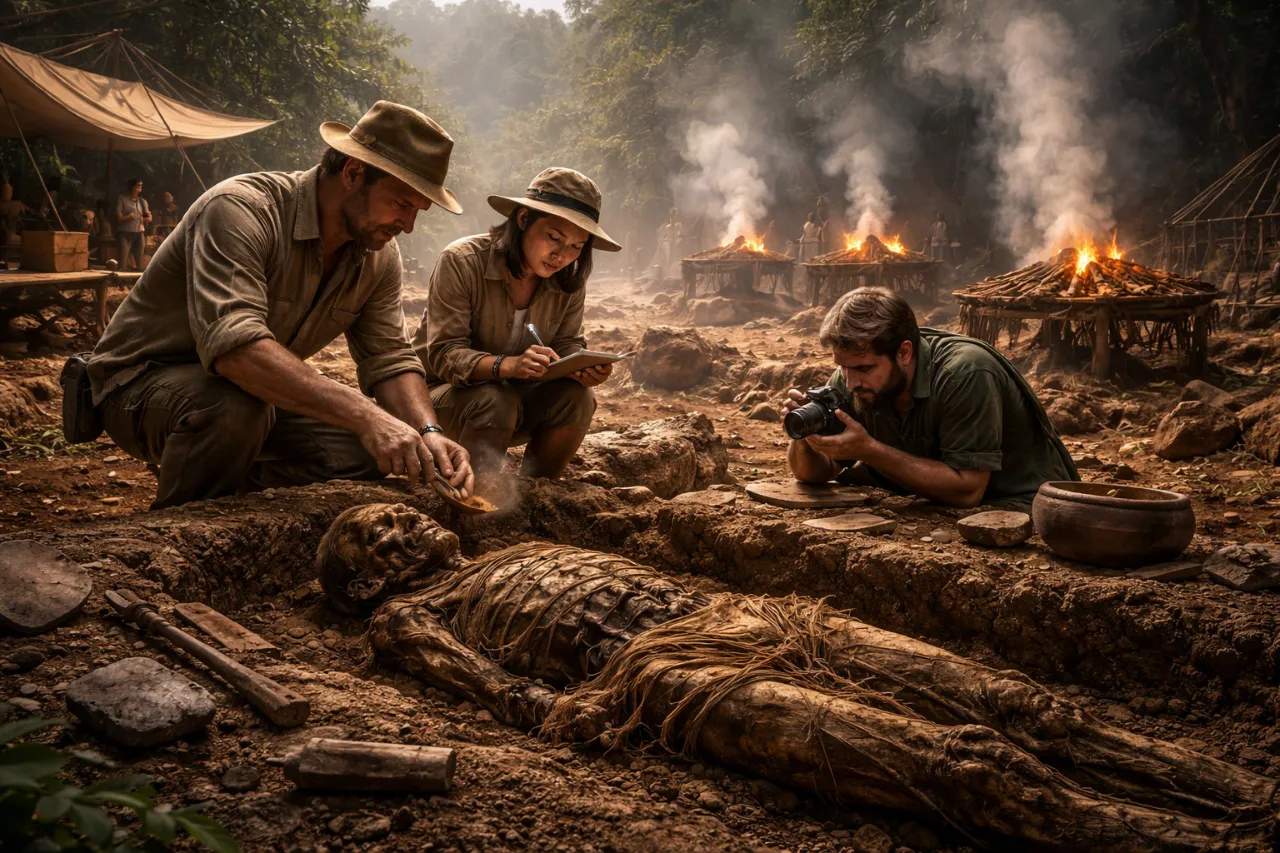
Smoke-dried bodies could be the world’s oldest mummies. That is the claim of a 2025 study of prehistoric burials in southern China and Southeast Asia, published by Hsiao-chun Hung and colleagues in the Proceedings of the National Academy of Sciences (PNAS) on 15 September 2025. The researchers argue that hunter-gatherers dried some of their dead over smoky fires, possibly earlier than the better-known mummies of Chile and Egypt.
At a glance
The study catalogues 95 sites with flexed or squatting burials. It tested 54 pre-Neolithic burials from 11 sites. The tests support smoke-drying at nine sites, and two remain uncertain.

Smoke-drying, not desert preservation
The familiar Old Kingdom mummies of Egypt date to about 4,500 years ago, although Egyptian embalming has earlier roots. The Chinchorro of coastal Chile practised deliberate mummification about 7,000 years ago. The Asian burials come from humid regions, where bodies rarely dry naturally. The researchers therefore propose intentional smoke-drying: bodies dried over a slow fire to slow decay before burial. Only bones survive today, so “mummy” here is an inference from traces, not a preserved body.
What the bones show
The skeletons lie in contorted, tightly flexed or squatting positions, and many remain articulated. The researchers read this as a sign that bodies were bound while still soft, since a stiff body is hard to fold so tightly. Some bones are also blackened.
Across 11 sites, the team investigated remains from 54 pre-Neolithic burials. Researchers used X-ray diffraction (XRD) and Fourier-transform infrared spectroscopy (FTIR) on selected bone samples to assess heat-related changes. Two comparison bone samples from Edo Castle, Tokyo, helped them interpret heating effects.
The results point to prolonged, lower-intensity heating and soot, although some bone regions also showed high-temperature damage. This differs from conventional cremation, which exposes the body to intense fire. The evidence supported smoke-drying at nine sites; weaker FTIR signals left Gaomiao and Hang Cho uncertain. Even these findings do not mean every burial at the 95 catalogued sites was smoke-dried.
| Evidence | Interpretation | Limit |
|---|---|---|
| Tightly flexed, mostly articulated skeletons | Bodies were bound or positioned, probably soon after death | Posture alone does not show smoking. |
| Soot and uneven charring on bone | Fire or smoke reached the body | Some bone regions show localized high heat; not every skeleton looks burned. |
| XRD and FTIR bone chemistry | Mostly prolonged, lower-intensity heating, unlike cremation | Nine of 11 tested sites support smoking; Gaomiao and Hang Cho are uncertain. |
How old, and how the method is inferred
The burials span roughly 12,000 to 4,000 calibrated years before present, so some samples are more than 10,000 years old. That range frames the whole set and does not date every burial. To picture the practice, the authors turned to ethnography. In 2019, team members documented smoke-dried ancestral bodies among the Dani and Pumo of Papua, Indonesia, and similar traditions are reported among Indigenous Australian and New Guinea Highland groups. There the dead are tightly bound, placed above a slow-burning fire and dried over several months.
Ritual meaning is inference
In these living traditions, smoke-dried ancestors keep a place in community life, and the paper suggests the ancient practice may have kept a similar bond. That is a plausible reading, but it is a hypothesis built on analogy. Bones and chemistry cannot show that a spirit was thought to leave and return, or that ancestors were worshipped. The authors also raise the possibility of continuity with much older settlers of the region, which likewise remains unproven.
Why it matters for Anthropology
If the interpretation holds, early hunter-gatherers in the region treated death with elaborate and lasting care, adding to the evidence for complex mortuary behaviour in prehistoric societies. The authors suggest regional continuity rather than a single world origin of mummification. Chile and Egypt developed distinct traditions.
Using it in UPSC Mains
This is not a named syllabus topic. It is a clean example of ethnoarchaeology, where material remains are read through living practices. In an answer, keep three levels apart: what was observed (posture, heat traces), what was tested (bone chemistry) and what is inferred (smoke-drying, belief). That habit helps with two 2026 questions: Ethnoarchaeology and Classical Archaeology (2026, Paper I) and Comparative Analogy in Indian Ethnoarchaeology (2026, Paper II). The second asks for Indian examples, so use this case for the method, not as a substitute. More practice: Prehistoric Archaeology PYQs. For another case that separates a measured date from a debated meaning, see the world’s oldest cave paintings.
Sources: Hung, H.-c., et al. (2025), Earliest evidence of smoke-dried mummification: More than 10,000 years ago in southern China and Southeast Asia, PNAS 122(38), e2515103122 (online 15 September 2025). Background: Science News and Live Science, both 15 September 2025.