
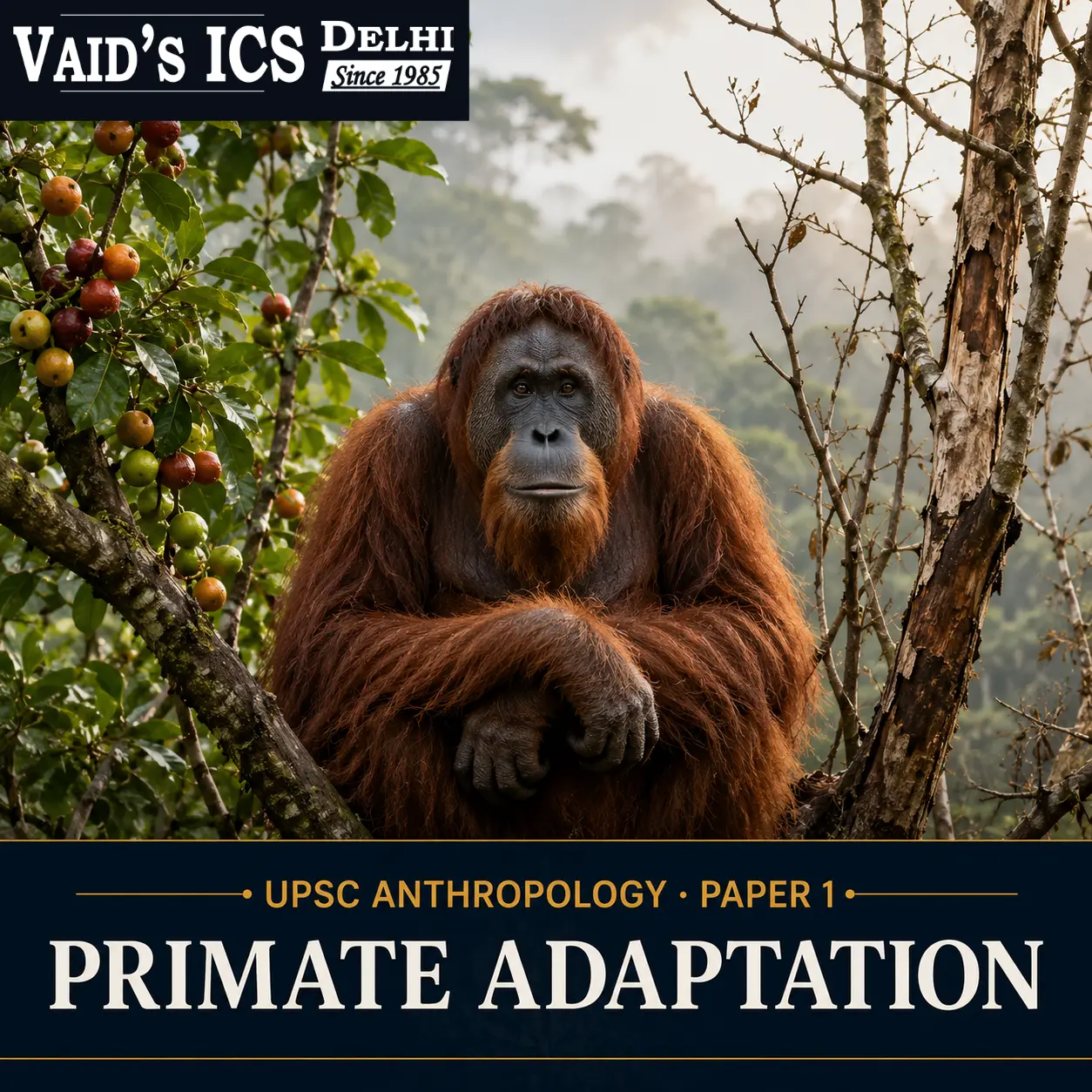
Primate metabolic adaptation is the capacity of an animal to change how it uses food energy when its food supply changes. A 2025 field study of wild Bornean orangutans shows what that looks like in a living ape. It gives Paper I a clear example that links primate ecology, bio-cultural adaptation and the evolutionary background of human metabolic health.
Source: Erin Vogel et al., Science Advances (27 August 2025), with a Rutgers University news release.
The study in brief
The paper, "Integrated behavioral and metabolically flexible responses of wild orangutans to ecologically driven dietary variation," draws on about 15 years of observation. The animals live at the Tuanan Research Station in Central Kalimantan, Borneo. Its central finding is that orangutans adjust what they eat, how active they are and how they use energy. They adjust as forest food availability rises and falls.

Feast and scarcity
When fruit is abundant, orangutans eat high-energy, carbohydrate-rich fruit. Protein intake still stays fairly stable, so the animals do not simply overeat sugar. When fruit becomes scarce, they shift towards leaves, bark and seeds, which are lower in sugar and higher in protein. They also draw on stored body reserves. They also reduce physical activity during low-fruit periods to conserve energy. In wetter, fruiting times the reserves can be rebuilt. The pattern is a flexible switching between fuel sources, not a fixed diet.
Check the claim
Press coverage says orangutans burn body fat and some protein in lean periods. If you quote a specific tissue or biomarker, check it against the paper. A safe sentence is that orangutans mobilise body reserves and cut activity when fruit is scarce.
Why this is evolutionarily interesting
A canopy-living ape faces an unpredictable food supply, and an animal that can switch fuel and cut its energy spending has an advantage. This is the kind of flexibility that selection in fluctuating tropical forests could favour. It also shows that diet in primates is about more than what the animal eats. It is also about how the body copes when the menu changes.
Shared biology with humans
Humans and orangutans share a distant common ancestor, so the two species probably conserve core metabolic pathways. That makes the study a useful lens on modern lifestyle disease: diets heavy in ultra-processed food, sugar and saturated fat are a very different environment from a seasonal forest. They may strain the systems that evolved to handle scarcity. That is a reasonable evolutionary argument, but it remains an argument. The study does not test human diets, and treat comparisons with intermittent fasting as an analogy, not a result.
Using it in UPSC Mains
Paper I, Section 1.5 lists "Primate Adaptations (Arboreal and Terrestrial)" and "Living Major Primates". Orangutan diet is not named, but the study works as a living-ape case of how an arboreal primate copes with seasonal food, and it supports bio-cultural adaptation answers. Cite it as a 2025 Science Advances study, then add one limit: one population at one field site.
No exam question matches the metabolic argument closely. The nearest primate themes are Forms of Primate Social Organisation (2022) and Jane Goodall and Primate Behaviour (2020). More questions are in the Human Evolution and Primatology PYQs. For related reading, see Chimpanzees, fermented fruit and food sharing and The Diet That Shaped Human Evolution. To plan the surrounding revision, use the Anthropology Optional complete guide.
Sources
Rutgers University news release, Be it feast or famine, orangutans adapt with flexible diets (2025)