
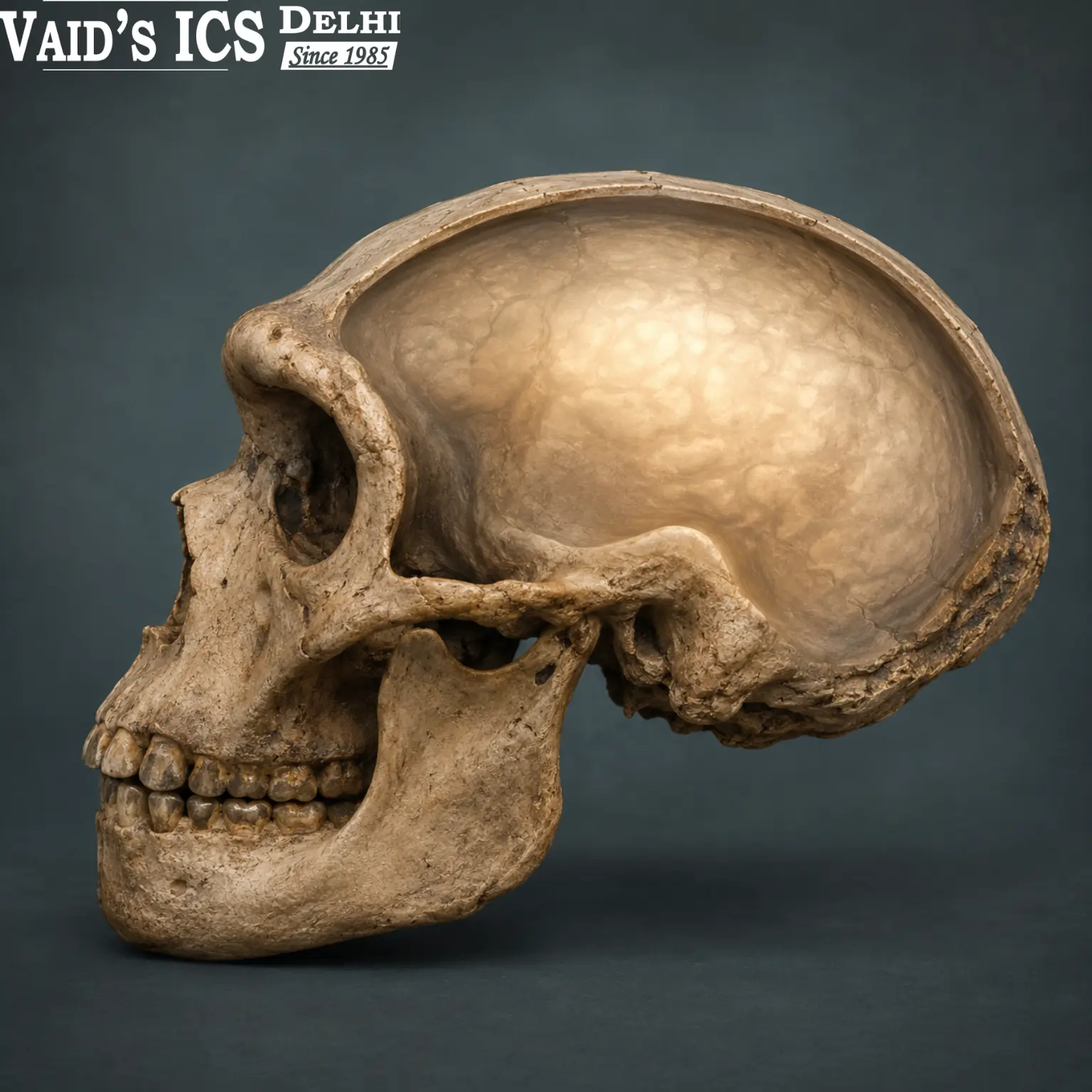
Source: Hong Ao et al., Journal of Human Evolution (2024).
The Xujiayao hominin brain is forcing a rethink of how brain size evolved. This Middle Pleistocene hominin from northern China had an exceptionally large brain — among the biggest known for its time — even though it lived hundreds of thousands of years ago. For UPSC Anthropology Paper 1, it is a useful case on encephalisation and on the diversity of Middle Pleistocene humans.
Why this matters: an unexpectedly large brain in a Middle Pleistocene hominin challenges the idea that brain size increased steadily over time.
Syllabus relevance: Anthropology Paper 1 — human evolution, encephalisation, and Middle Pleistocene hominin variability.
Best use in answers: use it to argue for mosaic, non-linear brain evolution and for high hominin diversity in Pleistocene Asia.
The Xujiayao hominin
The Xujiayao site in northern China has yielded fragmentary hominin remains dated broadly to the Middle Pleistocene. The fossils show a mix of features — some archaic, and (in a previously studied juvenile) teeth resembling those of modern humans. Xujiayao is part of a diverse set of Chinese hominins that lived alongside Neanderthals and Denisovans elsewhere in Eurasia.

An exceptionally large brain
The 2024 analysis estimates a very large endocranial capacity for the Xujiayao hominin — one of the largest reported for the Middle Pleistocene. It is described as comparable to, though slightly below, the roughly 1,800 cubic centimetres estimated for the related “Xuchang” (Lingjing) fossils, which are somewhat younger. In other words, Xujiayao is among the largest-brained hominins of its period — not a proven single “record holder,” but a striking outlier for its age.
Rethinking brain-size evolution
Scientists once assumed brain size rose steadily from Australopithecus through Homo habilis and Homo erectus to modern humans. Xujiayao complicates this. So does Homo floresiensis (“Flores Man”), whose brain was only about 400 cubic centimetres yet who lived relatively recently (roughly 100,000–60,000 years ago). Together they suggest mosaic, non-linear brain evolution rather than a simple upward march.
Middle Pleistocene human diversity
Xujiayao adds to the picture of the Middle Pleistocene as a time of high hominin diversity — sometimes called the “muddle in the middle” — with several populations across Africa, Europe and Asia showing different combinations of traits. This diversity is central to debates on the origins of Neanderthals, Denisovans and modern humans.
Why this matters for UPSC Anthropology
It supports Paper 1 answers on human evolution and encephalisation — map it to the Paper 1 human-evolution syllabus, contrast it with our note on Homo floresiensis and small brains, and see the complete optional guide.
Use in Answer Writing
Syllabus topic: Human evolution, encephalisation and Middle Pleistocene diversity (Paper 1).
Key concepts to apply: Cranial/endocranial capacity; non-linear (mosaic) brain evolution; “muddle in the middle”; hominin variability.
How to use it in answers: pair Xujiayao (very large brain) with Homo floresiensis (very small brain) to argue that brain size did not simply increase over time.
Concepts to apply in answers
- Encephalisation and cranial capacity
- Mosaic / non-linear brain-size evolution
- Middle Pleistocene hominin diversity (“muddle in the middle”)
\n
\n
FAQ
Did the Xujiayao hominin have the largest brain ever?
Not proven. It had one of the largest known Middle Pleistocene brains — comparable to, but slightly below, the ~1,800 cc estimated for the related Xuchang fossils.
Why is it important?
Such a large brain so long ago challenges the idea that brain size grew steadily over time.
Where is this useful in the syllabus?
Paper 1 — human evolution, encephalisation and Middle Pleistocene diversity.
Preparing Anthropology Optional for UPSC?
Turn nuanced fossil debates like this into precise Paper 1 answers with VAID SIR at VAID’S ICS.
Explore the Anthropology Optional programme →
VAID’S ICS has mentored Anthropology-optional rankers across years, including AIR 3 (2023) and AIR 1 (2020). See the full results.
Sources
- Hong Ao et al., study of the Xujiayao hominin endocranial capacity, Journal of Human Evolution (2024).