
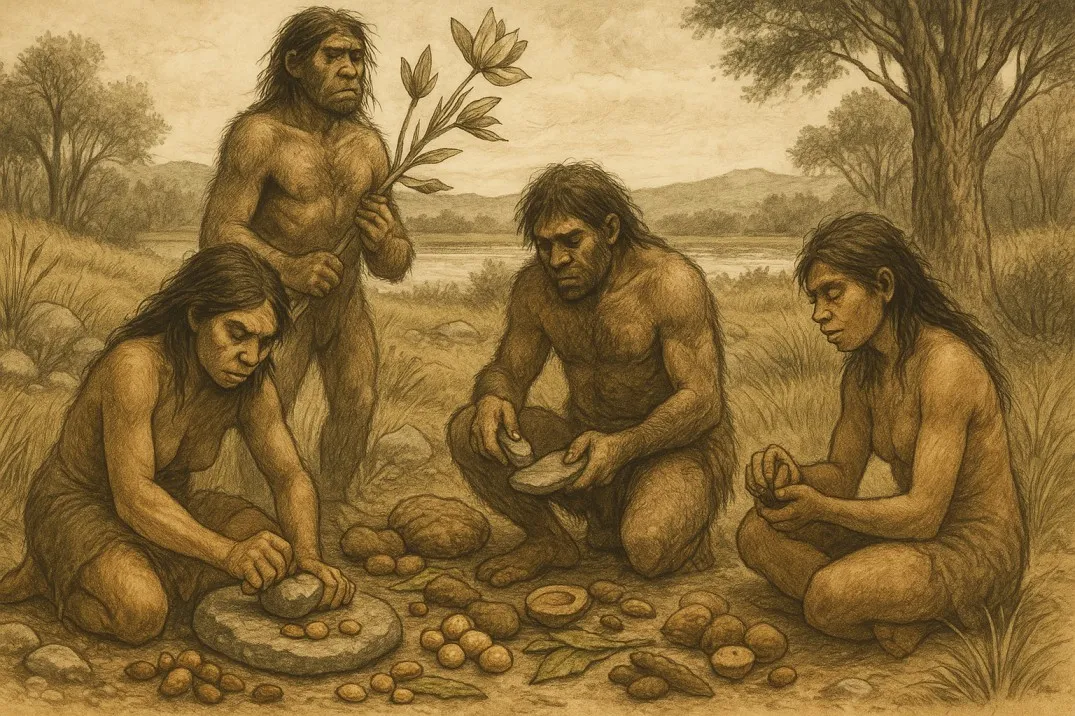
Eight stone tools, a lake margin and more than 650 starch grains: that is the physical evidence behind the claim that early humans ate plants 780,000 years ago. The headline says “plant-based”, which is a simplification. What the stones really show is skilled foraging that included starchy plants.
Source: Ahituv et al., “Starch-rich plant foods 780,000 y ago: Evidence from Acheulian percussive stone tools”, PNAS 122(3), January 2025, DOI 10.1073/pnas.2418661121. Evidence level: journal record and press summaries (Jerusalem Post, Sci.News). The full text was not independently reviewed.
Where the evidence comes from
The tools come from Gesher Benot Ya’aqov in Israel, an Acheulian site of about 780,000 years ago. Ahituv and colleagues studied eight basalt percussive tools, including anvils and hammerstones. They extracted and classified more than 650 starch grains, along with other microscopic remains such as pollen grains, rodent hair and feathers. Those extra remains support the case that the grains belong to the site and do not come from later contamination.

The team then compared the grains with the plants of the ancient lake margin. The starches came from acorns, cereals and legumes, and also from aquatic plants such as the yellow water lily and the water chestnut. Neither plant grows in the region today.
What the authors argue
They describe the tools as the earliest direct evidence of starch-rich plant processing. They also link starchy tubers, nuts and roots to the energy demands of the growing human brain. Using both aquatic and terrestrial resources suggests deep ecological knowledge. Further, processing food with tools may point to cooperation, though the stones alone cannot show how groups were organised.
What the evidence cannot show
The grains tell us which plants people pounded. They do not show how much of the diet those plants formed. In addition, fish and animal remains from the same site show that these hominins ate more than plants. So the finding challenges a purely meat-centred picture of early diets without replacing it with a plant-only one. Similarly, it does not prove that diet by itself drove cultural evolution.
Why it matters for Anthropology
The site gives an early example of culture and biology feeding each other: tool-assisted food processing, a wider diet and a hypothesis about brain evolution. It also reminds us that Lower Palaeolithic tools were not only for butchery.
Using it in UPSC Mains
Paper I, clause 1.4(a) covers biological and cultural factors in human evolution, and clause 1.8(b)(i) covers the Palaeolithic. Use this site when an answer needs a concrete Acheulian example. No exact PYQ asks about diet and tools, so practise with the nearest one, Lower and Middle Palaeolithic cultures (2020, Paper 1), where this site shows how tools were used. Browse the topic pages for human evolution and primatology and prehistoric archaeology.
Related reading: the diet that shaped human evolution and the full optional guide.
Sources
Sci.News summary of Ahituv et al., PNAS (2025); Jerusalem Post report; publication record (Israeli universities CRIS).