
Pedigree versus Genealogical Analyses — 2025 Paper I
Differentiate between pedigree and genealogical analyses. Discuss the history and application of these methods in anthropological studies.
Model Answer
VAID ICSIntroduction In anthropology, both pedigree and genealogical analyses are methods used to trace relationships across generations. However, their ontological focus differs: pedigree analysis is a tool of physical/biological anthropology focused on the genetic inheritance of traits, whereas genealogical analysis is a socio-cultural tool used to map kinship, social structures, and descent systems.
Differentiation
| Feature | Pedigree Analysis (Biological) | Genealogical Analysis (Socio-Cultural) |
| Primary Aim | Tracing the inheritance of biological/genetic traits or diseases. | Mapping social relations, marriage rules, descent, and alliances. |
| Unit of Study | Family lines showing affected/unaffected individuals (genotypes/phenotypes). | "Ego-centered" kin networks, lineages, or clans. |
| Nature of Links | Strictly biological parentage (genetic links). | Biological + Social (includes adoption, fictive kinship, and social fatherhood/ Pater). |
| Symbols/Notation | Uses shaded/unshaded circles and squares to denote affected/carrier status. | Uses standard kinship symbols focusing on marriage (=) and descent lines. |
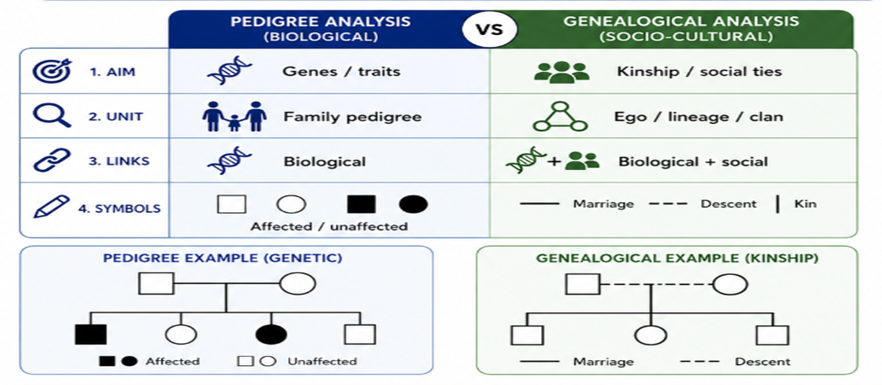
History and Development
- Genealogical Method: It was systematically developed by W.H.R. Rivers during the Cambridge Anthropological Expedition to the Torres Strait (1898). Rivers used it to overcome language barriers by asking informants the names and relationships of their kin. It later became the methodological backbone of British Structural-Functionalism (used heavily by Radcliffe-Brown, Evans-Pritchard for the Nuer, and Meyer Fortes).
- Pedigree Analysis: Its roots lie in the early work of Sir Francis Galton and the rediscovery of Mendelian genetics in the early 20th century. It was adopted by anthropological geneticists and population geneticists to study human variation, tracing dominant, recessive, sex-linked, and mitochondrial traits in specific populations.
Applications in Anthropological Studies
- Applications of Pedigree Analysis:
- Medical Anthropology & Population Genetics: Tracing hereditary disorders in endogamous populations.
- Indian Context: It is extensively used to study the inheritance of Sickle Cell Anemia among Central Indian tribes (e.g., Baiga, Gond) and the effects of inbreeding depression/consanguinity in South Indian populations (as studied by L.D. Sanghvi).
- Genetic Counseling: Helping communities understand the probability of passing on traits like Thalassemia or Hemophilia.
- Applications of Genealogical Analysis:
- Kinship and Social Structure: Decoding rules of endogamy/exogamy, preferential marriages (e.g., cross-cousin marriage), and segmentary lineage systems.
- Demography & Migration: Anthropologists use genealogies to reconstruct historical migration patterns, settlement histories, and local demographic changes.
- Property and Politics: Understanding rules of inheritance, succession to political or ritual office, and the resolution of social disputes.
Conclusion While traditionally separated into physical and social anthropology, contemporary studies increasingly use them together in a Biocultural Synthesis. For instance, in genetic epidemiology, social genealogies are used to map endogamous boundaries, while pedigrees track the flow of specific mutations within those boundaries, proving that biology and culture are inextricably linked.
Want feedback on your answer?
Join the Anthropology workshop or get structured answer-writing guidance from VAID ICS.