
Basic Personality Types and National Character — 2026 Paper I
Discuss, with appropriate examples, how basic personality types may lead towards building up of national character.
Model Answer
VAID ICSApproach
|
Model Answer
Introduction: The Culture-and-Personality school examined how recurrent patterns of socialisation produce recurring psychological orientations. Abram Kardiner and Ralph Linton called this a basic personality Answer structure and Flow; Cora Du Bois refined the argument through modal personality, the personality configuration occurring most frequently rather than uniformly within a population. National-character studies extended this logic to larger societies.
The theoretical mechanism: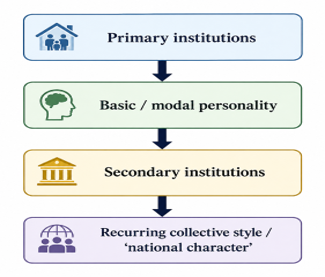
Primary institutions—child-rearing, weaning, discipline, family organisation and subsistence—create recurring childhood experiences. These may generate shared tendencies involving trust, dependency, anxiety, authority and emotional expression. Such orientations are then projected into secondary institutions such as religion, ritual, myth and ideology, which in turn reinforce Recurring
collective style / “national character”
Kardiner’s formulation therefore links institutionalised socialisation with patterned personality without requiring every person to be identical. Du Bois’s The People of Alor (1944), based on life histories and psychological materials, developed the more defensible idea of modal personality precisely because substantial individual variation remains.
Extension to national character:
During the Second World War, anthropologists attempted “culture at a distance” studies of national societies. Ruth Benedict’s The Chrysanthemum and the Sword (1946) interpreted Japanese cultural patterns through obligation, hierarchy, self-discipline and the famous contrast between shame- and guilt-oriented controls. Such studies suggested that recurrent institutions and public expectations can produce recognisable collective styles.
Critical evaluation:
- Nations are internally heterogeneous by class, gender, ethnicity, religion, region and generation.
- Wartime studies often lacked direct fieldwork and risked treating state ideology or elite norms as national personality.
- The causal chain from childhood experience to adult institutions is difficult to demonstrate conclusively.
- Migration, education, markets and political change continuously reshape personality patterns.
- “National character” becomes stereotyping if treated as fixed, innate or shared equally by every citizen.
Conclusion: Basic or modal personality can contribute to national character only as a historically produced and probabilistic cultural tendency. It is not an innate or homogeneous national psychological essence.
Want feedback on your answer?
Join the Anthropology workshop or get structured answer-writing guidance from VAID ICS.