
Anthropology Bridging Science and Humanities — 2025 Paper I
Anthropology provides a multidimensional understanding of human beings by bridging the gap between science and humanities. Elucidate.
Model Answer
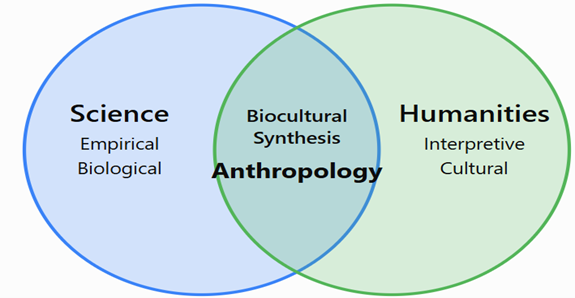
VAID ICSIntroduction As anthropologist Eric Wolf famously stated, "Anthropology is the most scientific of the humanities, and the most humanistic of the sciences." By employing Franz Boas’s four-field approach (Biological, Socio-cultural, Archaeological, and Linguistic), anthropology studies humans holistically. It bridges the rigid gap between the objective, empirical realm of the sciences and the subjective, interpretive realm of the humanities, offering a multidimensional understanding of humankind.
- Anthropology as a Science (The Nomothetic Approach)The scientific dimension of anthropology relies on positivism, empirical observation, quantification, and hypothesis testing to discover universal laws of human evolution and variation.
- Biological Anthropology: Employs genetics, osteology, and biometrics. For example, using mitochondrial DNA (mtDNA) to trace human origins out of Africa, or studying the sickle-cell trait as an evolutionary adaptation to malaria.
- Archaeological Anthropology: Uses hard scientific methods like Carbon-14 dating, stratigraphy, and isotope analysis to reconstruct past lifeways from material remains.
- Methodological Rigor: Driven by objective measurements (anthropometry, craniometry) and statistical models in population genetics.
- Anthropology as Humanities (The Idiographic Approach)Humans cannot be reduced to mere biological organisms or statistics; we are meaning-making beings. The humanistic dimension focuses on subjective experiences, values, symbols, and emotions.
- Interpretive Anthropology: Clifford Geertz’s concept of "Thick Description" treats culture as a text to be interpreted, not a law to be discovered.
- Symbolic Anthropology: Victor Turner’s work on rituals demonstrates how symbols evoke deep psychological and emotional responses.
- Empathy and Relativism: Through Malinowski’s method of participant observation, anthropologists build empathetic connections, writing ethnographies that capture the "native’s point of view."
- Bridging the Gap: The Biocultural SynthesisThe true multidimensionality of anthropology lies in how it intersects these two realms. Anthropology demonstrates that biology and culture are not separate; they mutually constitute each other.
- Medical Anthropology: A pure biomedical (scientific) approach treats tuberculosis as a bacterial infection. A humanistic approach understands the stigma of the disease. Anthropology merges them, showing how social inequality and poverty (humanities) create the biological conditions for the disease to spread (Paul Farmer’s "Structural Violence").
- The Concept of Race: Anthropology uses science (genetics/Richard Lewontin) to prove that biological race is a myth, while using humanities to understand racism as a very real, lived socio-cultural experience.
- Human Evolution: Biological brain expansion in Homo habilis (science)
 cannot be understood without the simultaneous invention of cultural tool-making and symbolic language (humanities).
Indian Context The bridging of these domains is evident in Indian anthropology. Scholar Irawati Karve, in her work Kinship Organization in India, combined anthropometric data (science) with the study of folklore, ancient texts like the Mahabharata, and marriage rules (humanities) to map the socio-biological landscape of India.
Conclusion Anthropology is unique because it refuses to artificially separate the human body from the human mind. By asking both "What are humans biologically?" and "What do humans mean culturally?", it offers the most comprehensive, evidence-based, yet profoundly empathetic understanding of humanity.
Want feedback on your answer?
Join the Anthropology workshop or get structured answer-writing guidance from VAID ICS.