
Palaeolithic Sites of the Himalayan and Sub-Himalayan Region — 2026 Paper I
Give the distribution of Palaeolithic sites around the Himalayan and Sub-Himalayan areas, highlighting the typo-technologies of the tools.
Model Answer
VAID ICSApproach
|
Model Answer
Introduction
The Himalayan Palaeolithic is concentrated not in the high mountains but mainly around the Sub-Himalayan/Siwalik foothills, river terraces, dun valleys and piedmont surfaces extending from the Potwar–Soan region of Pakistan through north-west India to the Nepal Siwaliks. Its best-known archaeological expression is the traditionally defined Soanian pebble–cobble/core–flake technology, alongside less frequent but significant Acheulean bifacial assemblages. Modern studies, however, show substantial technological and chronological variability within this belt.
Distribution and typo-technology
- Potwar Plateau–Soan Valley, Pakistan — classical type region
The Soan Valley provided the basis for de Terra and Paterson’s original formulation of the Soanian. River gravels yielded pebble/cobble-based assemblages dominated by:
Choppers + chopping tools + cores + flakes + scrapers/discoids
The fundamental technological principle was relatively direct reduction of locally available cobbles, although the wider Potwar region also contains Acheulean bifacial evidence. Therefore, even the type region should not be represented as a single homogeneous chopper tradition.
- Jammu and adjoining NW Siwaliks
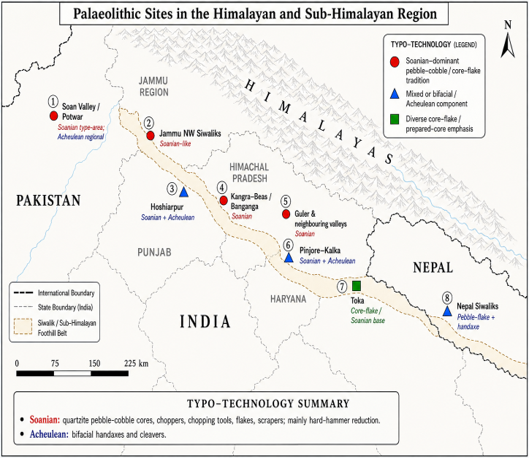
Investigations between the Chenab and Ravi identified numerous localities subsequently compared with Soanian industries. Saroj (1974) reported 16 sites and grouped their assemblages into Jammu A–D. The evidence reinforces a west-to-east extension of pebble/core–flake technological behaviour beyond Potwar.
- Hoshiarpur–Punjab Siwalik frontal range
This region is especially important because Soanian and Acheulean technological components occur within the same broad landscape.
Soanian-type assemblages include:
Quartzite cobbles → cores → unifacial/bifacial choppers + chopping tools + flakes
However, Atbarapur, north of Hoshiarpur, has yielded the largest well-studied Acheulean collection in the Siwalik region. Its chaîne opératoire involved both cobbles producing small flakes and boulders producing large flakes, which were subsequently shaped into handaxes and cleavers.
Thus:
Soanian: core–flake/pebble emphasis
versus
Acheulean: large-flake production → bifacial handaxe/cleaver shaping
- Kangra–Beas/Banganga–Guler, Himachal region
Pebble-tool assemblages occur in the Beas–Banganga valleys and associated Siwalik contexts. Their dominant forms include quartzite choppers, chopping tools, cores and flakes, reflecting exploitation of readily available fluvial cobbles.
Importantly, earlier attempts to fit every locality into the Soan Valley sequence have been questioned; regional technological development should be studied in its own geomorphological context.
- Pinjore–Siwalik frontal zone and Toka
Toka is especially valuable for typo-technological analysis. Chauhan’s study describes it as a rich Soanian locality with a dynamic range of non-biface quartzite cores and core-tools, rather than a uniform collection of crude choppers. Different core-reduction patterns, edge retouch and tool forms demonstrate considerably greater technological variability than older typological schemes implied.
Nearby Siwalik assemblages also demonstrate hard-hammer percussion; at Bam, for example, single-platform, multiplatform and even limited bipolar reduction have been documented alongside choppers, flakes, discoids and scrapers.
A useful exam formulation is therefore:
Quartzite cobble → hard-hammer flaking → core/flake → chopper, chopping tool, scraper or discoid
rather than simply writing “pebble tools”.
- Nepal Siwaliks
The Sub-Himalayan distribution continues eastward into Nepal. Here both pebble/core–flake traditions and unequivocal Acheulean bifaces are known.
At Satpati Hill, Corvinus documented a Lower Palaeolithic assemblage including bifacially trimmed handaxes, a pick, flakes and cores in an Upper Siwalik context; handaxes are also known from the Dang-Deokhuri/Dun Valley region.
Typo-technological pattern
| Feature | Soanian / pebble-core tradition | Acheulean component |
| Raw material | Mainly river-worn quartzite pebbles/cobbles | Cobbles/boulders; often large flakes |
| Reduction | Mainly direct/hard-hammer core reduction; locally varied strategies | Deliberate large-flake production and bifacial shaping |
| Typical tools | Choppers, chopping tools, cores, flakes, discoids, scrapers | Handaxes, cleavers, picks |
| Shaping | Often limited/selective edge working | More extensive bifacial shaping |
| Technological emphasis | Core–flake utilisation | Biface/Mode-2 organisation |
Critical perspective
The old model of a neat Early Soan → Late Soan → Evolved Soan succession should not be projected automatically across the entire Himalayan foothill zone. Much of the material comes from surface scatters, gravels and redeposited contexts, making terrace height or typology alone unreliable for chronology. Toka and recent Hoshiarpur studies further show that “Soanian” encompasses considerable variability in core reduction and artefact morphology.
Conclusion
The Himalayan–Sub-Himalayan Palaeolithic is therefore best understood as a technological mosaic shaped by riverine quartzite resources and varied reduction strategies. The Soanian pebble/core–flake tradition is dominant across many foothill contexts, but Acheulean bifaces and technologically diverse flake industries show that the region cannot be reduced to a single uniform “Soan culture”.
Want feedback on your answer?
Join the Anthropology workshop or get structured answer-writing guidance from VAID ICS.