
Power, Authority, Legitimacy and Social Control — 2026 Paper I
How do the concepts of power, authority, legitimacy and social control change with changing political organization? Discuss in detail giving suitable examples.
Model Answer
VAID ICS| Approach
· Demand of Question: Define power, authority, legitimacy and social control and compare how their source, scale and institutionalisation vary across political organisations. · Structuring the Response: Core concepts -> band -> segmentary/tribal systems -> chiefdom -> state -> comparative matrix of change -> critical qualification -> conclusion. · Key Dimensions to Cover: Service as heuristic, !Kung, Nuer, leopard-skin chief, Melanesian big-man, chiefship, Weber, diffuse vs institutional power, customary vs legal legitimacy and informal vs formal sanctions. |
Model Answer
Model Answer
Introduction: Political anthropology distinguishes power (capacity to influence outcomes), authority (socially recognised right to exercise power), legitimacy (belief that rule is rightful) and social control (mechanisms maintaining norms and settling disputes). As political organisation becomes more differentiated, these tend to become more specialised and institutionalised, though no rigid evolutionary ladder is implied.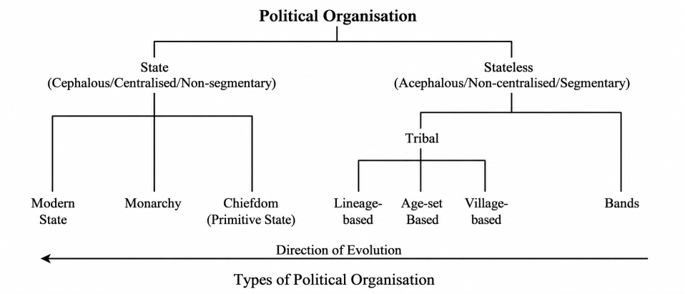
Comparative pattern
| Political form | Power & authority | Legitimacy | Social control / example |
| Bands | Situational, diffuse; influence of skilled/experienced persons | Reputation, age, consensus | Gossip, ridicule, reciprocity, avoidance; !Kung levelling mechanisms |
| Segmentary/tribal systems | Lineage elders, councils, age sets, ritual specialists; no central sovereign | Kinship, seniority, custom, ritual | Feud, mediation, lineage opposition; Nuer and leopard-skin chief |
| Big-man systems | Achieved personal influence through persuasion, exchange and redistribution | Performance, generosity, followers | Competitive exchange and public opinion; Melanesian big-men |
| Chiefdoms | Ranked/hereditary office; more concentrated authority | Sacred ancestry, redistribution, rank | Tribute, chiefly councils, sanctions |
| States | Territorial, bureaucratic, specialised offices and coercive agencies | Legal-rational plus traditional/charismatic forms | Codified law, courts, taxation, police/administration |
Weber’s legal-rational authority is especially relevant to states: legitimacy attaches increasingly to office and procedure rather than only to the personal qualities of a ruler. Yet traditional and charismatic legitimacy can coexist with bureaucracy.
| Diffuse/personal influence -> more specialised office | informal sanctions -> increasingly formal law (heuristic trend, not inevitable evolution) |
Critical qualification
Small-scale societies can contain gender, age and status inequalities, while modern states continue to depend on family, caste, community leaders and informal moral sanctions. Political forms also overlap historically and need not pass through one sequence.
Conclusion: Changing political organisation transforms the scale, source and institutionalisation of power and social control, but legitimacy remains essential because coercion alone cannot sustain stable rule.
Want feedback on your answer?
Join the Anthropology workshop or get structured answer-writing guidance from VAID ICS.