
Somatotype and the Heath-Carter Method in Sports Sciences — 2026 Paper I
What is meant by a somatotype? Discuss the Heath-Carter anthropometric method, giving its advantages over that of Sheldon's method. How can somatotyping be applied in sports sciences?
Model Answer
VAID ICS| Approach
· Demand of Question: Define somatotype, explain the Heath-Carter anthropometric method, compare it with Sheldon, and evaluate its applications in sports science. · Structuring the Response: Definition/components -> ten measurements -> derivation of three scores/somatochart -> advantages over Sheldon -> sports applications -> limitations -> conclusion. · Key Dimensions to Cover: Endomorphy, mesomorphy, ectomorphy, ten measurements, corrected skinfolds/girths, height-weight ratio, somatochart, objectivity, repeatability, dynamic physique and athlete profiling. |
Model Answer
Model Answer
Introduction: A somatotype is a quantitative description of present physique expressed in three ordered components: endomorphy-mesomorphy-ectomorphy. Endomorphy reflects relative adiposity, mesomorphy musculoskeletal robustness and ectomorphy linearity.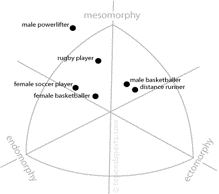
Heath-Carter anthropometric method
Heath and Carter converted Sheldon’s largely photoscopic typology into a reproducible anthropometric system. The standard protocol uses 10 measurements:
- stature and body mass;
- four skinfolds - triceps, subscapular, supraspinale and medial calf;
- humerus and femur breadths;
- flexed-arm and calf girths.
Endomorphy is calculated mainly from corrected skinfolds; mesomorphy from bone breadths and corrected limb girths relative to stature; ectomorphy mainly from the height-weight relationship. The three continuous scores can be plotted on a somatochart.
Advantages over Sheldon
- Measurement-based and mathematically derived rather than primarily visual/photoscopic.
- More objective, repeatable and suitable for statistical and longitudinal analysis.
- Describes current physique, which can change with growth, ageing, nutrition and training.
- Usable across sexes, ages and populations when appropriate reference procedures are followed.
- Avoids Sheldon’s unsupported constitutional-psychology claims linking physique to temperament.
Applications in sports science
- Athlete profiling: compare sport/event-specific physique distributions.
- Training monitoring: track changes in adiposity and musculoskeletal development across a season.
- Position/event comparison: identify typical morphological demands of playing roles or events.
- Conditioning and nutrition: supplement body-composition and performance assessment.
- Research: compare growth, training and physique across groups.
Limitation: Somatotype is descriptive, not destiny. Performance also depends on physiology, biomechanics, skill, training, motivation, injury history and opportunity.
Conclusion: Heath-Carter transformed somatotyping into a measurable, reproducible and dynamic method, making it useful in kinanthropometry and sports science without implying biological determinism.
Want feedback on your answer?
Join the Anthropology workshop or get structured answer-writing guidance from VAID ICS.