ARCHAEOLOGISTS & SANSKRIT SCHOLARS COLLABORATE TO DECIPHER THE RIGVEDA
Source: The Hindu | June 05, 2024
The New Collaboration
A team of archaeologists and Sanskrit scholars has come together to reinterpret the Rigveda using archaeological evidence from major Harappan sites. Vasant Shinde, former Vice-Chancellor of Deccan College, emphasises that a clear reading of the Rigveda is essential to understand cultural patterns seen in sites like Rakhigarhi, Banawali, Kalibangan and Dholavira. This approach aims to bring literary and material evidence into one coherent framework—important for both Anthropology Optional and GS-I Ancient History.
Are Harappan and Vedic People the Same?
Shinde highlights an ongoing hypothesis:
Harappan and Vedic people may represent the same cultural continuum.
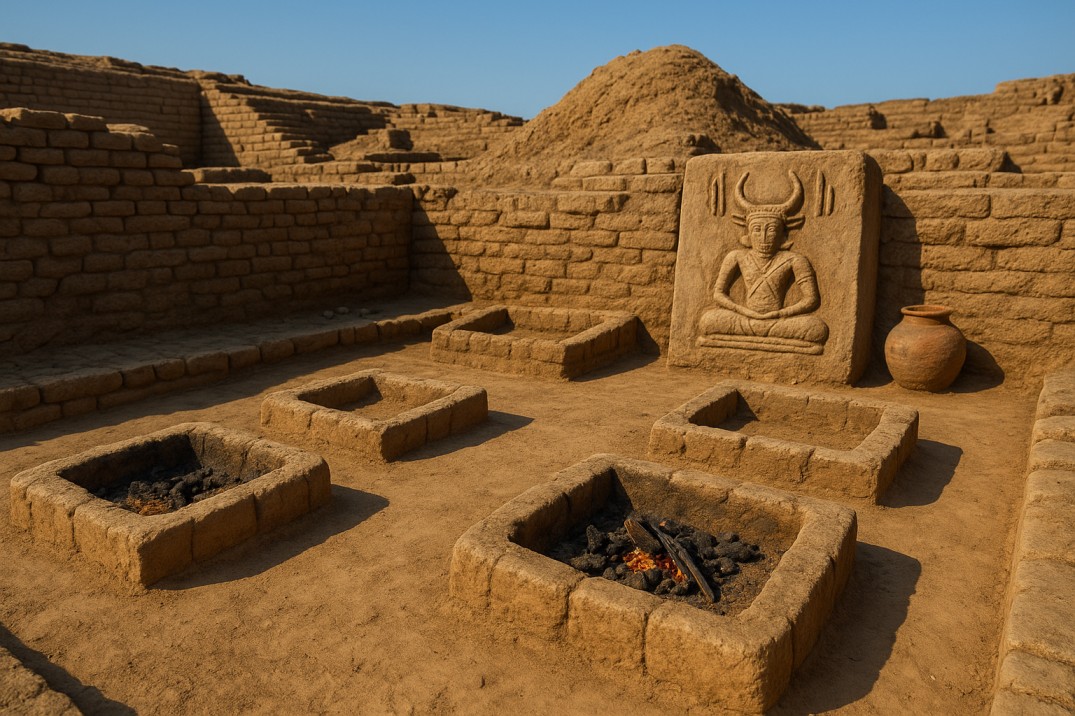
He cites the discovery of Vedic-style fire altars and ritual platforms in Rakhigarhi, which resemble descriptions found in the Rigveda. These findings challenge the older view that Harappan and Vedic cultures were separate and unrelated.
Saraswati River and Settlement Patterns
Shinde draws attention to a striking correlation:
Nearly two-thirds of Harappan sites (at least 1,200) are located along the Saraswati river system, a river mentioned 71 times in the Rigveda.
This strengthens the argument that the text may have been composed in regions inhabited by Harappan communities, especially during the Mature Harappan period.
Dating the Rigveda
Based on archaeological layers and cultural markers, Shinde proposes that the Rigveda could be at least 4,500 years old, or older.
This timeline supports the idea that parts of the Vedic corpus may overlap with the late Harappan phase.
Genetic Evidence and Cultural Continuity
Shinde’s research group reported genetic similarities between present-day Indian women and the skeletal remains of Harappan women.
For Anthropology Optional, this point directly connects to debates on population continuity vs. migration, a recurring UPSC theme. The evidence suggests a deep local ancestry, strengthening continuity models of Indian population history.
Most Relevant Anthropology PYQs
1. “Critically describe evidences from Rakhi Garhi and its linkages to Harappan civilization.” (20M/2024)
2.“Debates on Aryan invasion.” (10M/2020)
3. “Critically discuss the origin of Indus Valley Civilization. Mention the evidence of its endogenous origin from the pre-Harappan sites.” (20M/2021)
4.“What kind of society may be reconstructed from the archaeological evidences of Harappan culture?” (20M/2019)
5.“Describe what is known of Harappan Religion. Have some of its elements continued into later Hinduism?” (20M/2014)