6-Million-Year-Old Human Footprints: A Discovery That Rewrites History
A Find That Challenges the Textbook Story of Human Origins
30 May 2025 , The Greek Herald
In 2002, a set of mysterious fossilized footprints on the island of Crete caught the attention of Polish paleontologist Gerard Gierliński. What appeared at first to be simple impressions in rock would, years later, spark one of the most debated discussions in human evolutionary studies.
Starting in 2010, Gierliński’s student Grzegorz Niedźwiedzki took the lead on a detailed investigation, eventually helping establish the astonishing age of the tracks—around six million years old.
If validated, these prints would be the oldest known footprints of a bipedal primate, predating similar evidence from Africa and suggesting that early human ancestors may have roamed parts of Europe far earlier than previously believed.
The Discovery Site: Trachilos, Western Crete
A Coastal Rock Slab with a Hidden Past
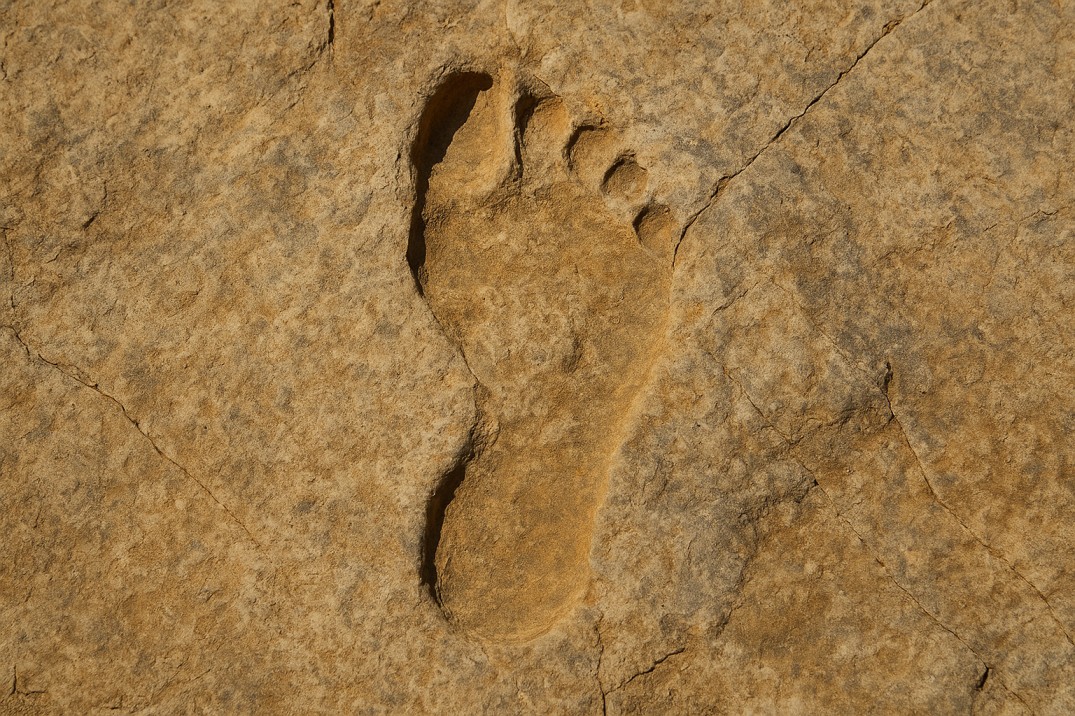
The footprints were found on a rock slab along the coast of Trachilos, near Kasteli in western Crete. What makes this site remarkable is not just the age of the impressions, but their anatomical detail.
Foot Anatomy Preserved in Stone
The tracks display several traits associated with later hominins:
-
A non-opposable big toe, aligned similarly to humans
-
A wide, triangular sole
-
A pointed heel
-
A slightly developed arch
These features strongly resemble those of known bipedal ancestors, indicating that the track-maker walked upright.
Scientific Significance: Rethinking Early Human Migration
A Challenge to the Africa-Only Narrative
When the findings were first published in 2017 in Proceedings of the Geologists’ Association, they immediately drew global attention. For decades, dominant scientific consensus held that bipedal hominins evolved and existed only in Africa during this period.
The Trachilos footprints tell a different story.
A Wider Prehistoric Range
If correctly classified, these tracks suggest that early human ancestors were present in Europe as well as Africa. This expands the geographic map of early hominin evolution and raises new questions:
-
Were early hominins more widespread than we assumed?
-
Did migration occur much earlier than current fossil records indicate?
-
Could Europe have played a role in early human evolution?
Conclusion: A Discovery Still Shaping Scientific Debate
The six-million-year-old footprints of Crete remain one of paleoanthropology’s most intriguing discoveries. Whether they ultimately redefine our understanding of human origins or simply add nuance to the African evolutionary timeline, they represent a powerful reminder that prehistory is far more complex—and far more interconnected—than once believed.
Most Relevant PYQs
1️⃣ Discuss the evolutionary significance of bipedalism and erect posture.
(20M / 2019)
2️⃣ Explain the skeletal changes due to erect posture and their implications.
(15M / 2016)
3️⃣ What is the hominization process? Discuss the major trends in human evolution.
(20M / 2023)