Why Did Early Humans Take Children into Deep, Dark Cave Networks?
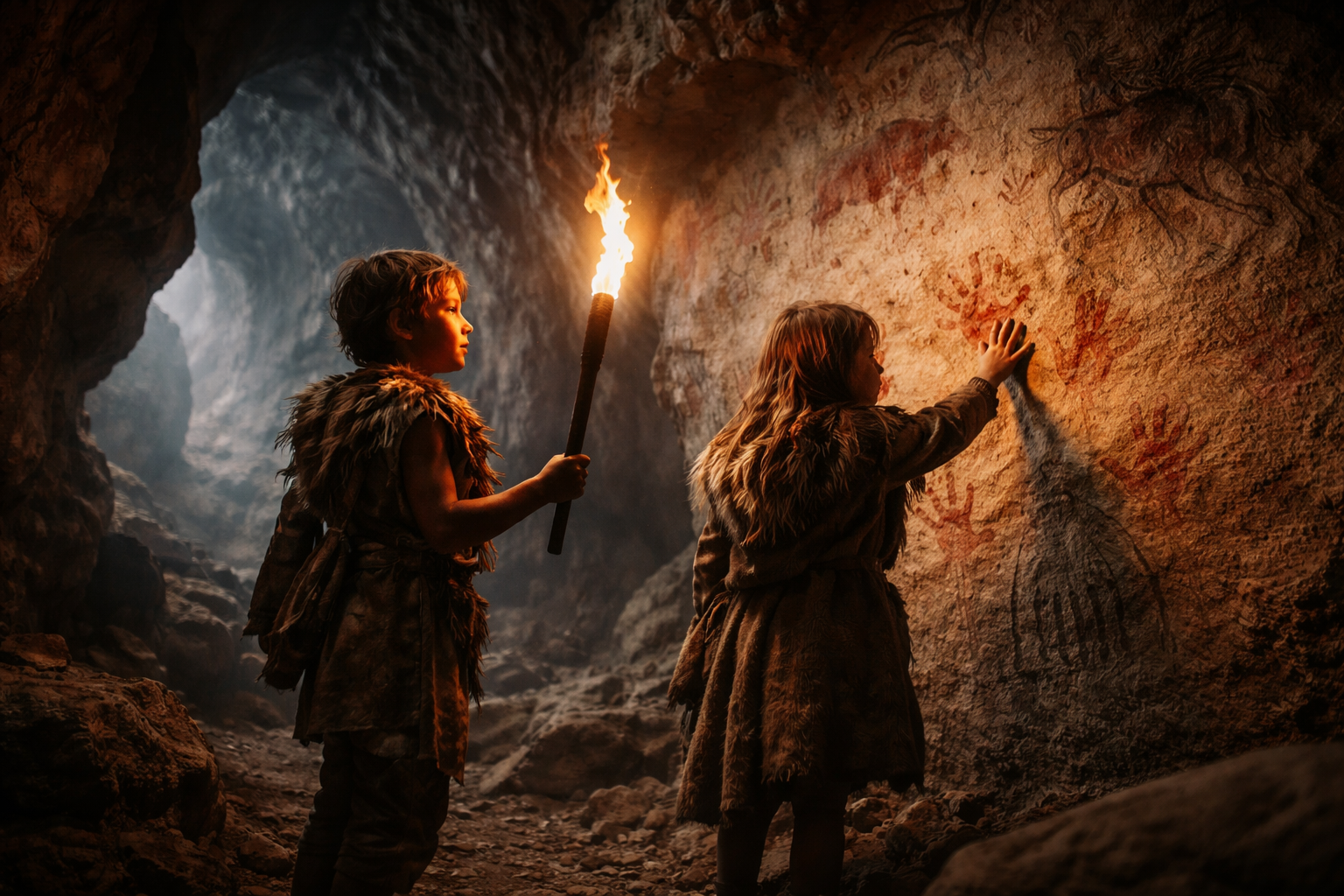
Source: Art | March 04, 2025
Background: The Mystery of Prehistoric Cave Art
Prehistoric cave paintings have long intrigued scholars due to their location, symbolism, and ritual depth.
Archaeological evidence shows that nearly 400 painted caves—primarily in France and Spain—date between 40,000 and 12,000 years ago.
Many of these caves are deep, dark, and difficult to access, raising a fundamental question:
Why would early hunter-gatherers take children into such dangerous and inaccessible environments?

Evidence of Children’s Presence
Dr. Ella Assaf and her team highlight that numerous caves contain clear traces of children’s participation, including:
• Handprints
• Finger flutings
• Simple drawings
These traces belong to children aged approximately 2 to 12 years, indicating that their presence was intentional, not accidental.
Children as Active Ritual Participants
The study challenges earlier assumptions that children were passive observers.
Instead, it argues that children played active and meaningful roles in ritual practices.
Children are interpreted as spiritual mediators, believed to communicate with entities inhabiting the caves and the wider cosmos.
Hunter-Gatherer Worldview and Spiritual Ecology
For prehistoric hunter-gatherers, survival depended on maintaining harmony with powerful non-human forces, including:
• Animals
• Plants
• Stones used for tools
• Ancestral spirits
Within this worldview, caves functioned as liminal spaces—thresholds between the human world and the spirit realm.
Children, due to their perceived closeness to the non-human world, were considered uniquely capable of facilitating these connections.
Children as Liminal Beings
A key anthropological insight of the study is the concept of children as liminal beings.
Children were viewed as existing between worlds:
• Between birth and social adulthood
• Between the human and the non-human
• Between the visible and invisible realms
This liminality made them ideal messengers and intermediaries, especially in rituals aimed at ensuring ecological balance and group survival.
Anthropological Significance
This interpretation has major implications for anthropology:
• Reframes children as ritual agents, not dependents
• Deepens understanding of prehistoric religion and symbolism
• Highlights early concepts of personhood and social roles
• Strengthens the link between art, ritual, and cosmology
It also challenges modern assumptions about childhood by showing that social value and agency were attributed early in life.
Why This Matters for UPSC Aspirants
This study is important for:
• Anthropology Paper-I – Prehistoric art, religion, symbolism
• Understanding ritual behaviour in hunter-gatherer societies
• Concepts of liminality, sacred space, and mediators
• Enriching answers on early human cognition and belief systems
Relevant UPSC Anthropology PYQs :
1. Discuss briefly the major traditions in the Upper Paleolithic cultures of Europe.
15 Marks | 2019
2. Mesolithic rock art in Indian subcontinent. 10 Marks | 2022


-10052026-113117pm.png)