Pax Silica and India: From Exclusion to Strategic Entry
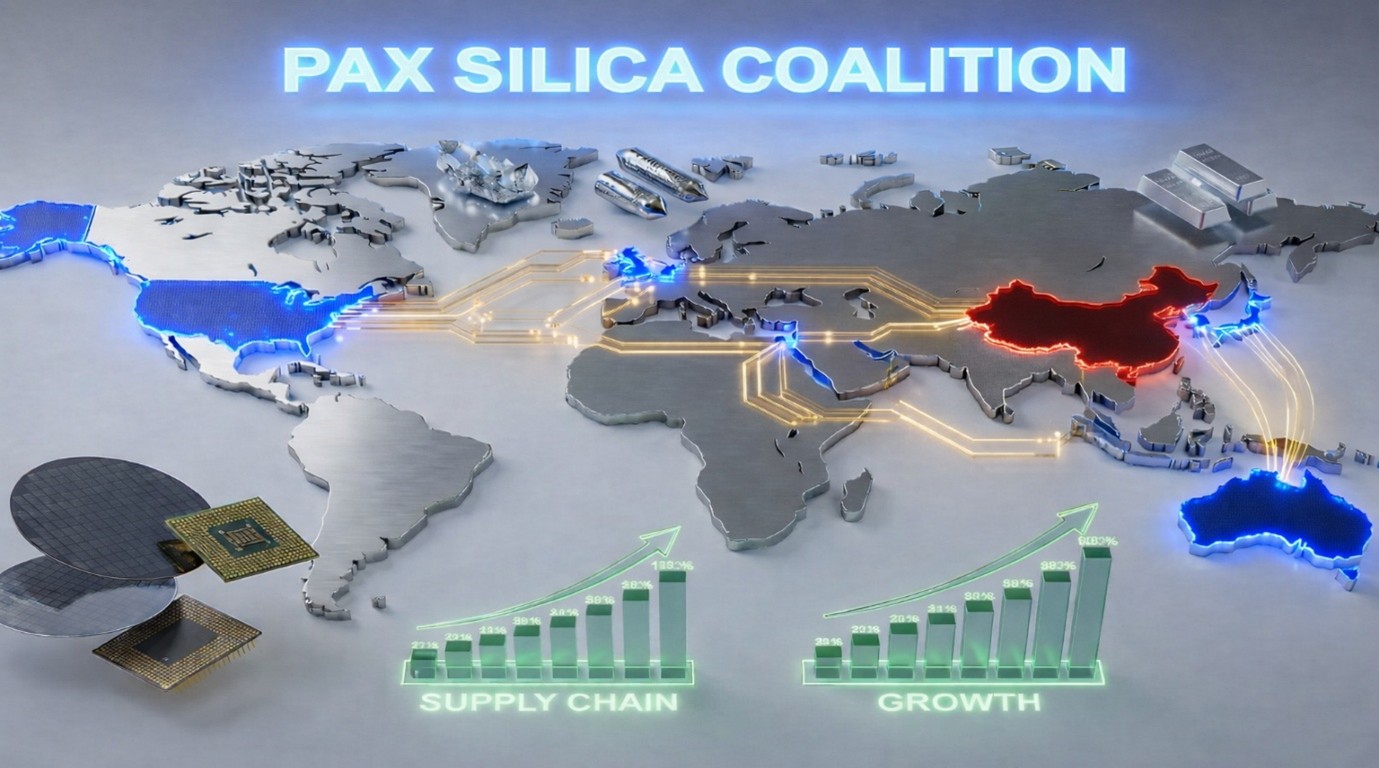
When the United States launched the Pax Silica Initiative in December 2025, India’s absence from the original list of signatories triggered sharp reactions at home. Many saw it as a diplomatic setback.
By February 2026, the story had completely changed.
What began as exclusion has now turned into formal entry — and strategic partnership.

What is Pax Silica?
Pax Silica is a U.S.-led multilateral initiative launched in December 2025 to build a secure and trusted global “silicon stack.”
The word “Pax” stands for stability and order. “Silica” represents semiconductor-based technology that powers the modern economy.
The initiative focuses on:
- Critical minerals
- Semiconductor manufacturing
- Energy inputs
- Artificial intelligence infrastructure
- Advanced manufacturing
- Digital and logistics networks
Its core aim is simple: reduce overdependence on China in rare earth processing, chip supply chains, and emerging technologies. It also seeks to ensure that advanced technologies are governed by open and democratic societies.
Initial Participants
At launch, the signatories included:
- Australia
- Greece
- Israel
- Japan
- Qatar
- South Korea
- Singapore
- United Arab Emirates
- United Kingdom
India was not part of this first group, despite being a Quad member and a key U.S. technology partner.
February 2026: From Invitation to Signing
On 8 February 2026, U.S. Under Secretary of State Jacob Helberg publicly confirmed that the United States had invited India to join Pax Silica. He described India–U.S. relations as “very positive” and spoke of a “major signing” ahead.
Just days later, on 20 February 2026, India formally joined the Pax Silica coalition at the India AI Impact Summit 2026 in New Delhi.
India signed:
• The Pax Silica Declaration
• A bilateral Joint Statement on the India–U.S. AI Opportunity Partnership
This move strengthens cooperation under the TRUST initiative (Transforming the Relationship Utilizing Strategic Technology) in India–U.S. relations.
The signing ceremony brought together senior leaders from both countries and marked a clear shift — India was no longer outside the framework. It was now part of shaping it.
What Pax Silica Now Stands For
At the Summit, Pax Silica was described as a coalition of trusted nations committed to securing the entire “silicon stack” — from minerals in the ground to chips in factories and AI systems in data centres.
The message from the U.S. side was strong:
• Economic security is national security
• Supply chains must not be weaponised
• Technology governance should remain democratic
The emphasis was clear — this is not just about chips. It is about control over the future digital economy.
India’s Growing Semiconductor Confidence
At the Summit, India’s Minister for Electronics and IT, Ashwini Vaishnaw, highlighted India’s expanding semiconductor capabilities.
He noted that:
• Indian engineers are designing advanced 2-nanometer chips
• The semiconductor industry will require nearly one million skilled professionals
• India’s long-term growth since Independence shows the power of compounding development
This messaging reflects growing confidence in India’s technology base.
Why India Matters to Pax Silica
India brings major strengths to the coalition:
• A large AI and digital market
• A young and technically trained workforce
• Expanding semiconductor investments under the India Semiconductor Mission
• Private investments from Tata Group and Micron
• Active participation in Quad supply chain efforts
Earlier, U.S. officials had pointed out that outside China, India is perhaps the only country with both the scale of talent and mining capacity needed to support a diversified supply chain.
The Trade Link
India’s entry into Pax Silica also came alongside progress in India–U.S. trade talks.
Both sides announced a framework for an Interim Trade Agreement that includes:
• Reduction of tariffs on industrial goods
• Lower U.S. tariffs on Indian goods
• Removal of earlier punitive tariffs linked to Russian oil purchases
This synchronisation shows deeper economic alignment, not just symbolic cooperation.
The Larger Strategic Picture
Pax Silica reflects a changing global order. The world is moving toward parallel technology ecosystems:
• One centred around China
• Another led by the United States and its trusted partners
By formally joining Pax Silica, India has positioned itself within the second group — while still preserving its strategic autonomy.
The signing at the India AI Impact Summit sends a clear signal: India is not a passive participant. It is emerging as a central pillar in the global semiconductor and AI supply chain redesign.
The Road Ahead
India’s journey from exclusion in December 2025 to formal membership in February 2026 shows how quickly global alignments can shift.
Pax Silica is no longer just a U.S.-led idea. With India inside the framework, it gains scale, talent, market depth, and political weight.
This is not just about supply chains. It is about who shapes the rules of the AI-driven global economy.
The real question now is not whether India belongs to Pax Silica.
The question is how central India will become in defining the next phase of global semiconductor and AI leadership.


-10052026-113117pm.png)