Young Chimpanzees and Cultural Evolution: How Play Drives Innovation in Primates
Scientific Reports | 17 October 2025
Chimpanzee Play and the Origins of Culture
A recent study by Iulia Bădescu and colleagues published in Scientific Reports explores how playful behavior among young chimpanzees may play a crucial role in the evolution of culture. By studying chimpanzee communities, researchers provide new insights into how innovation and learning might have shaped cultural evolution in humans.
Young Individuals as Drivers of Cultural Innovation
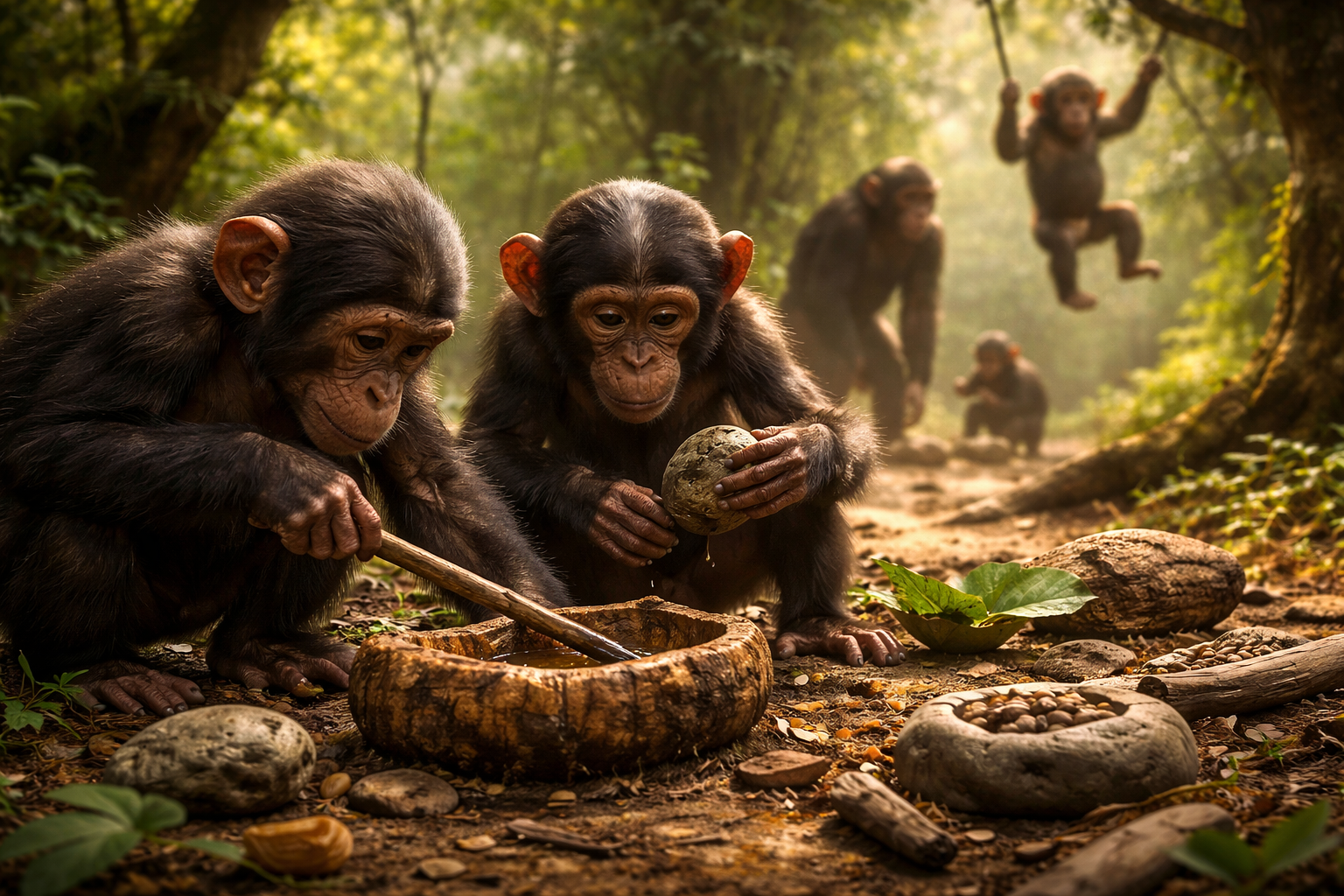
The study suggests that children and juveniles may be more influential in cultural development than previously believed. Young chimpanzees experience a developmental phase in which social rules are relatively flexible, allowing them to explore and experiment freely.
During this stage, youngsters often interact with tools and objects in creative ways, generating new behaviors that may later be adopted by adults within the group.

Play as a Source of Innovation
According to the researchers, play provides a unique environment for experimentation. Juvenile chimpanzees engage in exploratory activities that can lead to novel techniques and behaviors.
These activities introduce variation into the group’s behavioral repertoire. Once these innovations prove useful, they may spread through social learning and become part of the group’s cultural traditions.
From Individual Curiosity to Group Culture
The study challenges the traditional view that cultural innovation begins with dominant or experienced adults. Instead, it proposes that new behaviors may originate from curious juveniles whose experimentation creates opportunities for cultural transmission.
If the social group allows young members to explore freely, these innovations can gradually become established cultural practices.
Research Site: Ngogo, Kibale National Park
The research was conducted at Ngogo in Kibale National Park, Uganda, which hosts one of the largest known chimpanzee communities in the world. Long-term observations at this site allowed researchers to analyze how young chimpanzees interact with objects, tools, and group members.
Implications for Human Evolution
Chimpanzees share many behavioral similarities with humans, making them valuable models for understanding the evolution of culture. The findings suggest that play and curiosity among juveniles may have played an important role in early human societies as well.
Such behavior could have contributed to:
• Development of tool-use traditions
• Cultural transmission within groups
• Innovation and learning through experimentation
• Gradual evolution of complex cultural systems
Significance of the Study
This research highlights the importance of juvenile creativity in shaping cultural evolution. Rather than emerging solely from experienced adults, culture may develop through experimentation by younger individuals whose playful exploration introduces new ideas into the social group.
Relevant Questions :
• Jane Goodall’s contributions in studying primate behaviour. (2020)
• Explain the biological changes that made human beings capable of making cultures. (2018)


-10052026-113117pm.png)