UPSC Mains 2026: How Anthropology Optional Created an Advantage Across 110 Marks of GS
ANTHROPOLOGY OPTIONAL • UPSC MAINS 2026
UPSC Mains 2026: How Anthropology Preparation Created an Advantage Across 110 Marks of GS Questions
What the 2026 papers reveal about the real value of Anthropology Optional across GS, Essay and answer writing
|
9 |
110 |
2 / 8 |
|
GS questions |
marks represented |
Essay topics |

When aspirants decide on an optional, the conversation usually revolves around syllabus size, scoring potential and availability of guidance. All three matter. But there is a fourth question that is often more strategic: does the optional keep giving returns outside its own two papers?
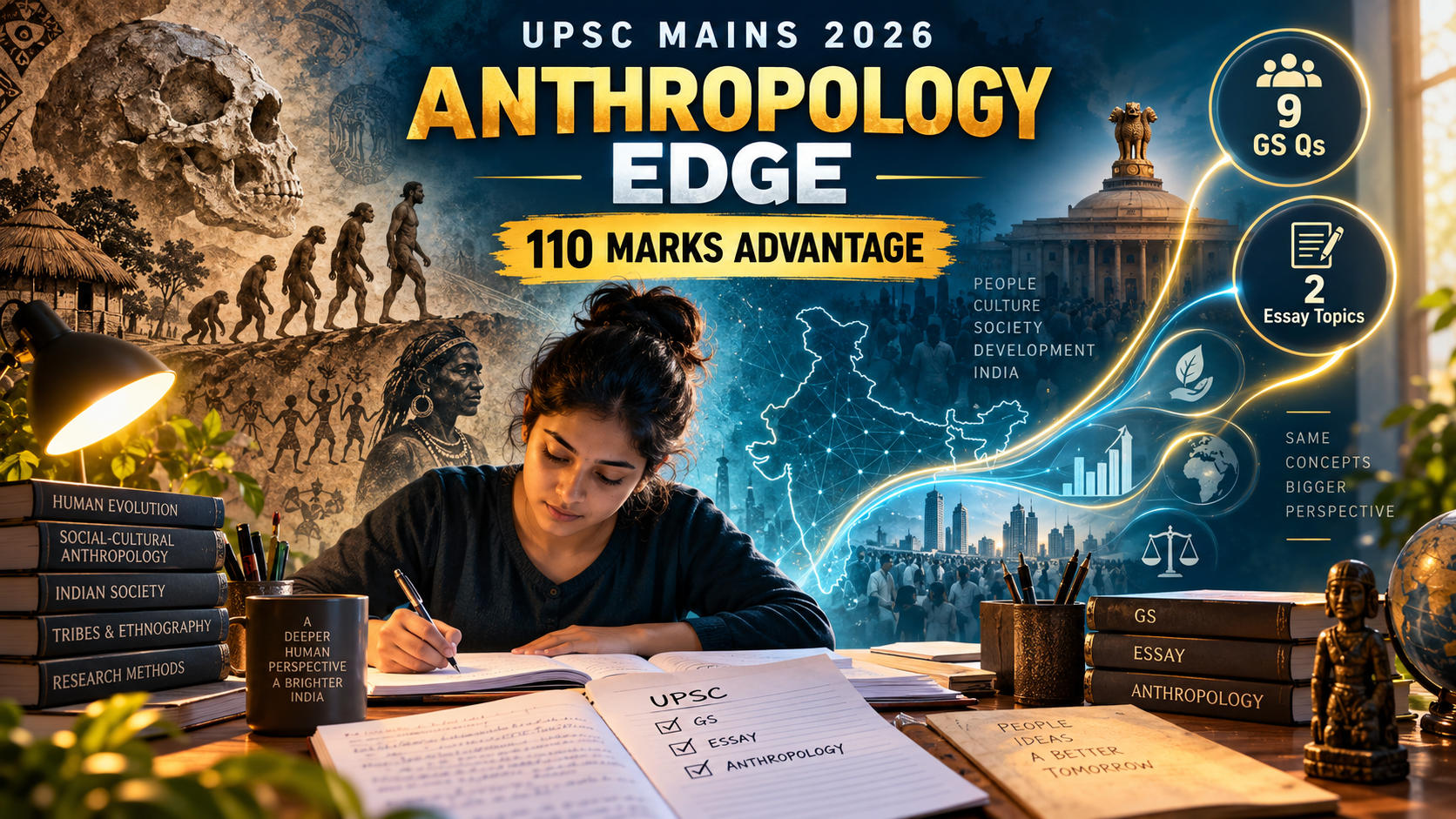
UPSC Mains 2026 offers a useful case study. A question-by-question mapping by Vaid’s ICS identified nine General Studies questions, representing 110 marks, where Anthropology preparation met a strict threshold for substantive answer-content reuse. Four showed very high direct utility and five showed strong direct utility. Two of the eight Essay topics also had strong or very high Anthropology utility.
That finding needs to be read correctly. Anthropology did not “cover 110 marks of GS”. Rather, in questions worth 110 marks, an Anthropology student could begin with part of the conceptual framework, terminology, examples or PYQ familiarity already in place. The remaining work still came from GS: current data, constitutional provisions, policy, schemes and paper-specific framing.
|
What 110 marks really means Not syllabus overlap as a slogan. It is answer-writing leverage: on selected questions, the candidate does not have to construct the analytical framework from zero. |
The Real Advantage: Transfer, Not Coverage
UPSC preparation is ultimately an exercise in retrieval and adaptation. Knowledge has value only when a candidate can recognise the demand of a question, organise relevant material quickly and convert it into a precise answer under time pressure.
That is why the 2026 mapping did not count superficial keyword similarities. A question was treated as a genuine overlap only when the underlying concept existed in the Anthropology syllabus, had already been tested through Anthropology PYQs, and could be directly adapted to the GS or Essay demand.
|
Vaid Sir on Mains preparation “What matters more is What You Can Write in the Exam, It doesn't matter How Much You Know” |
That one line captures the logic of the 2026 analysis. The advantage of Anthropology is not simply that a student has read more about caste, tribes, demography or culture. The advantage appears when that preparation has already been converted into answer-ready concepts and structures.
1. Society and Social Change: Where Anthropology Helped the Most
GS Paper I showed the highest direct utility: four questions representing 55 marks.
The caste question — “Is caste disappearing in urban India?” — is a good example. Anthropology students already study caste structure, dominant caste, caste mobility, the future of caste, social stratification, Sanskritisation, Westernisation and modernisation. UPSC has repeatedly asked the Optional to engage with the persistence and transformation of caste.
This prior preparation changes the answer itself. Instead of making the simplistic claim that urbanisation weakens caste, the candidate can distinguish between ritual decline and institutional transformation: caste may become less visible in some public settings yet continue through marriage, political mobilisation, social capital, associations, housing or occupational networks. GS preparation then adds current urban evidence.
The demographic transition question worked in a similar way. Anthropology already prepares fertility, mortality, fecundity, ageing, population structure and bio-social determinants. A 2024 Anthropology PYQ had specifically asked about the future demographic challenges of India’s changing population dynamics. By 2026, the conceptual skeleton was familiar; the GS task was to update it with jobs, skilling, migration, health, pensions and regional demographic divergence.
The questions on unity in diversity and globalisation among Indian youth further rewarded Anthropology’s vocabulary of ethnicity, regionalism, communalism, pluralism, cultural change, family relations and changing economic behaviour.
The value here is deeper than a few extra examples: Anthropology gives a language for explaining continuity, conflict and change.
2. Governance, Diversity and Social Justice: Anthropology Adds the Human Context
GS Paper II contributed another four questions representing 45 marks. Here the utility came not from replacing polity or governance content, but from explaining the social realities that institutions are meant to address.
The question on whether India’s tribal development policy reflects socially grounded and equity-based governance lies close to the core of Anthropology Paper II. Tribal administration, development programmes, displacement, rehabilitation, forest policy, PVTGs and the isolation–assimilation–integration debate are not peripheral topics in the Optional; they are part of its analytical core.
A conventional GS answer can list policies and programmes. Anthropology pushes the answer one step further: development for whom, designed by whom, and with what relationship to local institutions, livelihoods, identity and cultural autonomy?
The same distinction helps in the NCSC–NCST question. Anthropology cannot replace Articles 338 and 338A, institutional powers or reform proposals. But it supplies the substantive-equality dimension: historical exclusion, exploitation, deprivation and the gap between formal safeguards and lived outcomes.
In the federalism question, Anthropology helps explain why asymmetric accommodation may be necessary. Language, ethnicity, historical autonomy claims and cultural identities are not merely administrative variables; they shape political behaviour and demands for recognition. GS then provides the constitutional machinery through which accommodation is attempted.
The malnutrition question demonstrates another advantage — Anthropology’s bio-cultural lens. Nutritional Anthropology, Epidemiological Anthropology, growth and development, food practices, poverty and deprivation allow the candidate to see malnutrition as an interaction among biology, culture, household behaviour, inequality and welfare delivery.
In such questions, Anthropology often moves the answer from “what the institution or problem is” to “why it exists in this social form”.

3. GS Paper III and the Importance of Not Forcing Overlap
The Ladakh question was the only GS-III question to cross the strict threshold. Anthropology directly prepared the Sixth Schedule, tribal autonomy, local participation, customary institutions and the tribe–nation-state relationship. But strategic geography, the China–Pakistan context, Border Area Development Programmes and Army civic action still required GS-III preparation.
Equally important is what was not counted. No GS-IV question was classified as strong or very high direct overlap. Anthropology may enrich an ethics case involving displacement, ethnicity or marginalised communities, but Ethics still requires its own principles, values and decision-making framework.
This restraint matters. Once every social question is labelled “Anthropology overlap”, the claim loses meaning. The 2026 pattern is valuable precisely because the advantage is concentrated, identifiable and reusable.
4. Essay 2026: Selective Utility, but High-Quality Utility
Anthropology should not be inserted into every philosophical essay. But when a topic genuinely concerns nature, culture, power, community, identity or marginality, it can provide unusual depth.
“Nature is the symbol of the spirit” connects naturally with the Nature–Man–Spirit Complex, sacred and profane, animism, naturism, ritual and Ecological Anthropology. These frameworks show that communities do not relate to nature only as a resource; landscapes, species and ecological cycles can acquire sacred, symbolic and moral meanings.
Similarly, “When two elephants fight, it is the grass that gets trampled” can be developed through power, stratification, displacement, marginality and resource conflict. Anthropology would not write the entire essay, but it could provide a grounded analytical section that many generic essays lack.
5. What This Means for Someone Choosing an Optional
None of this proves that Anthropology is the right optional for every aspirant. Optional selection must still consider interest, aptitude, preparation time, comfort with both biological and socio-cultural components, access to guidance and willingness to practise answer writing.
But Mains 2026 reveals why Anthropology can be a strategically intelligent choice for the right student. Its preparation can become reusable across high-value themes; its PYQs train the candidate to recognise recurring conceptual demands; and its vocabulary helps transform descriptive GS answers into analytical ones.
The subject also sits at an unusual intersection of science and humanities. Its syllabus moves from human evolution, genetics and growth to culture, kinship, caste, religion, tribes, demography and development. That breadth is useful only when preparation is organised — not when topics are studied as disconnected chapters.
|
Reusable preparation |
Caste, demography, tribal India, ethnicity, nutrition, social change and human–environment themes can become pre-built GS/Essay resources. |
|
PYQ familiarity |
A familiar underlying concept reduces the cognitive load of structuring an answer when UPSC changes the wording or setting. |
|
Analytical vocabulary |
Terms such as dominant caste, ethnicity, bio-cultural factors, autonomy and Nature–Man–Spirit Complex help explain rather than merely describe. |
The Final Takeaway: Integration, Not Substitution
The strongest way to use Anthropology is not to treat it as a shortcut to GS. It is to prepare the Optional so well that its concepts become part of the way you think and write.
That is why the better question is not, “How many GS marks does Anthropology cover?” The better question is: “How often will this subject give me a framework, vocabulary or prepared line of reasoning when UPSC asks me to think about human society, diversity, development or adaptation?”
Mains 2026 provides a credible answer. Anthropology does not cover GS. But in a defined set of important questions, it can create a measurable answer-writing advantage — and that advantage can compound across Optional, GS and Essay.
-10052026-113117pm.png)