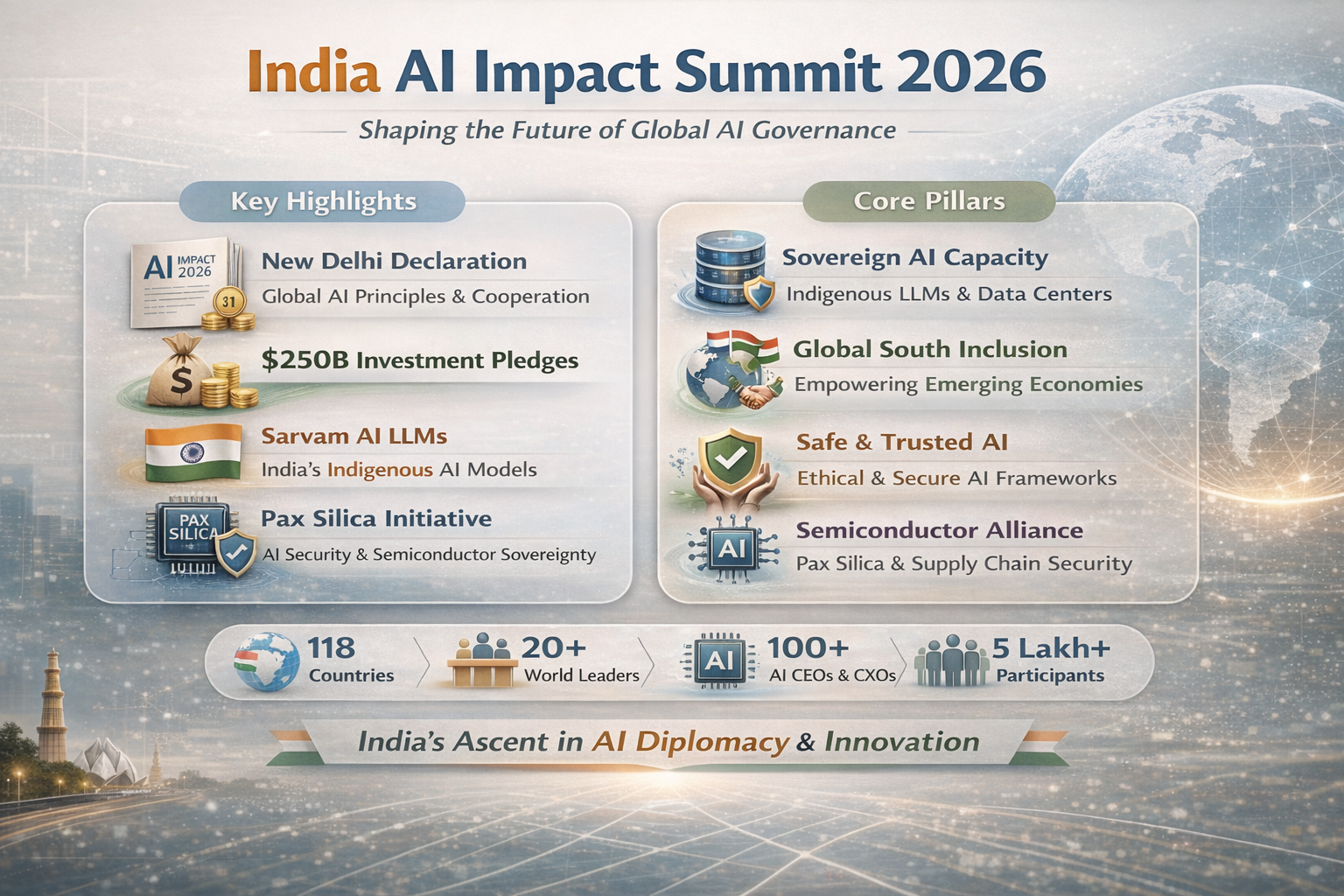
The India AI Impact Summit 2026, held from 16–21 February at Bharat Mandapam, New Delhi, marked a structural shift in the trajectory of global AI diplomacy. Designed around three core Sutras and seven Chakras (pillars of action), the Summit convened over 20 Heads of Government, delegates from 118 countries, more than 100 global AI CEOs and CXOs, and over five lakh participants. Beyond scale, the Summit signalled India’s transition from a participant in AI governance to an agenda-setting power articulating a distinct normative and strategic framework for Artificial Intelligence.

At its core, the Summit advanced India’s conception of AI as responsible, sovereign, and inclusive—anchored in the belief that frontier technologies must serve developmental priorities alongside innovation. In doing so, India attempted to recalibrate the global AI discourse, which until recently was dominated by advanced economies and focused primarily on safety risks. The New Delhi Summit reframed AI as a developmental instrument, particularly for the Global South, and foregrounded the politics of access, capacity, and technological autonomy.
Evolution of Global AI Diplomacy
The significance of the 2026 Summit becomes clearer when situated within the evolving architecture of AI diplomacy. The first major AI Safety Summit at Bletchley Park (2023) focused predominantly on existential risks and frontier model regulation. Subsequent meetings in Seoul (2024) and Paris (2025) expanded discussions to governance coordination and responsible innovation, with India positioning itself as a bridge-builder between regulatory caution and innovation imperatives.
The New Delhi Summit represented a decisive move from AI safety to AI strategy. It recognised that AI governance is not merely about risk mitigation but also about access to compute, infrastructure, semiconductor supply chains, and indigenous model development. In this sense, AI diplomacy matured from norm discussion to capability politics.
India’s Strategic Priorities
India articulated four integrated priorities that collectively defined its AI vision:
- Democratisation of AI capabilities to prevent concentration of foundational resources
- Inclusion of the Global South, especially under-represented languages in Large Language Models
- Development of safe and trusted AI through ethical governance frameworks
- Sovereign capacity building across data centres, semiconductors, and compute infrastructure
These priorities were operationalised through thematic working groups on human capital, resilience, social empowerment, and economic transformation. The emphasis on capacity building underscored India’s recognition that AI power in the 21st century is inseparable from control over hardware ecosystems and advanced compute.
.png)
The New Delhi Declaration on AI Impact
A landmark diplomatic achievement of the Summit was the adoption of the New Delhi Declaration on AI Impact, endorsed by 89 countries and international organisations. Drawing upon civilisational principles such as “Sarvajan Hitaya, Sarvajan Sukhaya” and “Vasudhaiva Kutumbakam,” the Declaration affirmed that AI’s benefits must be equitably distributed.
The Declaration institutionalised several global mechanisms:
· Charter for the Democratic Diffusion of AI
· Global AI Impact Commons
· Trusted AI Commons
· International Network of AI for Science Institutions
· AI Workforce Development Playbook and Reskilling Principles
· Guiding Principles on Resilient and Efficient AI Infrastructure
Importantly, all commitments were voluntary and non-binding. This flexibility enhanced participation from developing nations while avoiding rigid regulatory fragmentation. Norm-setting thus occurred without coercive multilateralism.
Participation and Technological Diplomacy
The Summit’s scale—over five lakh participants and extensive youth engagement—reinforced India’s credibility as a convenor in technology diplomacy. The inclusion of 2.5 lakh students in ethical AI discussions reflected an attempt to socialise AI awareness at the grassroots level, linking governance debates with domestic human capital formation.
Such broad-based engagement positioned India as not merely hosting an event but embedding AI within its societal discourse. Technology diplomacy was therefore accompanied by democratic participation.
Investment Commitments and Economic Signalling
Diplomatic momentum translated into substantial economic pledges. Approximately $250 billion in infrastructure investments and $20 billion in deep-tech venture funding were announced. Major Indian conglomerates such as Reliance Industries and Adani Group committed to expanding AI-linked infrastructure, particularly data centres and compute capacity. Global firms including Google, OpenAI, and Anthropic strengthened partnerships within India’s ecosystem.
These announcements served a dual function:
· Signalling investor confidence in India’s regulatory and market stability
· Positioning India as an emerging hub for AI infrastructure, not merely an application market
The Summit thus linked governance discourse with capital formation and industrial strategy.
Indigenous Innovation: From Consumption to Creation
A defining technological outcome was the launch of indigenous Large Language Models by Sarvam AI under the IndiaAI Mission. This development marked a symbolic and strategic shift from consumption of foreign AI systems to the creation of foundational models.
Indigenous LLM development carries implications for:
· Linguistic inclusion in Indian languages
· Reduced strategic vulnerability in digital infrastructure
· Enhanced bargaining power in global AI governance
In strategic terms, model sovereignty complements hardware and semiconductor autonomy.
Geopolitical Realignment: Pax Silica
Perhaps the most consequential geopolitical development was India’s entry into the Pax Silica Initiative. This U.S.-led framework seeks to secure semiconductor and advanced computing supply chains amid global technological decoupling. India’s participation reflects an alignment with trusted technology coalitions seeking to reduce dependence on concentrated manufacturing hubs.
The accompanying India–U.S. AI Opportunity Partnership envisages:
· Regulatory cooperation
· Enhanced access to advanced compute
· Joint R&D collaboration
· Data centre ecosystem development
In effect, AI governance and semiconductor geopolitics converged at the Summit.

Conclusion
The India AI Impact Summit 2026 represents a paradigmatic shift in global AI diplomacy. It advanced a developmental framing of AI, institutionalised flexible norm-setting mechanisms, mobilised large-scale investment, strengthened indigenous technological capabilities, and embedded AI within geopolitical strategy. Through the New Delhi Declaration and participation in Pax Silica, India signalled its aspiration not merely to adapt to the AI age but to shape its institutional architecture.
The Summit therefore stands as both a diplomatic milestone and a strategic assertion of technological sovereignty in the emerging AI order.
Frequently Asked Questions
1. What was the main objective of the India AI Impact Summit 2026?
Ans: To establish India as a global leader in responsible, sovereign and inclusive AI while shaping international governance frameworks.
2. How was the Summit structured?
Ans: It was organised around three core Sutras and seven Chakras (pillars), integrating governance, innovation, inclusion and strategic capacity building.
3. Why was the Summit globally significant?
Ans: It brought together representatives from 118 countries, over 20 Heads of Government, more than 100 global AI CEOs and over five lakh participants, making it one of the largest AI gatherings.
4. What is the New Delhi Declaration on AI Impact?
Ans: A voluntary and non-binding framework endorsed by 89 countries to promote equitable access to AI, safe development, workforce readiness and sustainable infrastructure.
5. Why did India emphasise the Global South?
Ans: India highlighted linguistic inclusion, affordable access to compute and AI applications aligned with developmental priorities of emerging economies.
6. What were the major investment commitments announced?
Ans: Around $250 billion in AI infrastructure pledges and $20 billion in deep-tech venture funding were announced.
7. What is the significance of Sarvam AI?
Ans: It represents India’s shift from consuming global AI systems to developing indigenous foundational Large Language Models.
8. What is the Pax Silica Initiative?
Ans: A U.S.-led framework focused on securing semiconductor, silicon and advanced computing supply chains.
9. How did the Summit move beyond AI safety debates?
Ans: It expanded the agenda to include infrastructure, semiconductor ecosystems, sovereign capacity building and economic transformation.
10. What is the long-term implication of the Summit?
Ans: It marks India’s transition from a participant in AI diplomacy to a norm-setting and infrastructure-building AI power.


-10052026-113117pm.png)