

India–EU Free Trade Agreement (FTA)
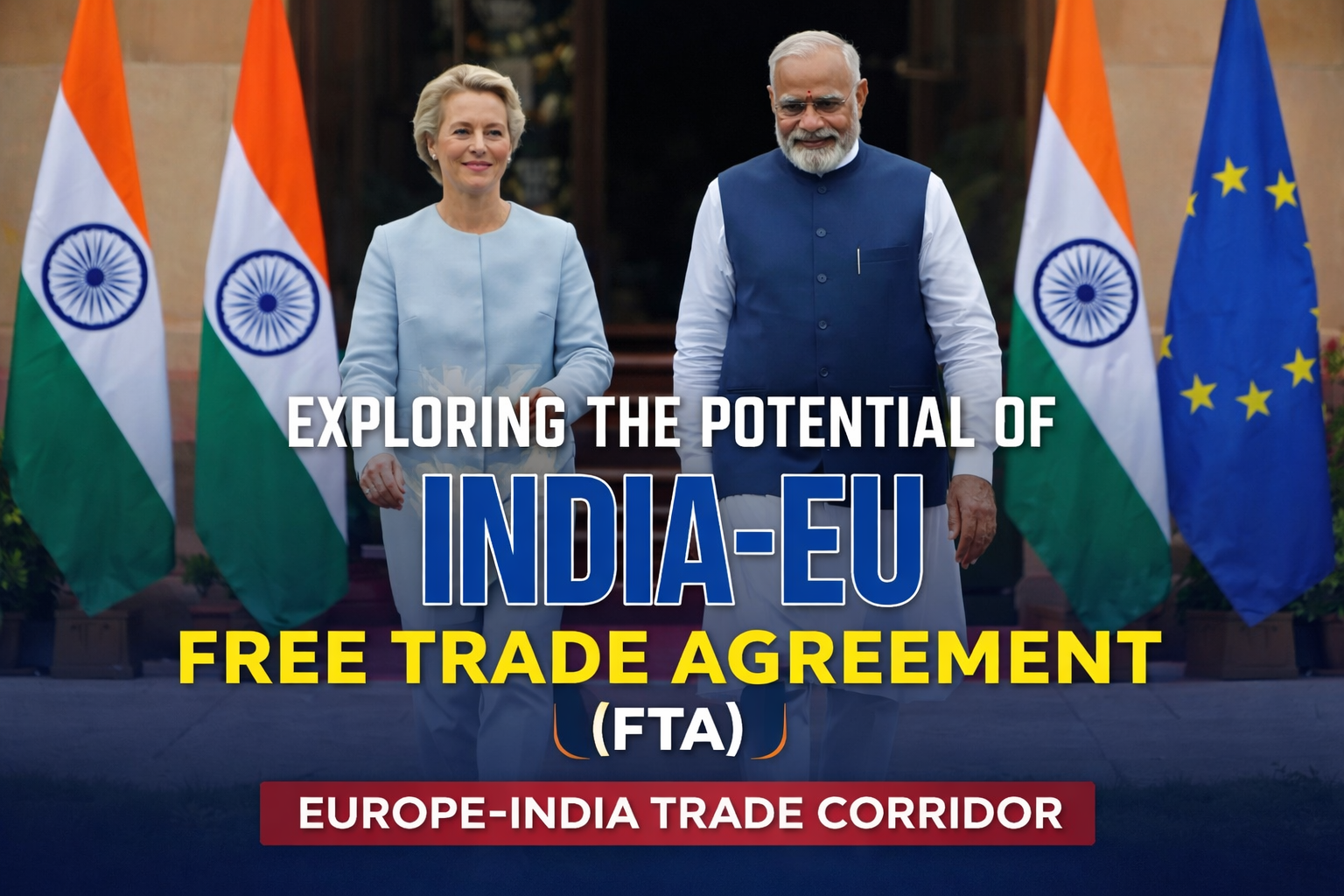
The conclusion of the India–EU Free Trade Agreement (FTA) in January 2026 marks a landmark moment in India’s trade diplomacy and global economic positioning. After nearly two decades of protracted negotiations, suspensions, and renewed engagement, India and the European Union have concluded one of the most comprehensive trade agreements ever negotiated by either side. Widely described as the “mother of all deals,” the agreement extends far beyond tariff liberalisation to encompass services, digital trade, professional mobility, sustainability commitments, and regulatory cooperation.
In a global context defined by supply-chain disruptions, geopolitical rivalry, and the gradual erosion of multilateral trade norms, the India–EU FTA represents a conscious effort to anchor economic relations between two democratic economic blocs within a predictable, rules-based framework. For India, the agreement is not merely about export expansion but about long-term structural transformation, strategic diversification, and enhanced global credibility.

Strategic Context and Economic Scale of the Agreement
At its core, the FTA integrates India, the world’s fourth-largest economy, with the European Union, the second-largest economy. Together, they form a combined market of nearly two billion people and account for roughly one-quarter of global GDP. This scale alone gives the agreement immense geoeconomic significance. More importantly, it enhances India’s strategic leverage by linking it more deeply with a major technology and capital-rich economic bloc.
The agreement also aligns with India’s broader strategy of diversifying trade partnerships and reducing excessive dependence on limited geographies, particularly in an era of increasing geopolitical uncertainty.
Evolution of Negotiations: From Stalemate to Strategic Trust
Negotiations for a comprehensive India–EU trade agreement began in 2007 but were suspended in 2013 due to persistent disagreements over automobiles, agriculture, services, intellectual property rights, and regulatory standards. The revival of talks in 2022 reflected a changed global environment shaped by the COVID-19 pandemic, supply-chain vulnerabilities, and the strategic risks of economic over-concentration.
For the European Union, India emerged as a large, stable, and politically compatible partner capable of contributing to supply-chain resilience. For India, deeper engagement with Europe offered diversification beyond East Asia, access to advanced technologies, and an opportunity to upgrade manufacturing and regulatory standards. The successful conclusion of the FTA in 2026 therefore reflects the emergence of strategic trust rather than mere technical compromise.
Core Architecture of the India–EU FTA
The India–EU FTA is among the most ambitious trade agreements signed by India. It covers trade in goods, services, digital commerce, investment-related disciplines, professional mobility, sustainability, and regulatory cooperation.
The agreement follows an asymmetrical liberalisation framework reflecting developmental realities. The EU has committed to opening approximately 97% of its tariff lines, covering about 99.5% of India’s exports by value. India has agreed to liberalise around 92.1% of tariff lines, covering nearly 97.5% of EU exports, largely through phased reductions. This design balances deep market access with protection of sensitive domestic sectors.
Market Access and Gains for Indian Manufacturing
A major outcome of the FTA is the near-universal preferential access it provides to Indian exports. Over 99% of India’s exports by value will now enter the EU market under preferential terms, substantially improving competitiveness by reducing tariff and non-tariff barriers.
The most pronounced gains accrue to labour-intensive sectors that had historically faced EU tariffs ranging from 4% to 26%.
Key beneficiary sectors include:
- Textiles and apparel, accessing an EU import market exceeding USD 260 billion
- Leather and footwear, benefiting from tariff removal up to 17%
- Marine products, including shrimp and processed seafood, earlier facing tariffs up to 26%
- Gems and jewellery, securing zero-duty access across the entire trade value
- Toys, sports goods, and select engineering products linked to MSME clusters
These sectors are critical for employment generation, particularly for women, artisans, and youth. The textile sector alone employs around 45 million people, and improved access to the EU market is expected to stimulate production expansion and job creation.
Agriculture and Processed Food: Calibrated Liberalisation
The FTA provides preferential access to the EU market for a range of Indian agricultural and processed food products, including tea, coffee, spices, table grapes, gherkins, cucumbers, dried onion, and processed foods. This improved access is expected to enhance rural incomes, promote value addition, and integrate Indian producers into European agri-food value chains.
At the same time, India has safeguarded sensitive agricultural sectors such as dairy, cereals, poultry, and soymeal. This calibrated approach ensures that trade liberalisation does not compromise food security or farmer livelihoods while still enabling export-led growth in competitive segments.
Services, Digital Trade, and India’s Structural Advantage
Services constitute the fastest-growing component of India–EU economic relations, and the FTA places strong emphasis on this domain. The EU has opened 144 services subsectors, while India has opened 102 subsectors. These include IT and IT-enabled services, digital services, professional services, education, financial services, tourism, and construction.
The services and digital trade chapters provide regulatory certainty and non-discriminatory treatment for Indian service providers. In an economy increasingly driven by data flows, digital platforms, and knowledge-intensive activities, these provisions are likely to yield long-term gains exceeding those from tariff reductions in goods.
Professional Mobility and Human Capital Integration
A significant innovation in the agreement is the structured professional mobility framework. It facilitates the temporary movement of business visitors, intra-corporate transferees, contractual service suppliers, and independent professionals, particularly in IT, research and development, and higher education.
Both sides have also committed to concluding social security agreements with all EU member states within five years. This will prevent double social security contributions and enhance the attractiveness of Europe as a destination for Indian professionals.
Strategic Sectors and Calibrated Concessions
Certain sectors required careful handling due to their economic and political sensitivity. Automobiles were among the most contentious areas. India has agreed to gradually reduce tariffs on European cars priced above a defined threshold, with duties falling from 110% to 10% over five to ten years. Tariffs on car parts will be fully eliminated over time, balancing foreign competition with domestic industry protection.
In pharmaceuticals and medical devices, the FTA opens access to the EU’s large market while addressing long-standing non-tariff barriers through regulatory cooperation. Crucially, the agreement remains compliant with international intellectual property norms and safeguards India’s capacity to manufacture affordable generic medicines.
Sustainability, Climate, and Regulatory Challenges
Sustainability forms a core pillar of the agreement, with binding commitments on environmental protection, labour rights, and gender empowerment. However, European regulations related to carbon pricing, deforestation, and corporate due diligence raise concerns about compliance costs for Indian exporters.
The FTA seeks to mitigate these challenges through assurances of non-discriminatory treatment, technical cooperation, and capacity-building support. The effectiveness of these mechanisms will be central to translating formal market access into real export gains.
Geoeconomic and Geopolitical Significance
Beyond its commercial dimensions, the India–EU FTA has substantial geostrategic significance. It supports supply-chain diversification, enhances India’s credibility as a high-standard trade partner, and contributes to the creation of a stable, rules-based economic space between two democratic blocs at a time of global uncertainty.
Conclusion
The India–EU Free Trade Agreement is not merely a tariff-cutting exercise but a strategic instrument reshaping India’s engagement with Europe. Its long-term success will depend on effective implementation, management of regulatory asymmetries, and the ability of Indian firms, particularly MSMEs, to adapt to higher standards.
If executed effectively, the agreement has the potential to drive manufacturing expansion, services-led growth, skilled mobility, and rural prosperity, aligning closely with India’s long-term developmental vision and positioning the country as a central player in the evolving global economic order.
FAQs:
1. Why is the India–EU FTA called the “mother of all deals”?
Ans: Because of its large scale, comprehensive coverage, and greater significance compared to India’s earlier FTAs with developed economies.
2. Who used the term “mother of all deals”?
Ans: The phrase has been used by India’s Commerce Minister and leaders from the European Union.
3. Why has the FTA gained sudden momentum?
Ans: Due to global supply-chain disruptions, energy insecurity in Europe, and changing geopolitical conditions.
4. How is this FTA different from previous Indian FTAs?
Ans: It is more comprehensive, covering goods, services, investment, digital trade, and sustainability issues.
5. What are the main benefits for India?
Ans: Improved export access, higher foreign investment, and support for manufacturing and services growth.
6. What does the EU gain from the agreement?
Ans: Better access to the Indian market and diversification of supply chains.
7. What are the key challenges in negotiations?
Ans: Tariff reductions, climate and labour standards, intellectual property rights, and policy space concerns.
8. How does climate policy affect the FTA?
Ans: EU measures like CBAM could increase costs for Indian exports.
9. Does the FTA affect India’s strategic autonomy?
Ans: It could if commitments restrict policy flexibility, but careful negotiation can safeguard autonomy.
10. Why is the India–EU FTA important for UPSC?
Ans: It is relevant for GS II, GS III, and Essay due to its economic and geopolitical implications.


-10052026-113117pm.png)


Debashish
8 months agoVery well written, Thankyou. Please continue writing on important exam topics.
Reply