Early Humans Might Have Walked from Turkey to Mainland Europe
The Journal of Island and Coastal Archaeology | 17 September 2025
New Migration Route into Europe Identified
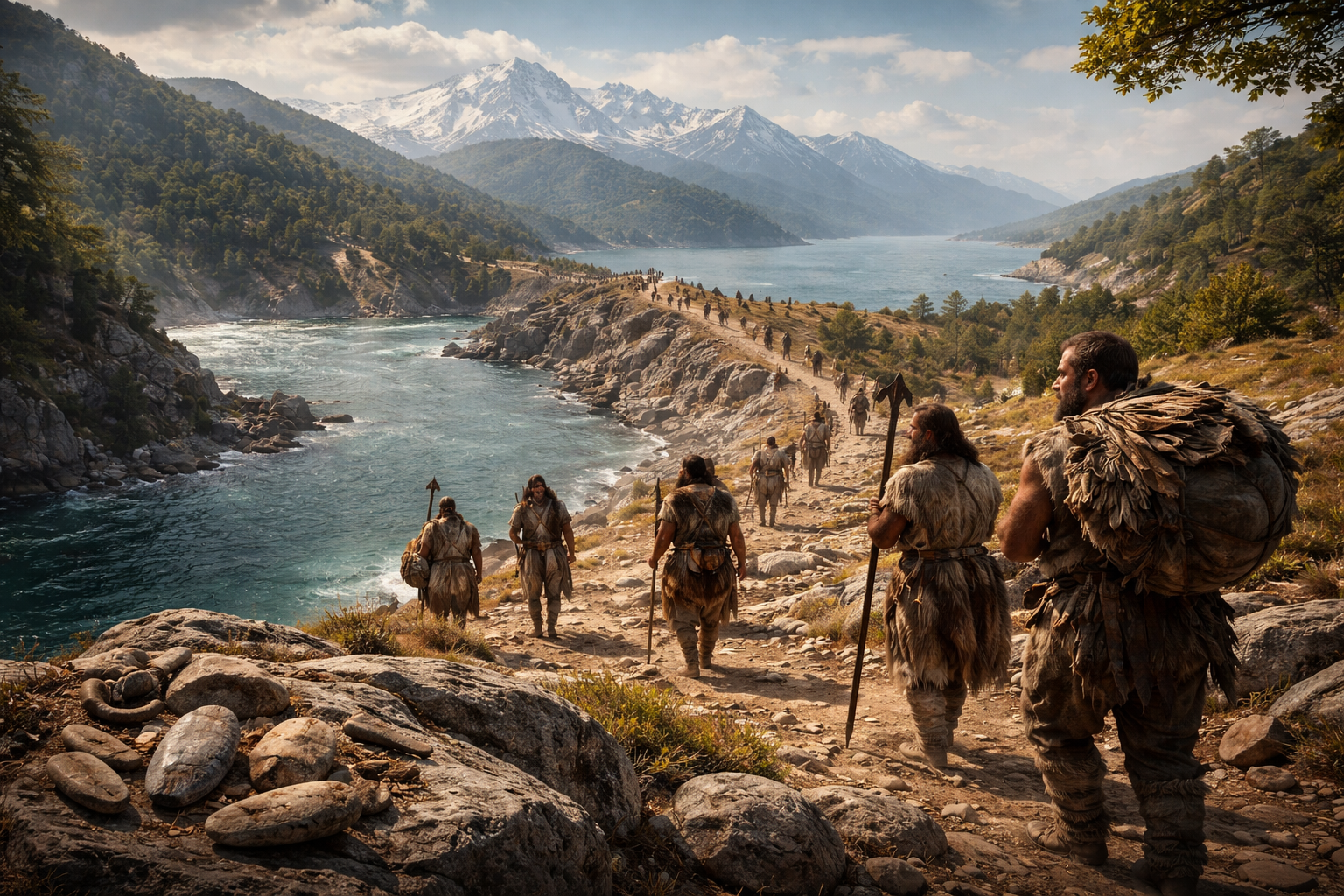
A recent study by Hande Bulut et al. suggests that early humans may have reached mainland Europe through a previously overlooked route via the northeastern Aegean coast of present-day Turkey (Ayvalık).
This challenges the long-held view that Homo sapiens entered Europe primarily through the Balkans and the Levant.

Archaeological Evidence from Ayvalık Region
Researchers discovered 138 lithic artifacts across 10 sites, spread over an area of nearly 200 km².
These findings indicate that the Ayvalık region was not just a peripheral zone but an important corridor for human movement during prehistory.
Ice Age Geography and Land Bridges
During the Ice Age, sea levels dropped by more than 100 meters, exposing vast coastal plains that are now submerged.
As a result:
• Present-day islands and peninsulas were part of a continuous landmass
• The region formed a natural land bridge between Anatolia and Europe
• Early humans could have walked across instead of relying on maritime routes
Lack of Need for Advanced Seafaring
This finding suggests that early humans may not have required sophisticated seafaring technologies to enter Europe through this route.
Instead, environmental changes created accessible pathways, facilitating migration and dispersal.

Levallois Technology and Cultural Connections
Among the most important discoveries were Levallois-style flake tools, associated with the Middle Paleolithic Mousterian tradition.
Key implications:
• Indicates presence of Neanderthals and early Homo sapiens
• Shows advanced tool-making techniques
• Reflects shared technological traditions across Africa, Asia, and Europe
Evidence of Interconnected Prehistoric World
The tools demonstrate that prehistoric populations were not isolated but part of a broader cultural and technological network.
This suggests:
• Exchange of ideas and techniques across regions
• Mobility of early human groups
• Continuity in technological traditions
Relevant PYQs :
1. Critically evaluate the contesting theories of the emergence and dispersal of modern Homo sapiens. (20M/2020)
2. Differentiate between Lower Palaeolithic and Middle Palaeolithic culture with suitable examples. (15M/2020)


-10052026-113117pm.png)