

A concise and practical guide to whether anthropology is a good optional for UPSC — its advantages, challenges, preparation strategy, comparison with other optionals, and who it actually suits.
By Bharat Bhushan Asthana · Appeared, UPSC CSE Interview · Reviewed by VAIDS ICS Anthropology faculty · Updated June 2026
-10052026-113117pm.png)
Why Choosing the Right Optional Matters in UPSC
Choosing an optional subject is one of the most stressful parts of UPSC preparation. Many aspirants spend months confused, scared of choosing the wrong subject and wasting an entire attempt. Since the optional carries 500 marks in UPSC Mains, it can completely change your final rank.
That is exactly why is anthropology good optional for UPSC is one of the most searched questions before serious preparation begins. In recent years, anthropology has become popular because of its short syllabus, easy revision, and good scoring potential. Many beginners, engineers, and working professionals prefer it because it feels more manageable than lengthy subjects like history or geography.

But no optional is perfect for everyone. Before choosing anthropology, weigh your interest, learning style, and consistency — not trends, toppers, or social media opinion.
What is Anthropology Optional in UPSC?
Meaning of Anthropology: Anthropology is the scientific study of humans — their evolution, culture, society, and biological development. It combines elements of science and humanities, which makes it a genuinely interdisciplinary subject.
Paper Structure: The anthropology optional consists of two papers. Paper I focuses on physical anthropology and socio-cultural anthropology, while Paper II deals with Indian society, tribes, caste, religion, and applied anthropology. (See Anthropology Syllabus Decoded for the full topic-wise breakdown.)
Scientific + Social Blend: Part of the subject’s appeal is the balance it strikes between scientific concepts and social understanding. That blend is what makes it workable for students from very different academic backgrounds.
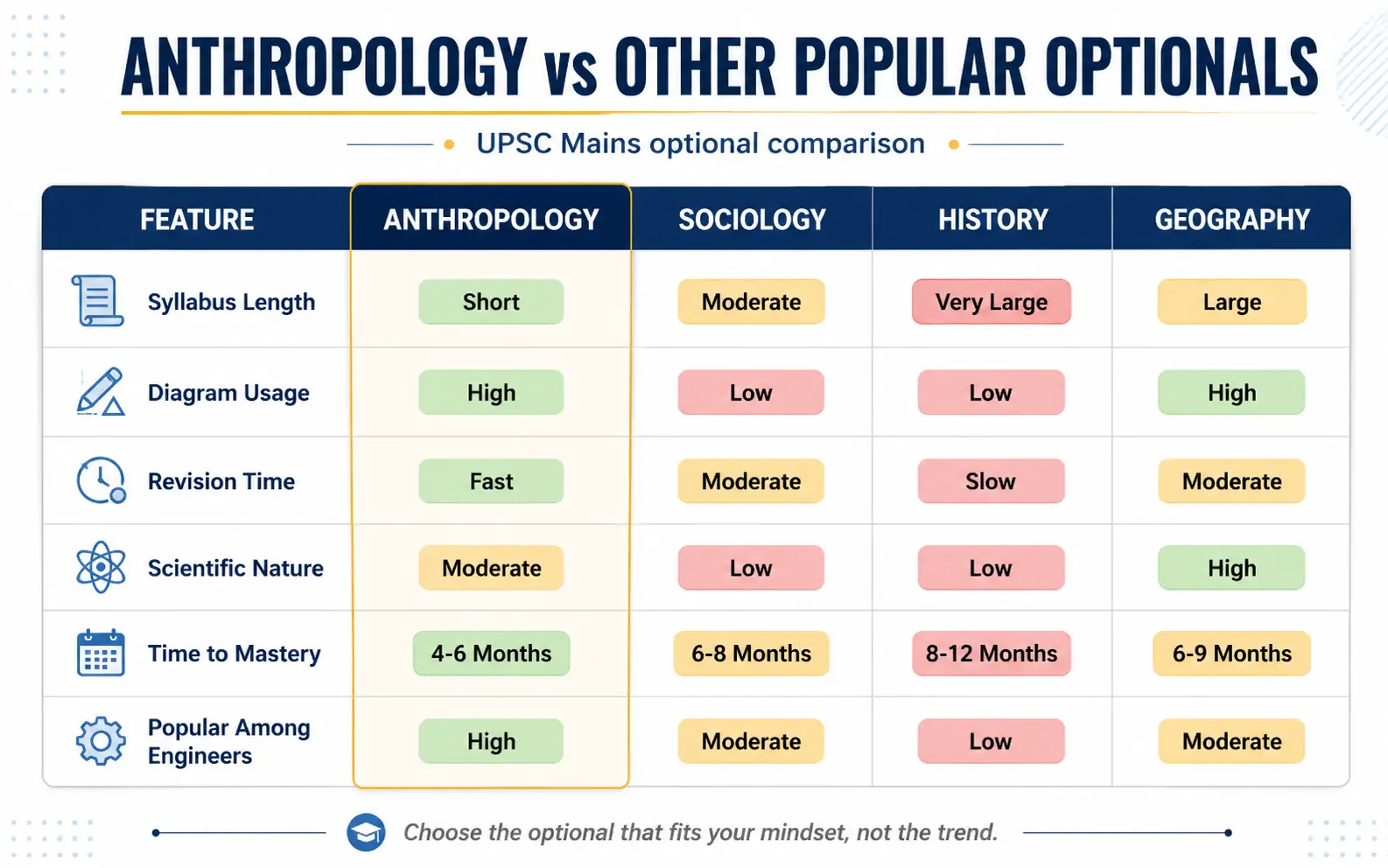
Compact Nature: Compared to history or geography, anthropology has a shorter syllabus. With proper planning, many aspirants complete the core syllabus within 4–6 months.
Answer Writing Style: Anthropology answers reward diagrams, flowcharts, tribal case studies, and clear conceptual explanations. Good presentation lifts marks noticeably.
Why Anthropology Became Popular Among UPSC Aspirants
A fair question before you commit: is the popularity earned, or is it just hype? Mostly the former, with a few caveats worth knowing.
Topper Influence: Several UPSC toppers from engineering and medical backgrounds have cleared with anthropology, and those results pushed the subject into the mainstream.
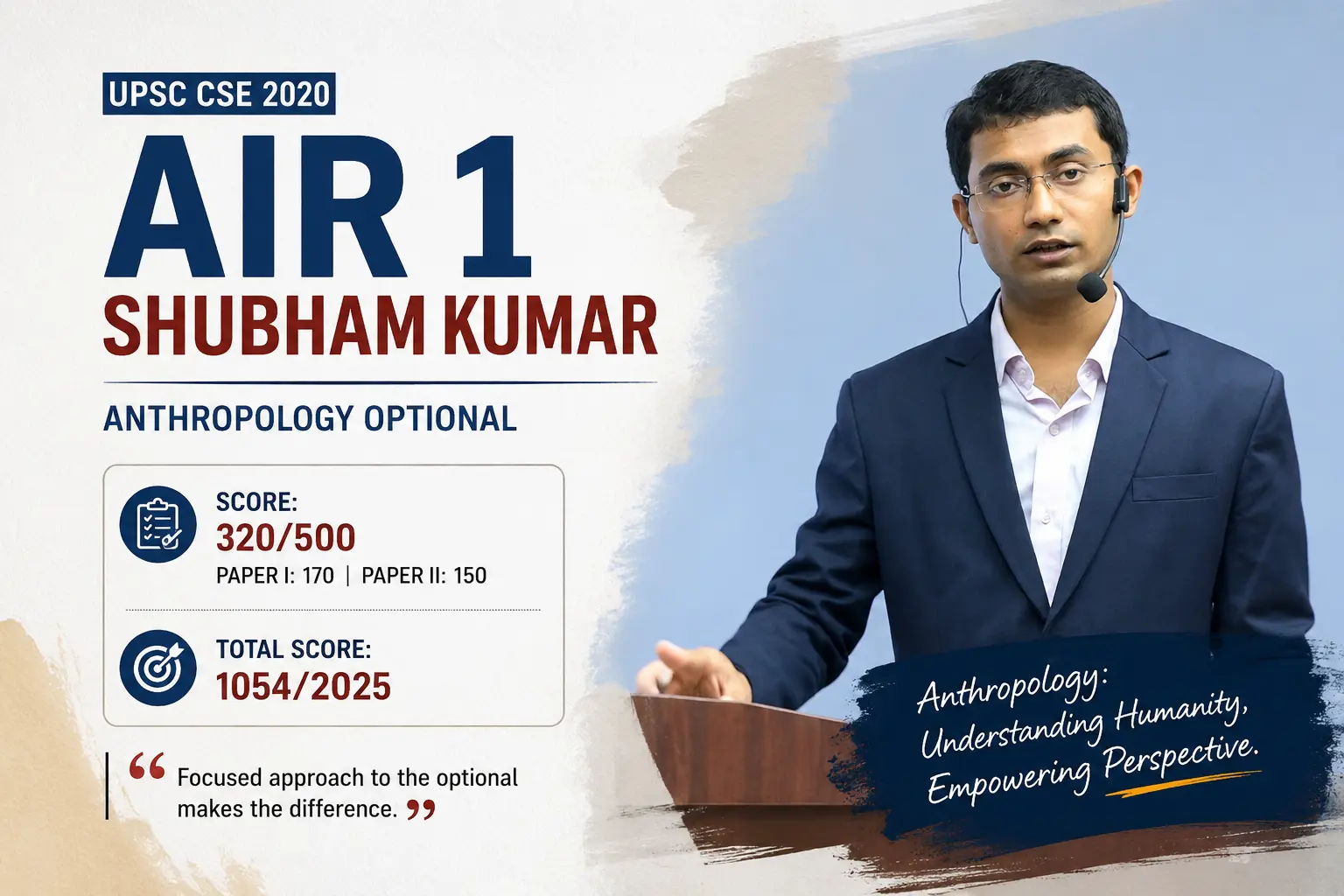
The most cited example is Shubham Kumar, AIR 1 in CSE 2020. An IIT Bombay engineer, he scored 170 in Paper I and 150 in Paper II — 320 out of 500 — within a total of 1054/2025. Worth noting how he got there: he used civil engineering as his optional in his first attempt, moved to anthropology from the second, and has said that his closer focus on the optional in his final attempt is what lifted his score. For many top rankers, the optional is where the decisive marks are made, not the GS papers.
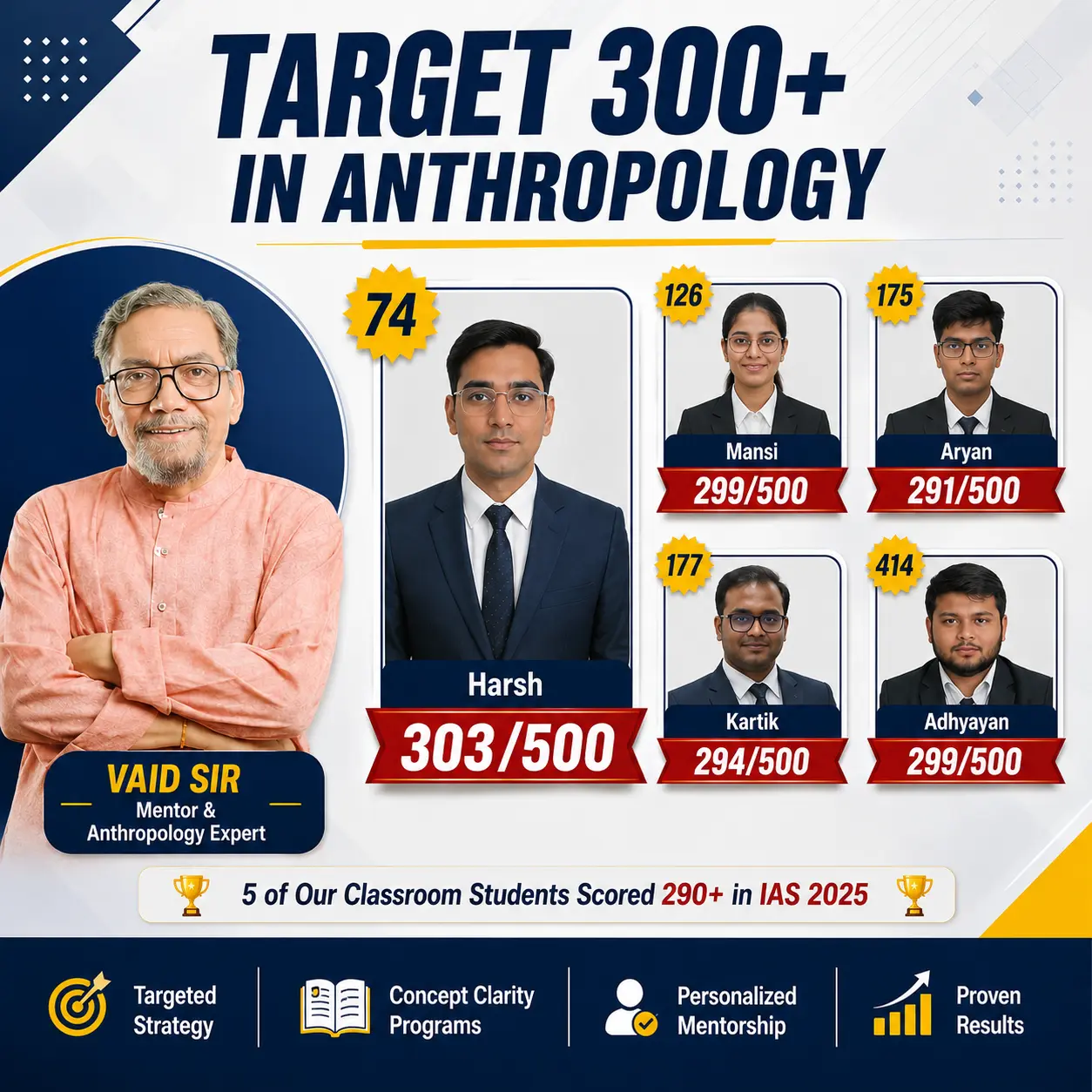
Closer to home, the pattern repeats. In CSE 2025, five classroom students at VAIDS ICS crossed 290 in the anthropology optional, the highest at 303/500. The individual scores and ranks are listed on the Toppers Talk page if you want to verify them for yourself.
Short Syllabus Advantage: A major reason behind its popularity is the concise syllabus. Aspirants juggling Prelims and GS at the same time find anthropology easier to revise repeatedly.
Scoring Potential: Many candidates believe anthropology delivers stable marks when prepared properly — which is precisely why it keeps surfacing on the shortlist of aspirants hunting for a scoring subject.
Diagram-Based Answers: The subject rewards visual presentation. Simple diagrams of skulls, evolution, tribes, kinship, and genetics make answers sharper and more analytical.
Balanced Difficulty Level: Anthropology is neither excessively theoretical nor extremely technical. That balance draws aspirants from both science and humanities streams.
Major Advantages of Anthropology Optional
So what makes aspirants pick it over more established optionals? Five things stand out.
Revision Friendly: The compact syllabus allows multiple revisions before the exam, and repeated revision improves both retention and answer quality.
Suitable for Beginners: Even students with no prior anthropology background can build command with proper guidance — one reason first-time aspirants are so often drawn to it.
Interdisciplinary Nature: Anthropology overlaps with sociology, ethics, essay, tribal governance, and social justice topics across the General Studies papers, so your optional preparation does double duty.
Faster Completion: Where some optionals demand 1–2 years, anthropology can usually be covered faster with focused effort.
Good Return on Investment: For the time it asks of you, anthropology gives back well — a strong balance of preparation time and scoring opportunity.
Comparison Table: Anthropology vs Other Popular Optionals
Hidden Challenges in Anthropology Optional
No optional is all upside, and an honest mentor will tell you where this one bites. Go in knowing these.
Technical Terminology: Evolution, genetics, skull classification, tribal terms — these are precise and must be reproduced precisely. That takes repeated revision.
Need for Diagrams: Aspirants uncomfortable with diagrams may struggle early, because anthropology rewards presentation heavily. The good news: this is a trainable skill, not a talent.
Dynamic Tribal Issues: Indian tribal issues, displacement, government schemes, and cultural change need regular updates from current affairs. Paper II is never “finished” in one sitting.
Limited Standard Sources: Unlike polity or history, anthropology has fewer universally accepted books. The discipline here is to avoid excessive resource collection, not chase it.
Answer Writing Practice: Reading anthropology is not enough. The real test is writing structured, analytical answers within the time limit — and this is the part most aspirants quietly underestimate.
Who Can Benefit the Most from Anthropology Optional?
The honest answer to “should I take it?” depends less on the subject and more on how your mind works. You are likely to do well if you fit one of these profiles.
Students with an Analytical Mindset: Those who enjoy logical thinking, structured concepts, and scientific reasoning tend to find anthropology comfortable.
Students from Science and Social Science Backgrounds: Aspirants from biology, medicine, engineering, sociology, or humanities adapt well, because the subject pairs scientific concepts like genetics and evolution with society, culture, tribes, and human behaviour.
Aspirants with Limited Preparation Time: The concise syllabus makes it practical for working professionals and candidates preparing alongside college or a job.
Candidates Looking for Faster Revision: Those who like multiple revision cycles before Mains gain from a syllabus that turns over faster than history or geography.
Diagram-Oriented Learners: Aspirants who think visually — flowcharts, tribal maps, skeletal diagrams, evolutionary illustrations — gain a real edge in answer writing.
Aspirants Seeking a Balanced Optional: Anthropology offers a mix of scientific objectivity and social understanding, ideal for those who don’t want an entirely theoretical subject.
Essay and GS-Oriented Aspirants: Candidates strengthening their essay, ethics, society, tribal, and social-justice content benefit indirectly from anthropology preparation.
Candidates Comfortable with Interdisciplinary Subjects: Because it ties together biology, sociology, history, culture, governance, and current affairs, aspirants who enjoy interconnected learning often perform well.
Anthropology Preparation Strategy for UPSC
If you have decided to take it, here is the approach that consistently works. Nothing exotic — just the fundamentals applied with discipline.
Foundation Building: Begin with NCERT-level understanding and basic concepts before moving to advanced sources. Don’t open with the hardest book on the shelf.
Limited Resources: One of the biggest mistakes is collecting too much material. Anthropology rewards revision far more than resource accumulation.
Diagram Notebook: Keep a separate notebook for diagrams — tribes, evolution, skulls, tools, kinship systems. This single habit can lift your presentation marks.
PYQ Analysis: Previous Year Questions reveal recurring themes and important thinkers. Serious aspirants should analyse at least 10 years of previous year question papers before going deep, not after.
Revision Cycles: Because parts of the subject are fact-heavy, revision must be systematic and repeated multiple times before Mains. Revision discipline is the quiet factor most aspirants underestimate.
Comparison Table: Anthropology vs Sociology vs History
| Parameter | Anthropology | Sociology | History |
| Nature of Subject | Scientific + Social Science | Pure Social Science | Humanities Subject |
| Syllabus Length | Short and Compact | Moderate | Very Vast |
| Ease of Completion | Faster Completion | Moderate Time | Time-Consuming |
| Answer Writing Style | Diagrams + Concepts | Thinkers + Analysis | Facts + Analysis |
| Diagram Usage | High | Very Low | Minimal |
| Scientific Concepts | Present | Almost Absent | Absent |
| Overlap with GS | Moderate | High | Very High |
| Current Affairs Integration | Moderate | High | Moderate |
| Revision Requirement | High | Moderate | Extensive |
| Availability of Resources | Limited but Sufficient | Abundant | Abundant |
| Scoring Stability | Generally Stable | Moderate | Variable |
| Time Needed for Mastery | 4–6 Months | 6–8 Months | 8–12 Months |
| PYQ Repetition Trend | High | Moderate | Moderate |
| Tribal/Society Topics | Strong Focus | Moderate Focus | Limited Focus |
| Popularity Among Toppers | Increasing | Consistent | Traditional |
Final Verdict: Is Anthropology Good Optional for UPSC in 2027?
Balanced Subject: Anthropology remains one of the most balanced optionals in UPSC, combining a concise syllabus, scoring potential, and manageable preparation.
Not a Magic Subject: That said, no optional guarantees success on its own. You still need disciplined revision, answer writing practice, and conceptual clarity. The subject doesn’t produce ranks — prepared aspirants do.
Best for Strategic Aspirants: Candidates who want a shorter syllabus paired with analytical, diagram-supported answer writing tend to find anthropology rewarding.
Importance of Aptitude: Optional selection should rest on long-term interest, comfort level, and consistency — not topper hype or social media influence.
Final Advice: If you genuinely enjoy understanding human society, tribal culture, evolution, and scientific reasoning together, anthropology can be an excellent optional for your UPSC preparation.
FAQs
Is anthropology good optional for UPSC for beginners?
Yes. It is considered beginner-friendly thanks to its concise syllabus and the availability of structured notes and PYQs. A non-anthropology background is not a barrier with proper foundation.
Can humanities students choose the anthropology optional?
Yes. Many humanities students score well through strong conceptual understanding and consistent answer writing practice. The scientific portion is fully learnable from scratch.
How much time does the anthropology optional take to complete?
Most aspirants complete the basic syllabus within 4–6 months with consistent study and revision. Full mastery, including answer writing, takes longer.
Is anthropology more scoring than sociology?
Anthropology is often seen as more stable and diagram-oriented, while sociology offers heavier GS overlap. In practice, scoring depends mainly on preparation quality, not the subject alone.
What about the anthropology optional success rate?
The subject has a respectable, stable track record. But treat the exact percentages circulating online with caution — reliable recent optional-wise data is limited, and results owe a lot to the disciplined aspirants who choose it. View it as reassurance, not a guarantee.
Can I prepare the anthropology optional without coaching?
Yes, many do. The keys are limited reliable sources, a strong PYQ-based approach, a diagram notebook, and regular answer-writing practice — the last two being where most self-study aspirants need the most support.
Which books are best for the anthropology optional?
Popular sources include P. Nath, Ember & Ember, IGNOU notes, and previous year questions for answer-writing practice. The mistake to avoid is collecting more than you can revise.
Related Reading
- Anthropology Syllabus Decoded — Paper I & Paper II
- How to Choose the Right Optional Subject for UPSC
- How to Write High-Scoring Anthropology Answers (With Diagrams)
- Anthropology Optional Booklist: A Minimal Reading Plan
- Anthropology vs Sociology: Which Optional Should You Pick?
- 10-Year PYQ Analysis for Anthropology Optional
- Toppers Talk: Anthropology Optional Success Stories
Still Unsure About Your Optional for UPSC 2027?
| You’re not alone.
For many aspirants, choosing an optional is one of the toughest decisions in the entire UPSC journey. A lot of time goes into comparing subjects, watching topper videos, and seeking advice from seniors. And sometimes, the confusion still remains. That is exactly where honest mentorship makes the difference. VAIDS ICS has guided anthropology aspirants since 1985, and our mentors can give you a clear, no-pressure read on whether this optional truly fits your mindset, academic background, and timeline. If it helps, start by reading how earlier students made the same decision on the Toppers Talk page, then decide with confidence. |
Written by Bharat Bhushan Asthana, who appeared in the UPSC CSE Interview, and reviewed by the VAIDS ICS anthropology faculty. Last updated: 2027.