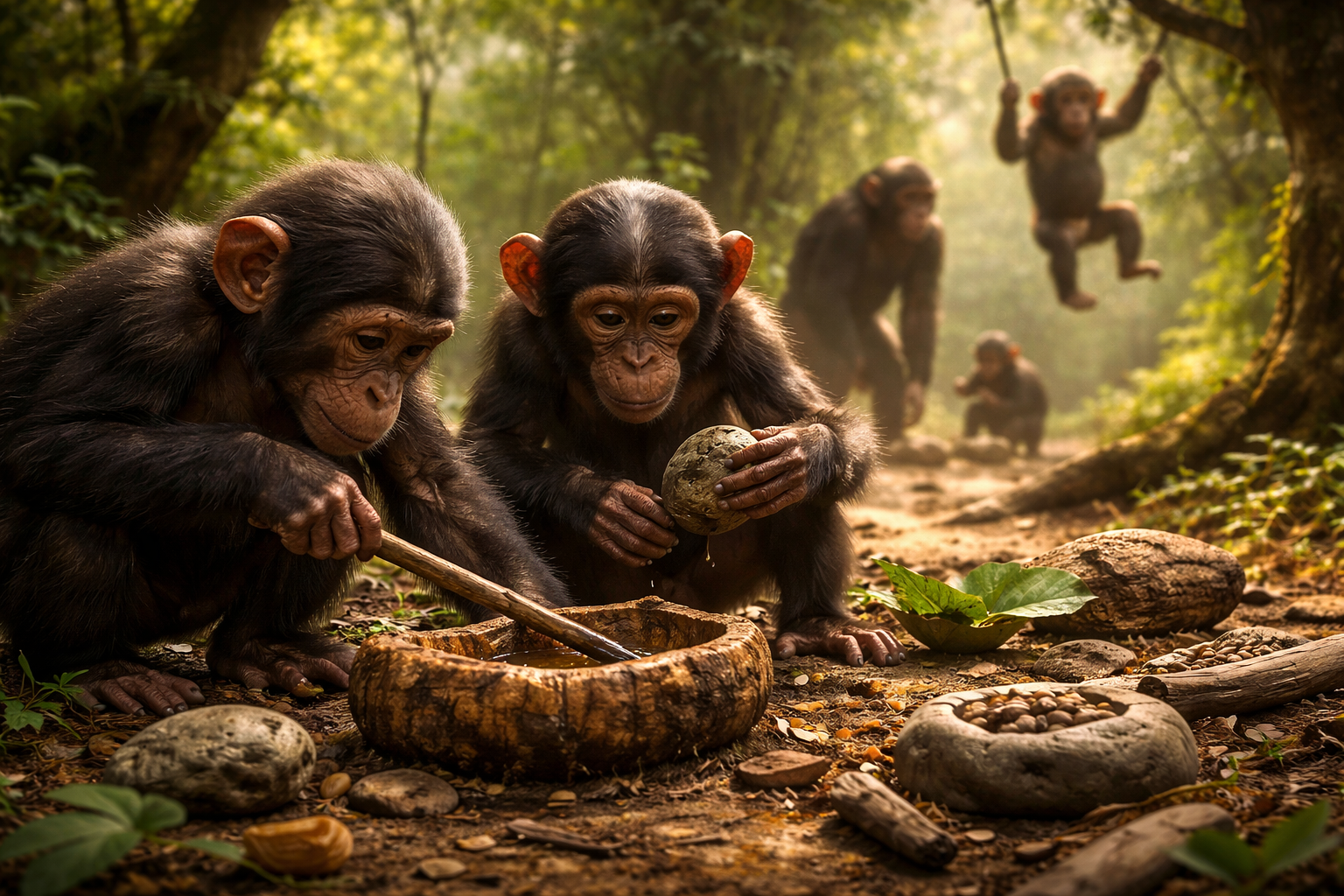
All Anthropoids Have a Drive to ‘People Watch’

Proceedings of the Royal Society B (04 June 2025) | Animal Cognition (June 2025)
Innate Social Curiosity in Primates
Recent studies by Laura Lewis et al. and Liesbeth Sterck et al. highlight that social curiosity—“people watching”—is a deeply rooted trait across anthropoids, including humans, chimpanzees, and macaques.
These findings suggest that the tendency to observe others is not merely cultural but has evolutionary origins.

Humans and Chimpanzees Prefer Social Interactions
In an experiment involving children aged 4–6 years and adult chimpanzees, both groups were shown videos depicting:
• Social interactions
• Solitary individuals
The results revealed that both humans and chimpanzees preferred watching social interactions, even sacrificing small rewards to do so.
This indicates that interest in social behavior is intrinsically rewarding.
Macaques and Attention to Social Dynamics
A separate study on long-tailed macaques found that both males and females:
• Showed greater interest in aggressive interactions than peaceful grooming
• Paid more attention to familiar individuals
This mirrors human behavior, where individuals are naturally drawn to:
• Social lives of known people
• Conflict-driven content (e.g., news, media, drama)
Importance of Tracking Social Hierarchies
Interest in aggressive interactions reflects the need to monitor power dynamics and dominance hierarchies within a group.
For primates, including humans:
• Understanding hierarchy helps in avoiding threats
• It aids in strategic social positioning
• It ensures better survival and cooperation
Role of Reputation in Primate Societies
According to Gillian Forrester, social attention is crucial for maintaining a good reputation in primate groups.
In ancient human and primate societies, reputational damage could lead to:
• Loss of access to food and resources
• Reduced mating opportunities
• Increased risk of conflict or aggression
• Social exclusion or ostracism, sometimes fatal
Evolutionary Significance of ‘People Watching’
These findings suggest that observing others is an adaptive behavior that evolved to:
• Monitor group dynamics
• Maintain social bonds
• Detect threats and opportunities
• Enhance cultural learning and transmission
Implications for Human Evolution
The study reinforces the idea that human social behaviour has deep roots in primate evolution.
Traits such as:
• Curiosity about others
• Interest in social interactions
• Attention to conflict and hierarchy
Relevant PYQs
• Discuss different forms of primate social organisation. (15M/2022)
• Role of Primatology in Anthropological studies. (10M/2013)