New Species of Australopithecus Challenges the Human Family Tree
Source: Nature | November 26, 2025
Context: Revisiting Early Hominin Diversity
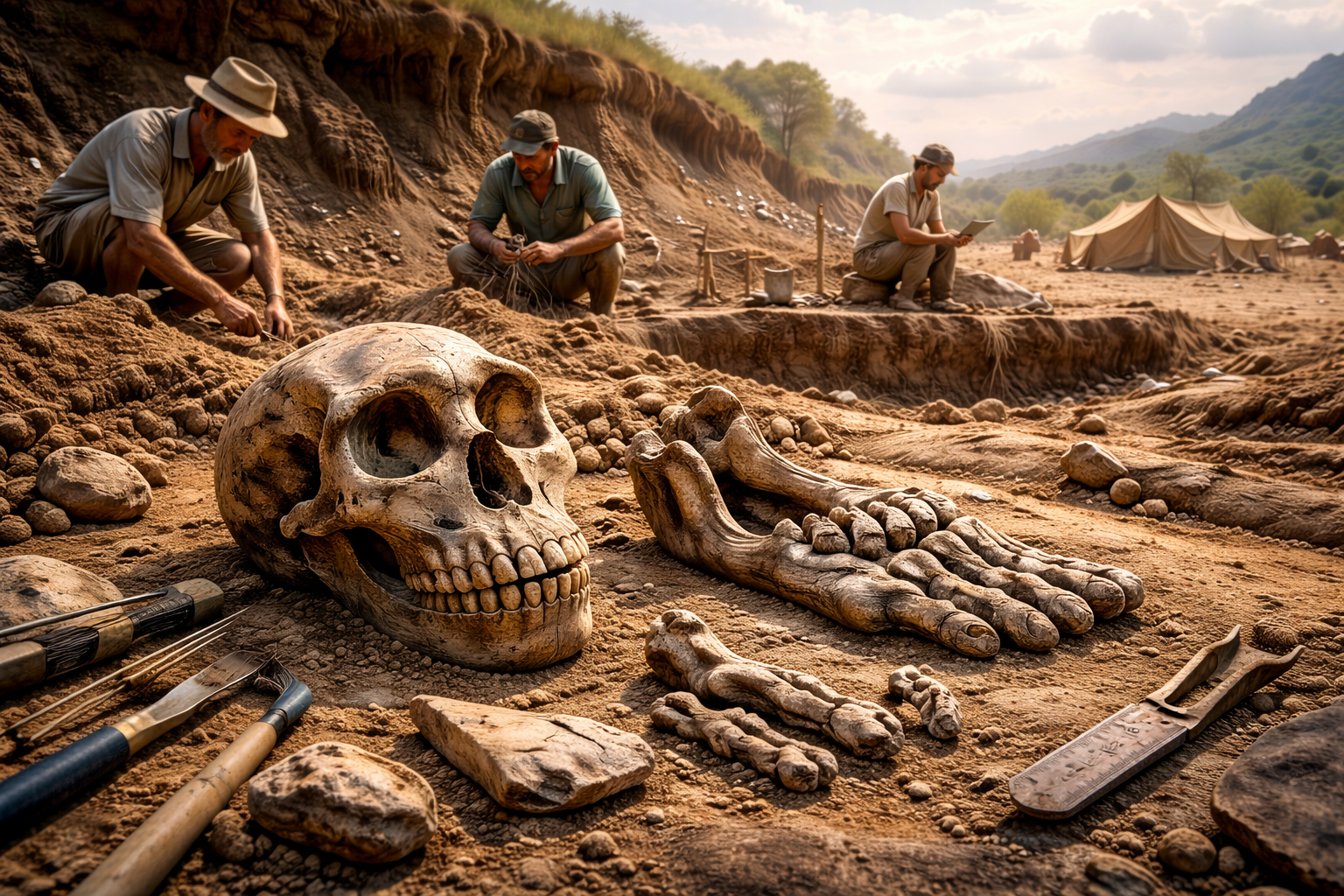
A 3.4-million-year-old fossilized foot discovered 15 years ago in Ethiopia’s Afar region has now been definitively linked to Australopithecus deyiremeda, a primitive hominin species.
The discovery, published in Nature, includes additional fossil material:
• Pelvis fragments
• Skull pieces
• Jawbone with 12 teeth
These findings provide stronger anatomical evidence that multiple hominin species coexisted in East Africa around 3–3.5 million years ago.

Why This Discovery Is Important
Until now, Australopithecus afarensis — the species to which the famous Lucy skeleton belongs — was widely regarded as the primary ancestor of later hominins, including possibly the genus Homo.
However, the new evidence suggests:
• At least two distinct hominin species lived in close proximity
• They had different gaits and dietary adaptations
• They occupied overlapping ecological zones
This challenges the long-held assumption of a single dominant lineage during this period.
Coexistence in the Afar Region
The Afar region of the Rift Valley is one of the most important sites in human evolutionary research.
The study proposes that:
• Australopithecus deyiremeda and A. afarensis lived “within a stone’s throw” of each other
• They likely exhibited different locomotor patterns
• Dietary variation suggests ecological niche differentiation
This indicates adaptive radiation rather than linear evolution.
Implications for Human Phylogeny
Researchers argue that the newly identified fossils resemble some South African hominins more closely than A. afarensis does.
If validated, this could mean:
• A. afarensis may not be the sole ancestor of later hominins
• The evolutionary tree may be branching rather than linear
• Lucy’s iconic position in the human lineage could be reconsidered
This strengthens the idea that early hominin evolution was diverse and complex, not a straight-line progression.
Anthropological Significance
This discovery contributes to key debates in anthropology:
• Diversity among australopithecines
• Locomotor evolution (bipedal variations)
• Dietary adaptation and ecological niches
• Cladistic vs linear models of evolution
• East African vs South African hominin relationships
It reinforces the understanding that multiple hominin species coexisted, competing and adapting in similar environments.
📝 Relevant UPSC Anthropology PYQs
1️⃣ Discuss major species of Australopithecus discovered from South and East Africa. Describe the discovery, physical features, and significance of Taung baby. (20M, 2023)
2️⃣ What is the hominization process? Discuss the major trends in human evolution with suitable examples. (20M, 2023)



-10052026-113117pm.png)