Ujjwal AIR 174 IAS 2025 Anthropology & GS Strategy | Vaids ICS
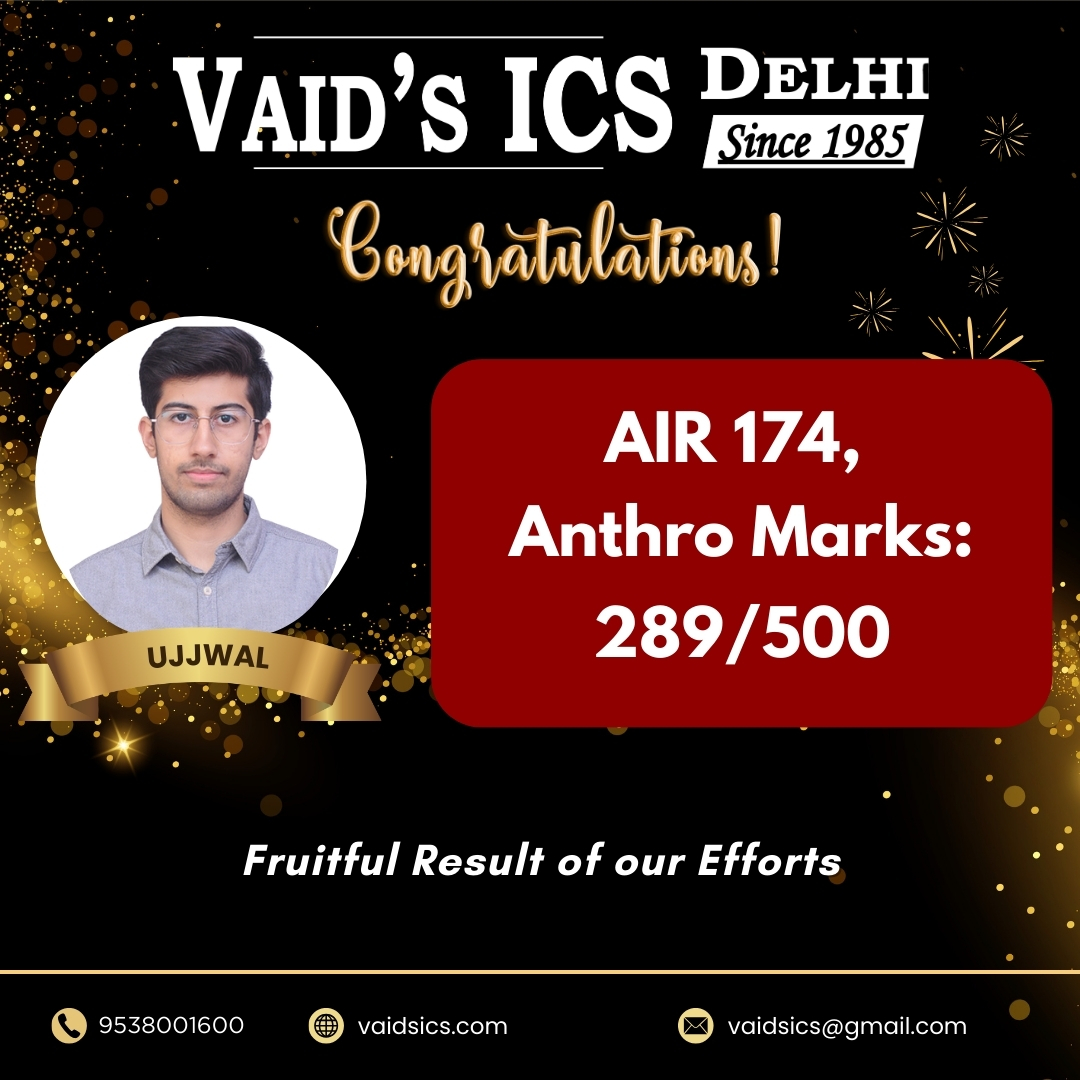
Cracking the UPSC Civil Services Examination requires the right strategy, disciplined execution, proper mentorship, and continuous improvement. Ujjwal, who secured AIR 174 in UPSC CSE 2025, shared a preparation journey that reflects all these qualities. His success story is especially important for serious aspirants because it shows how Anthropology optional, daily answer writing, and the right academic guidance can significantly improve performance in both the optional and General Studies papers.
Ujjwal’s journey also highlights the contribution of Vaid Sir and Vaids ICS Institute, where structured preparation, classroom guidance, current affairs support, and mentorship helped shape his approach. As a classroom course student, he built a strong Anthropology foundation that eventually became one of the major pillars of his UPSC success.

Ujjwal’s Academic Background and UPSC Journey
Ujjwal completed his graduation in Electrical Engineering from Delhi Technological University (DTU) in 2022. After graduation, he entered the UPSC preparation cycle with complete seriousness and consistency. This was his fourth attempt and third Mains appearance, and this time he finally secured AIR 174 in UPSC CSE 2025.
His success did not come from shortcuts or from following too many scattered resources. Instead, it came from building a strong foundation, identifying weaknesses, and improving continuously across attempts. His preparation model is useful because it is practical, realistic, and highly relevant for students preparing seriously for the Civil Services Examination.
Anthropology Optional as the Core Strength
One of the most important aspects of Ujjwal’s strategy was the role played by Anthropology optional. He clearly explained that his basic preparation in Anthropology was built on Vaid Sir’s classroom notes and printed study material. This became the core source from which he studied and revised repeatedly.
Rather than beginning with multiple books and excessive sources, he first relied on a clear and stable base material. Over time, he added selective content from topper notes, case studies, and examples. This helped him strengthen both Paper I and Paper II without making his preparation unmanageable.

For Paper I, he referred to selective topper notes to enrich topics like Physical Anthropology and Socio-Cultural Anthropology. For Paper II, he used additional notes and case studies where required. However, the base always remained Vaid Sir’s material, which gave structure and clarity to the subject.
This is a major lesson for Anthropology aspirants. A high score in optional does not come from reading ten different sources. It comes from mastering one trusted source, revising it repeatedly, and doing limited but effective value addition.
Role of Vaid Sir in Ujjwal’s Preparation
The contribution of Vaid Sir stands out strongly in Ujjwal’s preparation journey. The guidance he received was not limited to classroom teaching alone. It extended to concept-building, answer-writing direction, material selection, and overall mentorship.
The most important support that Vaid Sir provided was this:
Conceptual clarity
Anthropology becomes scoring only when concepts are clearly understood and can be applied in answers.
Focused notes
Instead of burdening students with endless material, the notes were compact and useful.
Exam-oriented mentorship
The guidance helped Ujjwal understand how to convert preparation into marks.
Long-term academic support
Even after classes, the mentorship ecosystem continued to support students in answer writing and enrichment.
For UPSC aspirants, the difference between ordinary preparation and guided preparation often lies in such mentorship. Ujjwal’s result reflects that clearly.
Vaids ICS Institute and the Academic Ecosystem
Another key factor in Ujjwal’s success was the role of Vaids ICS Institute as an academic ecosystem. His preparation did not happen in isolation. He remained connected to a system that continuously supported his learning through classes, notes, discussion, and updates.
This ecosystem provided him with:
Structured classroom preparation
A clear learning path made the subject manageable.
Printed study material
Reliable and revision-friendly material reduced confusion.
Regular academic continuity
The preparation environment kept students connected to the exam process.
Mentorship and answer-writing orientation
Students did not just study content; they were guided on how to use it.
This kind of environment matters deeply in UPSC because consistency is one of the biggest challenges for aspirants over a long cycle of preparation.
WhatsApp Group Current Affairs and Study Material Support
A major value addition in Ujjwal’s journey came through the Vaids ICS WhatsApp group, where students received current affairs support, editorial insights, and updated academic material.
This helped him enrich his answers with relevant examples, case studies, and contemporary issues. Such support becomes especially useful in:
- Anthropology Paper II
- GS Paper II
- GS Paper III
- Essay
- Ethics examples
Instead of wasting time collecting current affairs from too many places, students benefited from filtered and relevant content. This made their preparation more efficient and more exam-oriented.
For today’s UPSC pattern, where answers need current relevance, this kind of support becomes highly valuable.
Daily Answer Writing: The Turning Point in Success
One of the strongest lessons from Ujjwal’s strategy is the importance of daily answer writing. He openly admitted that writing speed was one of his biggest weaknesses in earlier attempts. In fact, his inability to complete the paper properly had affected his Mains performance in the past.
This time, he made answer writing the center of his preparation. During the period between Prelims and Mains, he wrote mock tests almost every day. Even when not formally enrolled in a test series, he kept practicing answer writing at home.
This helped him in three major ways:
Improved speed
Only regular writing can improve writing speed.
Better paper completion
Completing all questions became a conscious priority.
Sharper expression
Writing repeatedly helped him become more concise and effective.
He also followed an important technique: instead of trying to force himself to always match the printed word limit, he wrote slightly fewer words where needed so that he could complete more answers in time. This practical adjustment helped him handle the paper better.
For UPSC aspirants, this is a major takeaway. Content alone does not fetch marks. Writing it on time does.
Strategy for General Studies
For General Studies, Ujjwal followed a simple and highly effective strategy. He focused on the major core subjects and revised them repeatedly. For Prelims, he maintained subject-wise notebooks and concentrated on:
- History
- Art and Culture
- Economy
- Polity
- Environment
- Geography
His emphasis was on developing maximum command over core areas rather than worrying excessively about obscure or unpredictable questions.
For Mains, his approach remained consistent:
Build basic notes first
He prepared a stable foundation.
Do selective value addition
He added committee recommendations, examples, and quotes only where useful.
Use PYQs effectively
Previous Year Questions helped him understand the style of demand.
Practice answer writing regularly
This made content usable in exam conditions.
His GS preparation reflects a mature understanding of UPSC: repeated revision of core material is more valuable than endless source-hopping.
Importance of PYQs in Anthropology and GS
Ujjwal placed strong emphasis on Previous Year Questions (PYQs). According to him, PYQs are not useful only for identifying repeated topics; they are also important for understanding how UPSC frames questions.
He and his study group used to discuss older questions, especially questions from before 2013, in order to understand more analytical and unconventional themes. This helped him think beyond direct and factual questions and prepare for broader and more interpretative ones.
This method is especially useful for:
- Anthropology analytical questions
- GS conceptual questions
- Essay thought development
- Mains answer brainstorming
His experience shows that PYQs should not be treated as just a list of old questions. They should be used as a tool to train the mind.
Value Addition Without Overloading Notes
A very important part of Ujjwal’s strategy was his understanding of limited and intelligent value addition. He did not believe in collecting endless material. Instead, he believed in adding only that content which could actually be revised and reproduced in the exam.
For value addition, he used:
- topper notes
- case studies
- committee recommendations
- selected quotations
- examples from current affairs
- relevant material shared through WhatsApp groups
The guiding principle remained simple: add only what is useful, memorable, and writable in the examination hall.
This is especially important today because the post-ChatGPT era has made content abundance a serious problem. Students often collect too much but revise too little. Ujjwal’s strategy warns against exactly that mistake.
Essay and Ethics Strategy
For the Essay paper, Ujjwal advised students to avoid mechanical writing. He believed that essays should have a natural flow of ideas, not an artificial compartmentalized structure forced into fixed headings.
His preparation involved:
- identifying broad recurring themes
- preparing some annotations
- collecting a few quotes
- thinking through introductions and conclusions
For Ethics, he adopted a practical strategy. Instead of depending heavily on standard textbooks, he focused on:
- basic concepts
- PYQs
- examples
- selective online support
- topper notes for illustration
This approach once again shows his preference for clarity over bulk.
Biggest Lesson From Ujjwal’s Success
Perhaps the most important lesson from his preparation is this: revise more, collect less.
He openly admitted that in earlier phases of preparation, his content had become too bulky. Later, he realized that if a topic cannot be revised before Mains, it becomes almost useless in the exam. This led him to prepare shorter, sharper, and more revision-friendly notes.
This lesson is extremely valuable for serious aspirants. The purpose of notes is not to look impressive. The purpose is to be revised quickly and reproduced effectively.
How Anthropology Boosted His UPSC Success
Ujjwal’s journey is also a powerful example of how Anthropology optional can significantly boost UPSC success when prepared properly. With the right guidance, compact notes, value addition, and current relevance, Anthropology can become one of the most rewarding optionals.
In his case, Anthropology gave him:
A strong scoring base
A well-prepared optional can create a major advantage in the final ranking.
Better conceptual confidence
Anthropology helped him think analytically and structure answers better.
Useful examples and case studies
These enriched both optional and related GS answers.
A stable preparation framework
With guidance from Vaid Sir, the subject remained manageable and revision-friendly.
For aspirants considering Anthropology optional, his result is a strong indicator of the subject’s potential when guided properly.
Why Ujjwal’s Strategy Matters for Aspirants
Ujjwal AIR 174’s strategy matters because it is realistic and replicable. His journey teaches that UPSC success is not about dramatic hacks. It is about:
- trusted mentorship
- stable study material
- daily answer writing
- revision discipline
- selective value addition
- current affairs integration
- consistent academic support
These are exactly the areas where Vaid Sir and Vaids ICS Institute played a valuable role in his preparation.
Conclusion :
The success of Ujjwal AIR 174 IAS 2025 offers a clear and practical roadmap for UPSC aspirants. His journey shows how Anthropology optional, when prepared under proper mentorship, can become a major strength. It also highlights the importance of Vaid Sir’s guidance, Vaids ICS Institute’s classroom support, WhatsApp current affairs updates, focused study material, and daily answer writing discipline.
Most importantly, his success proves that the right preparation strategy is not about studying more than everyone else. It is about studying smart, revising consistently, writing daily, and staying connected to meaningful mentorship.
For any serious UPSC aspirant—especially those preparing Anthropology optional—Ujjwal’s strategy is both inspiring and highly useful.
-10052026-113117pm.png)