World’s Oldest Calendar Discovered at a 13,000-Year-Old Temple in Turkey
Source: Time and Mind | August 2024
The Discovery
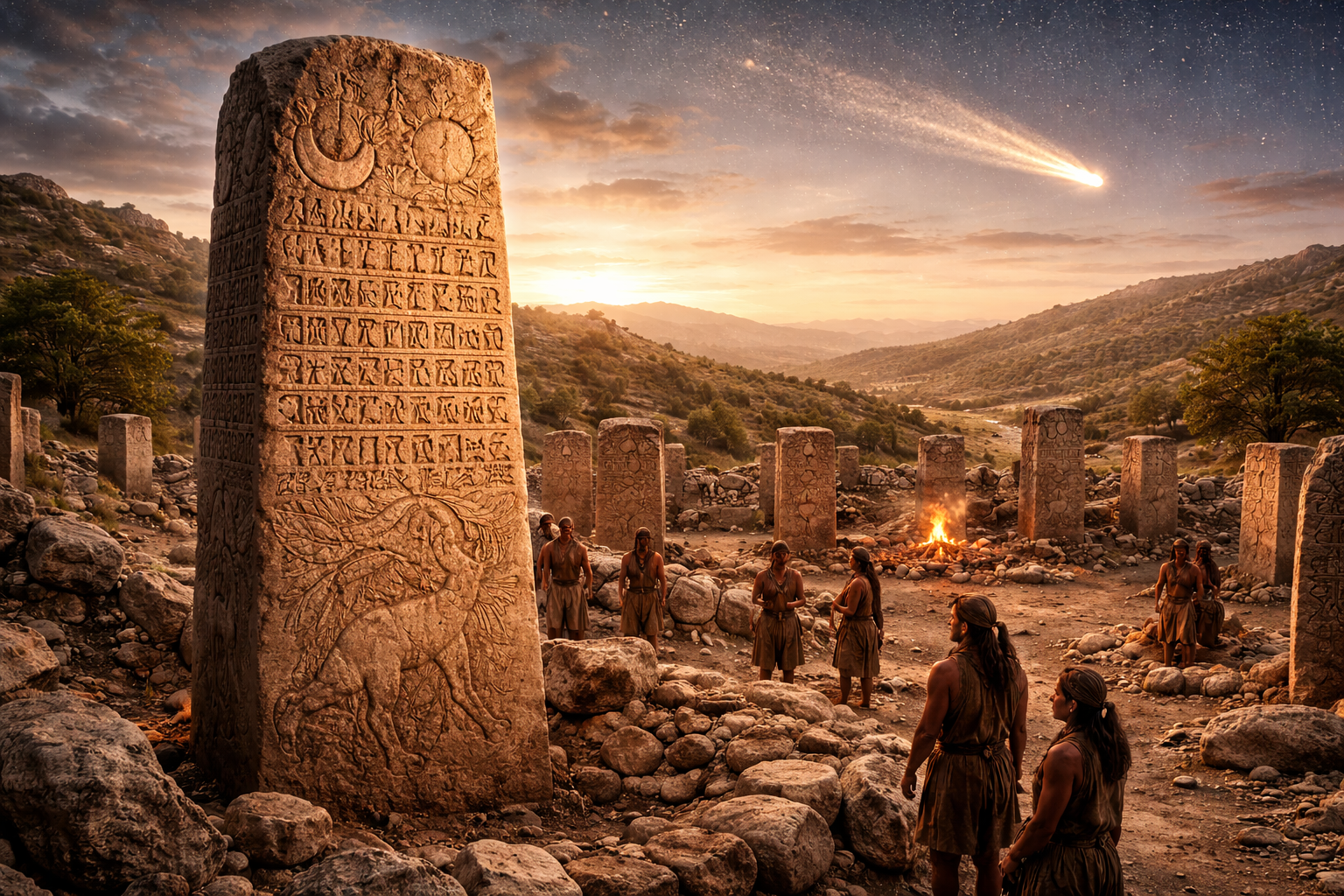
Recent research published in the journal Time and Mind by Martin Sweatman et al. suggests that carvings found at Göbekli Tepe, a prehistoric site in southern Turkey, may represent the world’s oldest known sun-and-moon calendar.
The calendar dates back to nearly 13,000 years ago (c. 10,850 BCE), placing it well before the advent of agriculture.
Göbekli Tepe: A Unique Prehistoric Site
Göbekli Tepe is globally recognised for its massive stone pillars, arranged in circular enclosures and decorated with elaborate carvings of animals and abstract symbols.
The site challenges conventional views that monumental architecture emerged only after settled farming societies.
The Calendar Evidence
The researchers analysed markings chiseled into a large stone pillar at the site.
Key observations include:
• The pillar contains 365 V-shaped symbols
• Each symbol is interpreted as representing one day
• Together, the markings suggest 12 lunar months plus 11 additional days, closely matching a solar year
This indicates an advanced understanding of time-reckoning and celestial cycles among prehistoric hunter-gatherer communities.
Link to a Catastrophic Event
The study proposes that the calendar may not have been purely observational, but commemorative in purpose.
According to the researchers, the carvings may have been created to record a catastrophic comet strike believed to have occurred around 10,850 BCE.
If correct, this would imply that early humans used symbolic systems not only to track time but also to memorialise extraordinary cosmic events.
Anthropological Significance
From an anthropological and archaeological perspective, this discovery is significant because it:
• Pushes back the origin of formal calendrical systems
• Demonstrates sophisticated astronomical knowledge in pre-agricultural societies
• Highlights the role of ritual centres in early cognitive and symbolic development
• Supports the idea that complex belief systems existed before settled village life
Why This Matters for UPSC Aspirants
This discovery is important for understanding:
• Cognitive evolution of early humans
• Relationship between astronomy, ritual, and architecture
• The nature of Pre-Neolithic societies
• Challenging linear models of cultural evolution
Most Relevant UPSC Anthropology PYQs
-
Chronometric dating. (10 Marks, 2024)
-
Describe the principles of radiocarbon dating. Mention its limitations. (15 Marks, 2018)
-
What are dating methods? Discuss one absolute and one relative method. (15 Marks, 2017)


-10052026-113117pm.png)