World’s Oldest Paintings Predate Modern Humans: Rethinking Cognitive Evolution
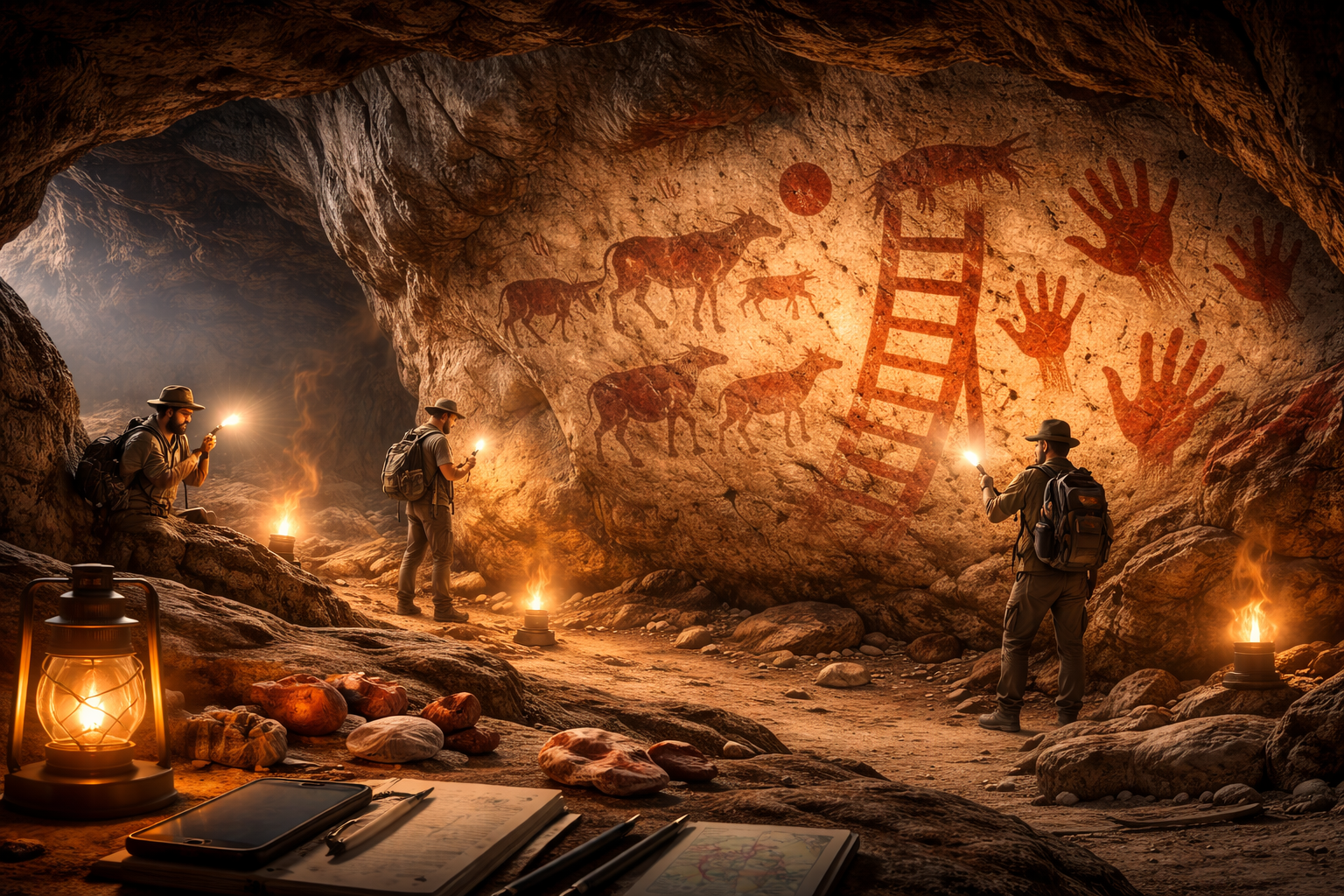
Sources: Science (2018), Nature (2023), Nature Ecology & Evolution (2021)
Context: A Major Shift in Prehistoric Interpretation
For decades, symbolic art was considered a defining feature of Homo sapiens, emerging during the Upper Paleolithic “Cognitive Revolution.”
However, new archaeological evidence challenges this long-held assumption.
Recent dating techniques show that some of the world’s oldest cave paintings predate the arrival of modern humans in Europe, suggesting that Neanderthals and other hominins possessed symbolic capacity.

The Spanish Cave Art Discovery (2018)
A landmark study published in Science (2018) dated cave paintings in Northern Spain to at least 64,800 years ago.
Key implications:
• These paintings predate the arrival of Homo sapiens in Europe by nearly 20,000 years
• The creators were most likely Neanderthals
• The art includes red disks, ladder motifs, and hand stencils
Sites such as La Pasiega directly challenge the outdated view of Neanderthals as cognitively inferior.
Evidence from Southeast Asia
In Sulawesi, Indonesia, cave art dated to 67,000 years ago (Nature, 2023) includes:
• Hand stencils
• Hunting scenes
• Animal depictions
• Possible cosmological symbols
This significantly extends the timeline of symbolic expression outside Europe.
African Evidence: Blombos Cave
Microscopic analysis at Blombos Cave (South Africa) revealed:
• Engraved ochre artifacts
• Dating back over 70,000 years
These findings support the idea that symbolic thinking emerged gradually, not suddenly during the Upper Paleolithic.
Neanderthal Cultural Competence
Additional discoveries across Europe include:
• Decorated shells
• Pierced pendants
• Ochre-stained tools
A 2021 review in Nature Ecology & Evolution emphasized:
• Growing consensus around Neanderthal symbolic behavior
• Rejection of the idea of a sudden cognitive “revolution”
• Acceptance of gradual cognitive evolution across multiple hominin lineages
Implications for Human Evolution
These discoveries suggest:
• Symbolism was not exclusive to Homo sapiens
• Neanderthals had advanced cognitive capacities
• Cultural complexity evolved gradually
• Multiple hominin species contributed to symbolic traditions
This supports a branching model of cognitive evolution, rather than a single-species breakthrough.
UPSC Anthropology – Relevant PYQs :
1. Mesolithic rock art in Indian subcontinent. (10M/2022)
2. Elucidate Mesolithic culture and associated rock art with examples from India. (15M/2019)



-10052026-113117pm.png)