
Mendelian and Non-Mendelian Traits — 2025 Paper I
Mendelian and non-Mendelian traits.
Model Answer
VAID ICSIntroduction
Gregor Mendel’s experiments on pea plants, published in 1866, showed that hereditary units are transmitted through segregation and independent assortment. In humans, some traits follow simple Mendelian inheritance, while many traits show more complex non-Mendelian patterns.
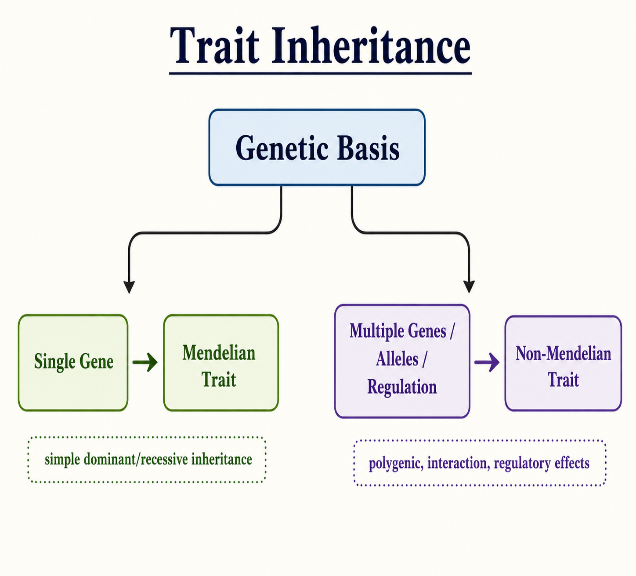
Mendelian traits
Mendelian traits are usually controlled by a single gene with alternative alleles showing dominant-recessive expression. They follow predictable ratios in families and pedigrees.
Examples: - Autosomal dominant: polydactyly, Huntington’s disease. - Autosomal recessive: albinism, cystic fibrosis, phenylketonuria. - Sex-linked: haemophilia and red-green colour blindness.
Non-Mendelian traits
Non-Mendelian traits do not show simple dominant-recessive ratios.
They include:
- Codominance and multiple alleles: ABO blood group, where A and B are codominant and O is recessive.
- Incomplete dominance: intermediate phenotype in heterozygotes.
- Polygenic inheritance: height, skin colour, intelligence, dermatoglyphics. - Pleiotropy: one gene affects multiple traits, as in sickle-cell anaemia.
- Mitochondrial inheritance: maternal transmission of mitochondrial disorders. - Epigenetic and genomic imprinting effects: expression depends on parent of origin or gene regulation.
Conclusion
Mendelian traits help in pedigree analysis and genetic counselling, while non-Mendelian traits explain real human biological variability more effectively. Together they connect classical genetics with population genetics, medical anthropology and human variation studies.
Want feedback on your answer?
Join the Anthropology workshop or get structured answer-writing guidance from VAID ICS.