
Determining the Inheritance of a Disease or Disorder — 2026 Paper I
How would you find out that a particular disease/disorder is inherited and, if so, in which manner? Elaborate with suitable examples.
Model Answer
VAID ICSApproach
|
Model Answer
Introduction: A disorder cannot be called inherited merely because several relatives are affected; relatives also share diet, infections and social environments. The task is therefore two-stage: first establish a genetic contribution, and then infer the mode of transmission, followed by biological confirmation.
- Define the phenotype and test family aggregation:
Record diagnostic criteria, age at onset and severity. Obtain a detailed three-generation family history including affected/unaffected persons, miscarriages, consanguinity and ancestry. Compare recurrence among biological relatives with background population frequency and exclude obvious shared exposures or phenocopies.
- Pedigree analysis:
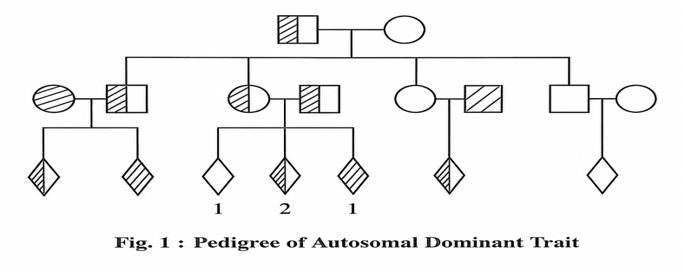
Construct a pedigree and examine vertical/horizontal transmission, sex ratio and parent–offspring patterns.
- Autosomal dominant: usually vertical transmission; both sexes affected; father-to-son transmission possible. Example: Huntington disease.
- Autosomal recessive: affected siblings may be born to unaffected carrier parents; may skip generations; consanguinity can increase occurrence. Examples: sickle-cell disease, cystic fibrosis.
- X-linked recessive: mainly males affected; no father-to-son transmission; carrier mothers may transmit to sons. Examples: haemophilia A, Duchenne muscular dystrophy.
- X-linked dominant: affected fathers transmit to all daughters and no sons; affected mothers may transmit to either sex.
- Mitochondrial: affected mothers may transmit the mutation to children; affected fathers do not transmit mtDNA. Expression may vary because of heteroplasmy.
- Corroborative evidence:
Higher concordance in monozygotic than dizygotic twins supports a genetic component for complex traits, though shared environment must still be considered. Segregation/linkage and population studies may provide additional evidence.
- Biological confirmation:
- Karyotyping or chromosomal microarray detects numerical/structural chromosome abnormalities.
- Targeted variant analysis, gene panels and exome/genome sequencing can identify pathogenic variants and test co-segregation.
- Biochemical tests may reveal abnormal proteins, enzymes or haemoglobin fractions.
- Interpret exceptions:
Reduced penetrance can make dominant traits appear to skip generations; variable expressivity changes severity; de novo mutations may produce an isolated affected child. Common disorders such as type 2 diabetes and hypertension are usually polygenic/multifactorial and should not be forced into simple Mendelian ratios.
| Family history → pedigree → genetic hypothesis → laboratory test → segregation confirmation → counselling |
Conclusion: The strongest inference comes when a characteristic pedigree pattern and molecular/cytogenetic evidence converge. This permits accurate recurrence-risk assessment and ethically informed genetic counselling.
Want feedback on your answer?
Join the Anthropology workshop or get structured answer-writing guidance from VAID ICS.