
Numerical Chromosomal Aberrations in Autosomes and Sex Chromosomes — 2026 Paper I
Numerical chromosomal aberrations can be due to abnormalities in autosomes as well as sex chromosomes. Elaborate in terms of the effects these have on human body, giving suitable examples.
Model Answer
VAID ICSApproach
|
Model Answer
Introduction: Numerical chromosomal aberrations are changes in chromosome number. In humans the most important viable forms are aneuploidies, usually produced by meiotic nondisjunction, in which homologous chromosomes or sister chromatids fail to separate. Gametes may therefore contain n+1 or n−1 chromosomes, producing trisomy or monosomy after fertilisation.
Autosomal aneuploidies: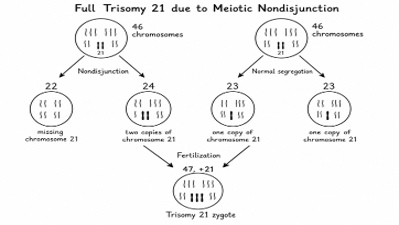
- Trisomy 21—Down syndrome: characteristic craniofacial morphology, hypotonia, variable intellectual disability, increased congenital heart defects and particular later-life health risks.
- Trisomy 18—Edwards syndrome: severe developmental impairment, growth restriction, characteristic hand/foot anomalies and high infant mortality.
- Trisomy 13—Patau syndrome: severe neurodevelopmental abnormalities, cleft lip/palate, polydactyly and multiple congenital defects; survival is commonly limited.
Complete autosomal monosomies are generally incompatible with survival because loss of an entire autosome creates severe gene-dosage imbalance. Risk of some trisomies, especially trisomy 21, increases with maternal age.
Sex-chromosome aneuploidies:
- 45,X—Turner syndrome: phenotypic female, short stature, gonadal dysgenesis/ovarian insufficiency, infertility and possible cardiovascular anomalies.
- 47,XXY—Klinefelter syndrome: phenotypic male, tall stature, testicular insufficiency, reduced fertility and sometimes gynaecomastia or learning difficulties.
- 47,XXX and 47,XYY: phenotypes are often milder and variable; some individuals remain undiagnosed.
Why effects differ: Additional X chromosomes are partly buffered by X-inactivation (Lyonisation), while the Y chromosome contains relatively few genes. However, some X-linked genes escape inactivation, so sex-chromosome aneuploidies still produce characteristic phenotypes.
Post-zygotic mitotic nondisjunction may produce mosaicism; severity then depends partly on the proportion and tissue distribution of abnormal cell lines.
Conclusion: The effects of numerical chromosomal aberrations reflect chromosome-specific gene dosage. Autosomal imbalances generally produce broader systemic effects, whereas X-inactivation makes several sex-chromosome aneuploidies more compatible with survival.
Want feedback on your answer?
Join the Anthropology workshop or get structured answer-writing guidance from VAID ICS.