
Canalization and Catch-up Growth — 2026 Paper I
Canalization and catch-up growth.
Model Answer
VAID ICSApproach
|
Model Answer
Introduction: Human growth is genetically regulated but environmentally responsive. Canalization expresses developmental stability, 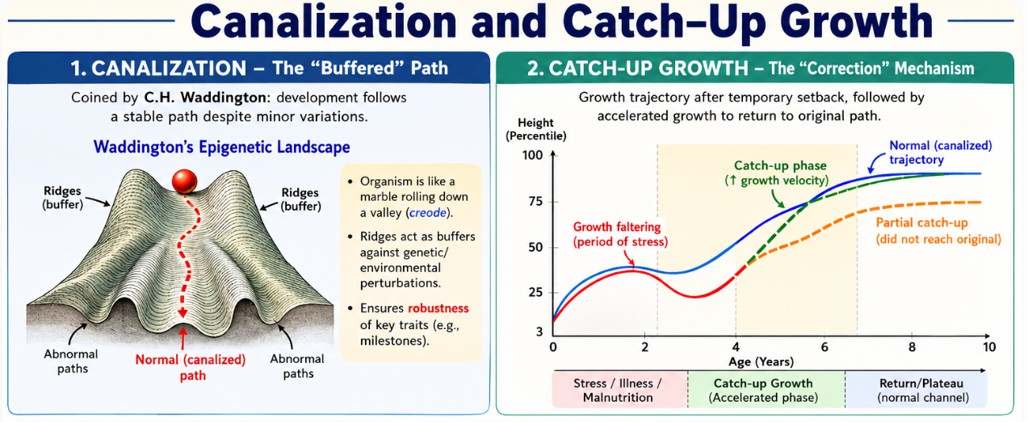
whereas catch-up growth demonstrates regulated plasticity after growth has been temporarily inhibited.
Canalization: C. H. Waddington (1942) used the term for the tendency of development to follow a relatively stable pathway despite moderate genetic or environmental disturbance. His “epigenetic landscape” metaphor depicts development moving within channels. In human auxology, J. M. Tanner’s observation that healthy children generally track a growth centile illustrates this relative stability.
Catch-up growth: Prader, Tanner and von Harnack (1963) described catch-up growth as growth velocity above that expected for age after removal of an inhibitory factor such as malnutrition, chronic infection or endocrine disturbance. The child may move back toward the earlier growth trajectory.
| Normal channel → growth insult → reduced growth velocity → recovery → temporary acceleration → earlier channel |
Catch-up is not always complete. Its extent depends on age at insult, severity and duration of deprivation, nutritional rehabilitation, endocrine status, chronic disease and whether a sensitive developmental period has been crossed. Severe or prolonged early-life deprivation may leave permanent stunting.
Conclusion: Canalization represents developmental buffering; catch-up growth represents compensatory plasticity. Together they show that human growth follows a regulated trajectory without being rigidly genetically predetermined.
Want feedback on your answer?
Join the Anthropology workshop or get structured answer-writing guidance from VAID ICS.