
Nuclear and Mitochondrial DNA: Distinguishing Features — 2026 Paper I
Question · 2026 · Paper I · 10 Marks
Distinguishing features of nuclear and mitochondrial DNA.
Model Answer
VAID ICSApproach
|
Model Answer
Introduction: Humans possess a large nuclear genome and a small mitochondrial genome. Their different Answer structure and Flows and inheritance patterns give them different uses in biological anthropology and population genetics.
| Feature | Nuclear DNA | Mitochondrial DNA |
| Location | Nucleus; 23 chromosome pairs | Mitochondria in cytoplasm |
| Answer structure and Flow | Linear chromosomes; ~3.2 billion bp haploid genome | Small circular molecule; ~16.6 kb |
| Genes | Vast majority of human genes | 37 genes—13 proteins, 22 tRNAs, 2 rRNAs |
| Inheritance | Biparental for autosomes | Predominantly maternal |
| Recombination | Extensive during meiosis | Generally treated as non-recombining for lineage studies |
| Copy number | Usually two copies per autosomal locus in diploid cells | Many molecules per cell |
| Variation | Genome-wide ancestry/admixture | Maternal haplogroups; heteroplasmy can occur |
Anthropological significance: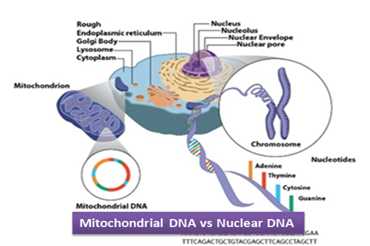
- Nuclear DNA samples ancestry across thousands of loci and is powerful for admixture, kinship, population history and selection.
- mtDNA’s high copy number historically made it easier to recover from degraded bone, teeth or hair, giving it major importance in ancient-DNA and forensic studies.
- Maternal inheritance permits reconstruction of maternal lineages.
However, mtDNA traces only one maternal genealogical pathway and should not be equated with the complete history of a population.
Conclusion: Modern molecular anthropology combines genome-wide nuclear DNA with mtDNA: nDNA provides broad biparental history, while mtDNA provides a high-copy maternal lineage record.
Want feedback on your answer?
Join the Anthropology workshop or get structured answer-writing guidance from VAID ICS.