
Mousterian Tool Tradition, Culture and Its Makers — 2025 Paper I
Write a note on Mousterian tool tradition, Mousterian culture and its makers.
Model Answer
VAID ICSIntroduction The Mousterian is a Middle Palaeolithic tool industry named after the rock shelter of Le Moustier in the Dordogne region of France. Flourishing roughly between 300,000 and 30,000 years ago, it represents a major technological leap from the preceding Acheulean (Lower Palaeolithic) tradition, shifting the focus from core tools to specialized flake tools.
- The Mousterian Tool TraditionThe hallmark of the Mousterian tradition is the Levallois technique(prepared-core technique).
- Technique: The toolmaker carefully prepares a tortoise-shaped core so that a single strike removes a pre-shaped, highly standardized flake. This shows advanced cognitive planning and efficient raw material usage.
- Tool Typology: It is predominantly a flake-tool industry. Key tools include:
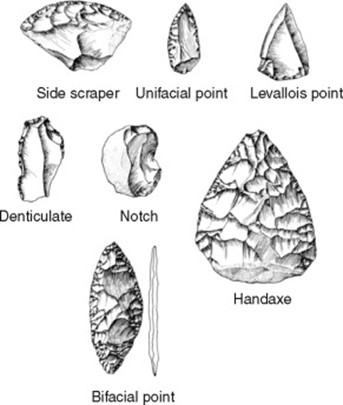
- Side Scrapers (Racloirs): Used for dressing animal hides.
- Mousterian Points: Hafted onto wooden shafts to make spears.
- Denticulates and Notches: Used for woodworking and sawing.
- Makers of the MousterianWhile strictly associated with the Middle Palaeolithic, the Mousterian is not a monolithic biological marker:
- Europe & Western Asia: Exclusively made by Neanderthals (Homo neanderthalensis).
- The Levant & Africa: Made by both Neanderthals (e.g., at Kebara Cave) and Early Anatomically Modern Humans (Homo sapiens at Skhul and Qafzeh). Thus, tool types did not strictly define species.
- Mousterian Culture and LifestyleMousterian sites reveal a complex, highly adaptive culture capable of surviving Ice Age conditions:
- Settlement & Fire: Intensive use of rock shelters and caves. Hearths indicate controlled use of fire for warmth, cooking, and protection.
- Subsistence: Apex predators engaging in close-quarter cooperative hunting of megafauna (mammoths, woolly rhinos).
- Compassion and Care: Skeletal remains at Shanidar Cave (Iraq) show individuals who survived severe trauma (amputations, blindness) for years, proving social care existed.
- Symbolic Behavior & Burials: First evidence of intentional burials (e.g., La Chapelle-aux-Saints, France, and flower pollen in Shanidar burials).
- The Mousterian Debate (Typology vs. Function)A famous theoretical debate exists regarding the variations found in Mousterian tool assemblages:
- François Bordes (Cultural View): Identified four distinct "facies" (types) of Mousterian tools and argued they represented different distinct tribes or cultural groups.
- Lewis Binford (Functional View): Argued that the variations did not represent different tribes, but rather different activity sets (e.g., hunting camps vs. base camps) used by the same people in different seasons.
Conclusion The Mousterian tradition marks a watershed moment in human evolution. Through the Levallois technique and complex social behaviors like burials and elderly care, its makers demonstrated a level of cognitive sophistication, ecological adaptation, and cultural transmission that laid the direct groundwork for the Upper Palaeolithic revolution.
Want feedback on your answer?
Join the Anthropology workshop or get structured answer-writing guidance from VAID ICS.