
Magdalenian Cultural Tradition of Europe — 2026 Paper I
Write a detailed note on the characteristic features, chronology, geographical distribution, tool types and lifeways of Magdalenian cultural tradition of Europe.
Model Answer
VAID ICSApproach
|
Model Answer
Introduction
The Magdalenian, named after the rock shelter of La Madeleine in Dordogne, France, represents one of the most developed cultural traditions of the Late Upper Palaeolithic of Europe. It flourished during the Late Glacial, broadly around 20,000–14,000 calibrated years BP in its classic western European sequence, though its chronology varies regionally and related final traditions continued later.
- Chronology and cultural position
The Magdalenian developed after the Last Glacial Maximum and underwent Lower, Middle and Upper/Late phases, distinguished particularly through changing lithic and osseous technologies.
A useful broad sequence is:
Lower Magdalenian → Middle Magdalenian → Upper/Late Magdalenian → Azilian/Final Palaeolithic traditions
In south-west France, the classic Middle–Upper Magdalenian broadly spans c. 18,000–14,000 cal BP, with the Upper Magdalenian giving way to the Azilian around 14,000 cal BP.
Clarification: Magdalenian is fundamentally Late Upper Palaeolithic, not Mesolithic.
- Geographical distribution
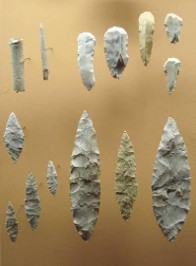
Its cultural heartland was the Franco-Cantabrian region:
South-western France ↔ Pyrenees ↔ Cantabrian/northern Spain
During climatic amelioration, Magdalenian populations expanded northward and eastward into Belgium, Germany, Switzerland and parts of Central Europe, ultimately reaching as far as southern Poland.
UPSC map: Shade southern France + northern Spain as the core and show arrows towards central/north-western Europe.
- Tool technology
The Magdalenian combined sophisticated stone technology with an exceptionally developed bone–antler industry.
| Technology | Characteristic forms |
| Lithic | Blades, bladelets, burins, endscrapers, backed/retouched bladelets |
| Bone/antler | Projectile points, needles, awls, perforated batons, spear-throwers |
| Late diagnostic forms | Barbed harpoons and increasingly elaborate hunting armatures |
Antler exploitation became increasingly intensive and diverse during the Middle and Upper Magdalenian.
Hence, instead of saying “stone tools disappeared”, the more accurate formulation is:
Lithic toolkit continues + osseous technology becomes exceptionally prominent
- Lifeways and economy
Magdalenian communities were mobile hunter-gatherers adapted to changing Late Glacial environments.
Their subsistence included:
- reindeer and horse in many areas;
- bison, ibex and red deer according to local ecology;
- increasing use of fish and aquatic resources in some later contexts.
Seasonal movements followed animal herds, river systems and raw-material sources. Caves, rock shelters and open-air camps were occupied.
The circulation of exotic flint, shells, ornaments and decorated objects across long distances indicates extensive exchange and social networks, rather than isolated hunting bands.
Bone needles, tailored clothing and diverse hunting equipment also reflect adaptation to cold and seasonally variable environments.
- Art and symbolic life
Art constitutes one of the most striking features of the Magdalenian.
Parietal art: cave-wall and ceiling paintings/engravings
Portable art: decorated bone, antler, stone, plaques and personal ornaments
Animal figures—especially horse, bison and other large mammals—predominate, whereas human representations are comparatively uncommon.
The Franco-Cantabrian region contains particularly rich Magdalenian artistic traditions.
Interpretation of art
Early scholars such as Salomon Reinach and Henri Breuil interpreted much Palaeolithic imagery through sympathetic or hunting magic—representation of animals supposedly aiding hunting success.
However, this should be presented only as a classic interpretation, not settled fact. Contemporary research also examines art in terms of symbolism, communication, territorial identity, social memory and ritual; recent analysis challenges the assumption that animal imagery simply depicts hunting activity.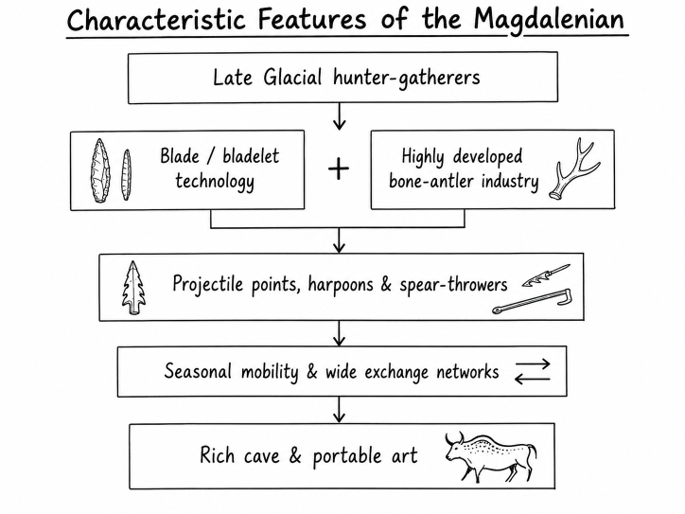
Conclusion
The Magdalenian represents the culminating florescence of Late Upper Palaeolithic hunter-gatherer adaptations in much of western and central Europe. Its distinction lies not merely in stone technology but in the exceptional development of bone–antler weaponry, diversified subsistence, long-distance social networks and elaborate symbolic art. As Late Glacial environments changed, Magdalenian traditions gradually transformed into Final Palaeolithic complexes such as the Azilian, rather than simply becoming “Mesolithic.”
Want feedback on your answer?
Join the Anthropology workshop or get structured answer-writing guidance from VAID ICS.