US–Venezuela Crisis
• UN Charter principles on use of force and self-defence were significantly strained.
• Narco-terrorism narrative broadened justification for unilateral military action.
• Oil wealth and great-power rivalry heightened Venezuela’s geopolitical significance.
• India’s response upheld strategic autonomy and non-intervention in line with its foreign policy tradition.
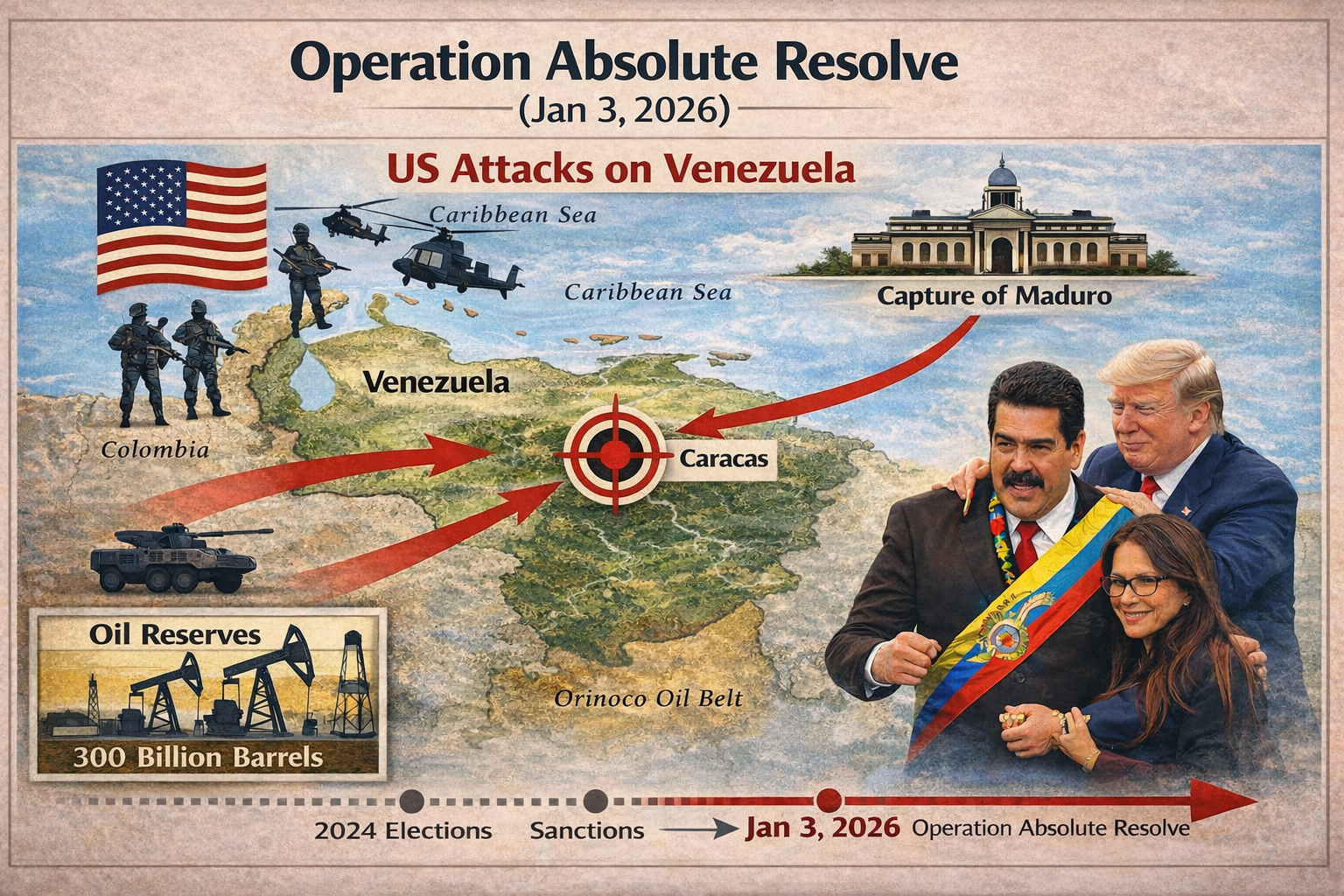
1. Nature of the Event: The January 2026 military operation carried out by the United States in Caracas marked a decisive rupture in contemporary international relations. The capture of Venezuelan President Nicolás Maduro by American special forces constituted one of the rare modern instances where a sitting head of state was apprehended by a foreign military without explicit UN authorisation. This action immediately transformed a long-running political standoff into a global geopolitical event with far-reaching legal and strategic implications. It signalled a willingness by a major power to move beyond sanctions and diplomacy toward direct coercive action, thereby challenging long-standing norms of state conduct.
2. Why It Matters Globally: The operation reverberated far beyond Latin America, igniting intense debates about sovereignty, legitimacy of governments, and the evolving thresholds for the use of force. It challenged the assumption that state leaders enjoy de facto immunity from foreign military action and exposed the widening gap between power politics and the rules-based international order. For many states, the episode raised concerns that political instability or contested legitimacy could increasingly invite external intervention, weakening established principles of non-interference.
3. Venezuela’s Prolonged Political and Economic Breakdown
3.1 Institutional Decay and Democratic Erosion: Venezuela’s crisis unfolded through gradual institutional decay rather than sudden collapse. Over the past decade, executive dominance expanded while judicial independence, legislative oversight, and electoral credibility steadily weakened. Opposition leaders were disqualified, detained, or pushed into exile, narrowing political space and eroding public trust. As democratic mechanisms hollowed out, governance increasingly relied on coercive instruments and security agencies rather than popular consent.
3.2 Humanitarian and Social Consequences: Economic mismanagement compounded political decay and produced severe social distress. Hyperinflation wiped out wages and household savings, public services deteriorated sharply, and shortages of food and medicines became widespread. Nearly eight million Venezuelans migrated abroad, transforming an internal governance failure into a regional humanitarian crisis that strained neighbouring countries’ economies, social cohesion, and political systems.
4. Collapse of the Oil Sector and Strategic Vulnerability
4.1 Decline of Production and State Revenue: Oil has long been the backbone of Venezuela’s economy and its principal source of fiscal revenue. Production declined from about 3.5 million barrels per day in the late 1990s to under one million barrels per day by 2025 due to mismanagement, corruption, chronic underinvestment, sanctions, and technical decay within PDVSA. This collapse deprived the state of resources required to sustain welfare programmes, infrastructure, and administrative capacity.
4.2 Geopolitical Dependence: As domestic capacity eroded, Venezuela became increasingly dependent on external partners, particularly China and Russia, for credit, technology, and diplomatic protection. Economic vulnerability thus translated into strategic dependence, drawing Venezuela into broader great-power rivalries and heightening its geopolitical salience for the United States.
5. Evolution of US Policy Towards Venezuela
5.1 From Sanctions to Coercive Isolation: During his first term, Donald Trump relied on sanctions, asset freezes, and diplomatic recognition of opposition leadership to pressure the Maduro government. These measures weakened the economy but failed to dislodge the regime, instead consolidating Maduro’s reliance on the military and foreign allies for political survival.
5.2 Criminalisation of the Regime: After Trump’s return to power in 2025, Washington reassessed its approach. The unsealing of indictments accusing Maduro of narco-terrorism reframed Venezuela from a political challenge into a security threat. This legal and rhetorical shift blurred the boundary between law enforcement and military action, providing the justification for direct intervention.
6. Operation Absolute Resolve:
6.1 Tactical Design and Execution: Operation Absolute Resolve was conceived as a short-duration, high-intensity special forces mission rather than a conventional invasion. US forces targeted the Miraflores Presidential Palace and extracted Maduro and First Lady Cilia Flores, aiming to decapitate the regime’s leadership without prolonged occupation. The operation reflected contemporary doctrines that prioritise speed, precision, and psychological impact over territorial control.
6.2 Casualties and Political Shockwaves: The mission resulted in more than 80 reported deaths, including Venezuelan security personnel and civilians. The killing of 32 Cuban military advisers highlighted Havana’s deep involvement in Venezuela’s internal security architecture. Politically, the capture of a sitting president shattered regional assumptions about immunity from foreign intervention and sent shockwaves across Latin America.
7. Strategic Motivations Behind the Intervention
7.1 Reassertion of Hemispheric Dominance: At a strategic level, the intervention reflected a revival of hemispheric assertiveness inspired by the Monroe Doctrine tradition. The Trump administration explicitly framed Latin America as a strategic priority and sought to deny extra-regional powers influence in the Western Hemisphere.
7.2 China, Russia, and Energy Geopolitics: China’s dominance in Venezuelan oil purchases and infrastructure investments, combined with Russian military cooperation, alarmed Washington. Control over Venezuelan oil thus became not merely an energy concern but a geopolitical lever aimed at constraining Chinese and Russian influence close to US borders.
8. Narco-Terrorism and the Redefinition of Security Threats
8.1 US Narrative and Justification: The United States justified the intervention through the narco-terrorism framework, alleging that Venezuela’s state apparatus actively facilitated drug trafficking networks threatening regional and domestic security. This narrative sought to place the operation within the global counter-terrorism paradigm rather than traditional regime-change politics.
8.2 Risks of Norm Expansion: Critics argue that equating criminal activity with armed attack dangerously expands the scope of legitimate military action. Such redefinition risks lowering the threshold for the use of force and normalising unilateral interventions, thereby increasing instability in international relations.
9. International Law Under Severe Strain
9.1 UN Charter and Use of Force: Article 2(4) of the United Nations Charter prohibits the use of force against state sovereignty, while Article 51 permits self-defence only in response to an armed attack. The US claim that state-linked narco-terrorism constitutes such an attack stretches established interpretations of international law.
9.2 Erosion of Collective Security: The International Court of Justice has historically adopted restrictive readings of self-defence. If unilateral interpretations prevail, the authority of international adjudication and collective security mechanisms may erode further, weakening the credibility of the UN system.
10. Domestic Debate Within the United States
10.1 Executive Power vs Congressional Oversight: The operation reignited debate over executive authority and the War Powers Resolution, with critics arguing that congressional oversight was bypassed. Supporters defended the action as a necessary and time-sensitive response to an urgent security threat.
10.2 Implications for Democratic Accountability: This debate reflects a broader tension within democracies between rapid security responses and constitutional restraint. The precedent set by the Venezuela operation may shape future US military engagements abroad.
11. India’s Response and Strategic Autonomy
11.1 Diplomatic Positioning: India responded with a carefully worded statement expressing deep concern and calling for peaceful dialogue. By avoiding explicit endorsement or condemnation, India reaffirmed its commitment to sovereignty, non-intervention, and regional stability.
11.2 Consistency with Indian Foreign Policy: India’s stance reflects its long-standing emphasis on strategic autonomy, multilateralism, and adherence to UN Charter principles, while also preserving diplomatic flexibility and safeguarding broader economic and energy interests.
12. Global Reactions and Regional Anxiety
12.1 Response of Major Powers: Russia and China condemned the operation as neo-imperial overreach, while regional powers such as Brazil and Colombia warned of destabilisation.
12.2 Latin American Concerns: For many Latin American states, the episode revived historical fears of external intervention, with growing anxiety that contested elections or internal instability could be used to justify foreign military action.
13. Uncertain Future for Venezuela
13.1 Political Vacuum and Internal Risks: Maduro’s capture does not automatically translate into stability or democratic transition. Venezuela faces uncertainty over military loyalty, governance arrangements, and opposition unity, raising the risk of internal fragmentation.
13.2 Need for Inclusive Resolution: The long-term outcome will depend on inclusive political dialogue, credible transitional mechanisms, and restrained external involvement. Without these, Venezuela risks prolonged instability shaped more by great-power rivalry than domestic reconciliation.
UPSC Mains Expected Exam Questions
GS PAPER II (International Relations, Polity)
1. The US military operation in Venezuela has reopened debates on sovereignty and the permissible use of force in international relations. Examine the issue in the context of the UN Charter and India’s stated position. (10 Marks)
2. Unilateral military interventions justified on grounds of legitimacy deficits and security threats pose serious challenges to the rules-based international order. Critically analyse this statement with reference to the US intervention in Venezuela. (15 Marks)
GS PAPER III (Security, Economy, Energy)
3. Narco-terrorism is increasingly being used as a justification for cross-border military action. Discuss its implications for international security using the Venezuela case. (10 Marks)
4. Energy security and great-power rivalry have transformed resource-rich but institutionally weak states into geopolitical flashpoints. Analyse this statement in the context of Venezuela’s oil resources and US–China competition. (15 Marks)
Frequently Asked Questions
1. When did the US military operation in Venezuela take place?
The operation was conducted in January 2026.
2. Which country carried out the military operation in Caracas?
The operation was carried out by the United States of America.
3. Which city was the primary target of the operation?
The operation was centred in Caracas, the capital of Venezuela.
4. Who was the Venezuelan President captured during the operation?
Nicolás Maduro, the sitting President of Venezuela, was captured.
5. Was the operation authorised by the United Nations Security Council?
No, the operation was conducted without explicit UN Security Council authorisation.
6. What was the name of the US military operation?
The operation was called Operation Absolute Resolve.
7. Which Venezuelan location was directly targeted?
The Miraflores Presidential Palace was the primary target.
8. Which foreign country’s military advisers were killed during the operation?
Cuban military advisers were among those killed.
9. Which UN Charter provision prohibits the use of force against state sovereignty?
Article 2(4) of the UN Charter.
10. Which UN Charter provision deals with self-defence?
Article 51 of the UN Charter.
11. Which state-owned company manages Venezuela’s oil sector?
PDVSA (Petróleos de Venezuela, S.A.).