

The most common pattern among first-time Anthropology aspirants is this: they spend their opening weeks collecting books, watching overview videos, and comparing notes formats — without ever reading the actual syllabus.
Most beginners go through this phase. When you are new to a subject, gathering materials feels productive. It gives the impression that preparation has begun. But Anthropology at the UPSC level is a subject that punishes aimless accumulation and rewards structured thinking. The aspirants who struggle most in the first few months are rarely those who studied less — they are those who studied without knowing what they were preparing for.
Anthropology is not a difficult subject. What makes it feel difficult is beginning without a clear sense of direction.
This article is written for aspirants who have already made the decision — “I am taking Anthropology optional” — and now want to know exactly how to begin.
Can a Beginner with No Anthropology Background Choose This Subject?
Yes. And this is not reassurance for the sake of it — it is simply accurate.
Most candidates who perform well in Anthropology optional did not study the subject in their undergraduate programmes. This is worth understanding clearly, because the anxiety around “I have no Anthropology background” is one of the most common things beginners carry into their first few weeks — and it is largely unnecessary.

Consider what the UPSC Anthropology syllabus actually contains. Paper 1 covers evolution, genetics, and physical anthropology — areas where science and engineering graduates are often already comfortable. It covers cultural anthropology and major theoretical frameworks — areas where humanities graduates tend to have natural affinity. Paper 2 covers Indian society, tribal communities, social change, and development — areas that any informed Indian citizen has encountered through general reading, current affairs, and everyday observation.
The syllabus is not designed for specialists. It is designed to test whether a candidate can understand, analyse, and apply anthropological ideas — regardless of where they studied.
Why Your Background Doesn’t Hold You Back
An engineering graduate who is patient with conceptual work and comfortable drawing diagrams will find Anthropology’s structure logical. A medical graduate who has studied human biology will find Physical Anthropology familiar. A humanities graduate will find that kinship theory, social change, and cultural anthropology sit close to what they already know. A commerce graduate — who may feel most uncertain — will discover that Anthropology requires no prior technical knowledge at all, and that a fresh mind approaching the subject systematically is often an advantage.
Key Takeaway
Your graduation background is not a limiting factor. What matters is how systematically you approach the syllabus.
👉 If you are still evaluating whether Anthropology is the right optional for you, read: Is Anthropology a Good Optional for UPSC? — an analysis of Anthropology’s scoring patterns and suitability across different candidate profiles.
Understand the Anthropology Syllabus Before Buying Any Book
This is the single most important instruction in this article, and it is the one most beginners skip.
The instinct, when starting a new subject, is to find “the best book” and begin reading. But in Anthropology, this approach almost always leads to a specific kind of confusion: you read broadly, you cover many pages, and yet you cannot tell what is exam-relevant and what is not. You are unable to judge whether you are making progress. You cannot connect what you are reading to what UPSC actually asks.
Two days spent reading the syllabus carefully — before touching any book — will change how you study everything that follows.
Anthropology has two papers with distinctly different characters. Understanding this distinction early shapes everything that follows — what you read, in what sequence, and how you frame your answers.
Paper 1 is fundamentally theoretical and conceptual. It asks you to understand how human beings evolved biologically, how physical variation developed across populations, what the major archaeological findings tell us about human prehistory, how genetics explains heredity and adaptation, and what the principal schools of anthropological thought have argued about culture, society, and human behaviour. This paper requires you to build a conceptual vocabulary — an understanding of terms, frameworks, and arguments that will inform everything you write.
Paper 2 is application-based and India-specific. It asks you to understand the structure of Indian society, the situation of tribal communities in India, the processes of social change, and how anthropological methods and perspectives apply to development questions in the Indian context. This paper feels closer to general studies for many aspirants, which is partly why its demands are underestimated.
Paper 1 vs Paper 2
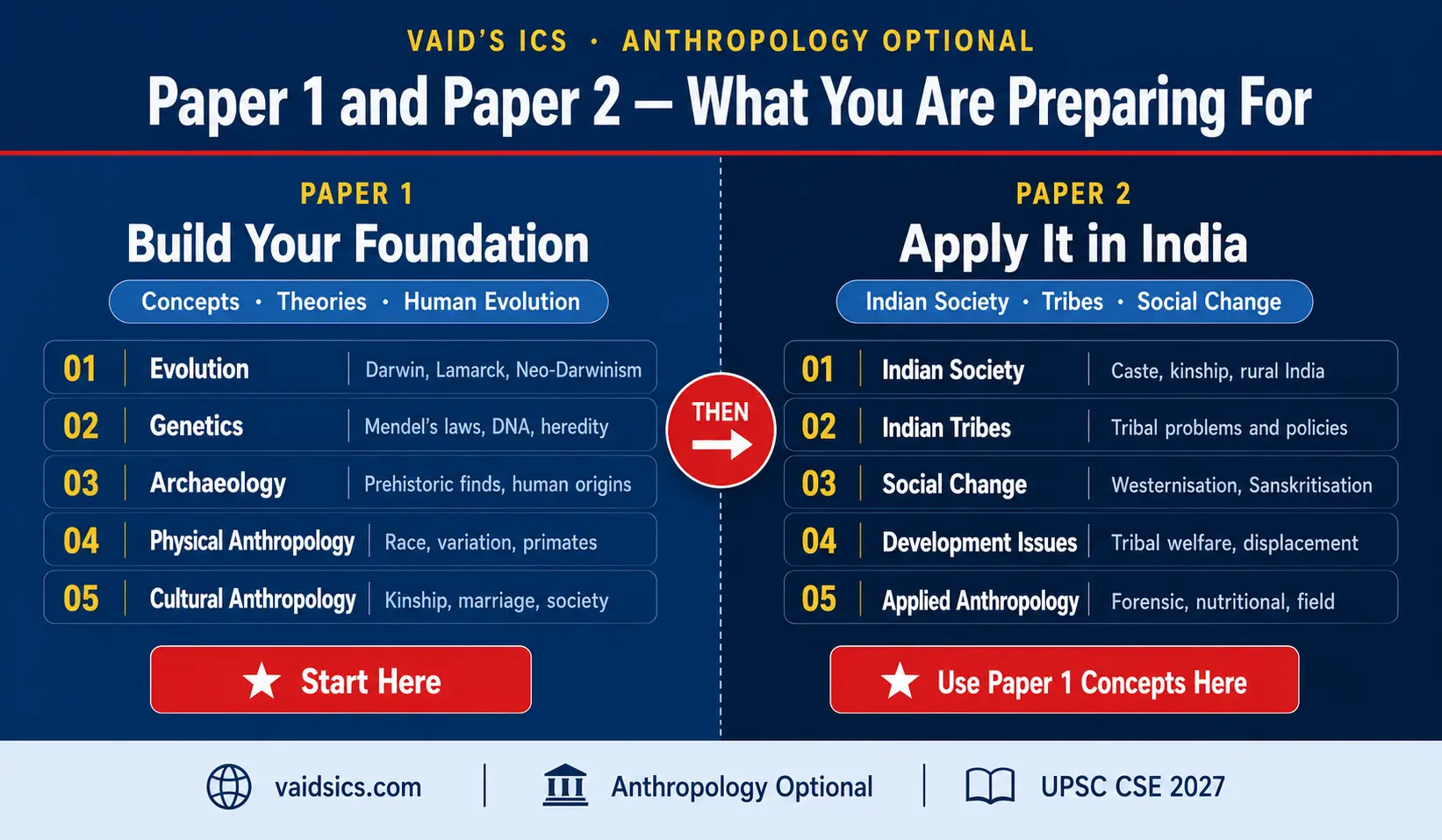
The sequencing point that most beginners get wrong: Paper 2 should not be studied before Paper 1.
Paper 2 feels easier at first glance. Indian tribes, social change, rural development — these topics seem familiar. Many aspirants begin with Paper 2 for this reason, treating it as a confidence-building exercise before tackling the “harder” Paper 1. In practice, this has real consequences for answer quality.
The concepts you build in Paper 1 — theories of social structure, kinship systems, evolutionary frameworks, the anthropological understanding of culture — are precisely the tools you need to write analytical Paper 2 answers. An answer on tribal development that draws on evolutionary theory, or an answer on social change that engages with anthropological theories of culture, is a fundamentally stronger answer than one written purely from descriptive knowledge. Paper 1 gives you the vocabulary. Paper 2 is where you apply it.
Study Paper 1 first. The initial discomfort of unfamiliar concepts is the investment that pays off when you reach Paper 2.
👉 For a complete chapter-wise breakdown with topic weightage: Anthropology Syllabus Explained
What Should Be Your First Book?
Most beginners approach this question the wrong way. They ask: “Which is the best book for Anthropology?” The better question is: “What should I read, and in what order?”
These are different questions with different answers. The first leads you toward a ranked list of titles. The second leads you toward a reading sequence that builds understanding progressively.
Start with class notes — specifically, notes that are written to the UPSC Anthropology syllabus, not general academic notes on the subject. The reason is important to understand. A book like Ember and Ember’s An Introduction to Anthropology is written for undergraduate students of the discipline. It is comprehensive, detailed, and not structured around what UPSC asks. If you begin with it, you will spend considerable time reading material that is not exam-relevant, and you will struggle to identify what to prioritise.
Class notes, by contrast, are already filtered. Someone has made the judgment calls about what matters for UPSC Anthropology, what depth is appropriate, and how topics connect to each other in an exam context. They are a distilled starting point, not a shortcut.
Where Each Book Fits
After your first reading of class notes, Ember and Ember becomes genuinely valuable — not as an introduction, but as a resource for conceptual depth on specific topics. When you are struggling to understand a concept in your notes, or when a PYQ asks something your notes cover only briefly, Ember and Ember fills that gap. That is its correct role.
P. Nath’s work on Physical Anthropology serves a similar reinforcing function. It belongs after your first reading, when you know specifically which areas need more depth. Braintree notes are revision material — useful from Month 5 onwards when you are consolidating, not at the beginning when you are building.
Key Takeaway
Begin with focused, syllabus-oriented material. Expand to broader reference books as your understanding deepens. Do not reverse this sequence.
📌 A Practical Note
Many aspirants spend their first two or three weeks researching which notes are “better” — comparing sources, asking in forums, reading reviews. This research becomes a form of procrastination. Choose a reliable set of class notes and begin. The difference between two good sets of notes is far smaller than the difference between starting and not starting.
👉 For a complete resource guide with chapter-level recommendations: Anthropology Booklist for UPSC
What Should You Study in the First 30 Days?
The first thirty days in Anthropology preparation are about orientation, not coverage. The goal is not to finish topics — it is to understand the landscape before you begin moving through it.
In practice, this makes a bigger difference than most students expect. An aspirant who spends Day 1 reading the syllabus carefully and scanning ten years of PYQs will study the entire subject differently from one who begins reading a book on Day 1 without that context. The first aspirant knows what is important before they study anything. The second discovers importance only retrospectively — and often re-reads material once they understand what UPSC actually asks.
First 30 Days: Week-by-Week Plan
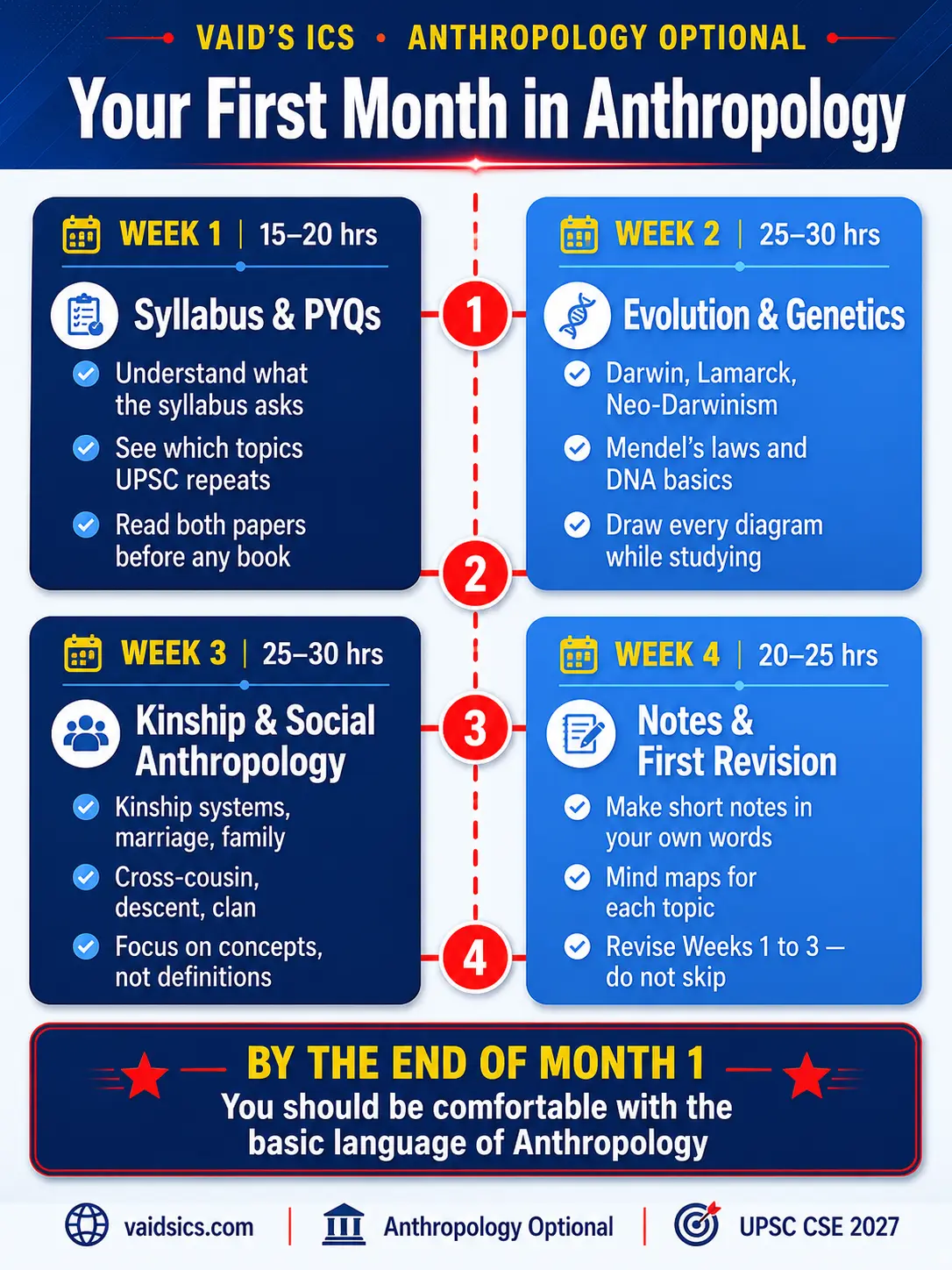
Week 1 — Syllabus and PYQ orientation
Spend Days 1 and 2 reading the full syllabus — Paper 1 and Paper 2 — twice. The first reading will feel abstract. Many terms will be unfamiliar. This is expected. Read anyway. By the second reading, you will begin to notice patterns: how topics cluster, which areas carry more content, where Paper 1 and Paper 2 connect.
From Days 3 to 5, scan the last ten years of Previous Year Questions. Read the questions only — do not attempt to answer them. You are not testing yourself. You are building a mental map of what UPSC considers important. Certain topics recur consistently: Evolution and its mechanisms, Genetics and its application to human populations, Kinship systems, Indian tribal communities. Note these. They deserve proportionally more attention throughout your preparation.
Days 6 and 7 are for reflection. Map the recurring PYQ topics against the syllabus. Notice where questions are concentrated. This gives you a prioritisation framework before you have read a single page of study material.
Week 2 — Evolution and Genetics
These two topics form the backbone of Paper 1. Begin with the major evolutionary theories: Darwin’s natural selection, Lamarck’s inheritance of acquired characteristics, and Neo-Darwinism’s synthesis of genetic understanding with evolutionary theory. Do not simply memorise these — understand what problem each theory was trying to solve and where each was later found incomplete or superseded.
Genetics in Anthropology is not advanced molecular biology. You need a working understanding of Mendel’s laws, basic DNA and chromosome structure, and how genetic variation relates to human population differences. The depth required is sufficient to explain and apply these concepts — not to solve problems at a biochemistry level.
Begin drawing diagrams as you study, not after. Evolution trees, DNA structure, Punnett squares — draw each one while reading about it. This builds retention and develops the habit of visual representation in answers.
Week 3 — Social Anthropology foundations
The core concepts here are kinship, marriage, and family. These may seem straightforward, but Anthropology’s treatment of them is technical in ways beginners often underestimate.
Kinship in Anthropology is not simply “family relations.” It involves a system of terminology — cross-cousins versus parallel cousins, patrilineal versus matrilineal descent, different forms of clan organisation — that requires patient, careful reading. Understand the underlying logic: how different societies organise relationships, why these distinctions matter anthropologically, and how kinship systems connect to marriage rules and property inheritance.
Marriage in Anthropology covers endogamy and exogamy as social principles, different forms of polygamy, and the debate between alliance and descent theories of kinship. Family forms — nuclear, joint, extended — are familiar to most Indian aspirants, but UPSC questions require comparative and analytical treatment, not just description.
Week 4 — Consolidation
Do not move to new content in Week 4. Write short notes in your own words from Weeks 1 through 3. Build simple mind maps for each major topic. Spend two hours daily revisiting earlier material.
The purpose is retention, not coverage. A student who has genuinely consolidated the first three weeks is in a far stronger position than one who has rushed through four weeks of content with nothing sticking.
By the End of Day 30
You should be able to explain the core ideas of Evolution, Genetics, and Kinship in plain language without consulting notes. If you can, your foundation is correctly built.
👉 For a methodical approach to PYQ analysis from Week 1: Anthropology PYQ Analysis
Common Mistakes Beginners Make
These are not abstract warnings. They are patterns that appear consistently among aspirants who struggle in the early months — and most are entirely avoidable with awareness.
Common Mistakes and Better Approaches
| Mistake | Better Approach |
|---|---|
| Buying many books at the start | Follow 2–3 resources in a clear sequence |
| Ignoring PYQs until late in preparation | Scan PYQs from Week 1 |
| Delaying answer writing until syllabus is complete | Begin after completing approximately one-third of the syllabus |
| Skipping diagrams | Practice diagrams from Month 2 onwards |
| Studying without a topic sequence | Follow a month-wise plan |
| Starting Paper 2 before Paper 1 | Complete Paper 1 conceptual base first |
| Memorising without understanding | Build conceptual clarity before memorising facts |
The resource accumulation mistake is worth examining closely, because it feels productive while it is happening. A new aspirant searches for “best books for Anthropology optional” and finds many different recommendations. They order four or five texts. Each looks useful. The desk fills with good intentions. But having five books open simultaneously means none are read with the depth they require. Coverage becomes patchy. Confidence remains low. The preparation that looks comprehensive from the outside is actually dispersed and shallow.
The PYQ mistake is quieter but equally costly. Many aspirants treat PYQs as a testing tool — something to attempt near the end, after studying everything. But PYQs are a study tool. Reading them before and during preparation tells you how UPSC frames questions, what depth of analysis is expected, and which topics receive the most consistent attention.
The diagram mistake is the most common among aspirants from non-science backgrounds. Diagrams feel decorative — something to include if there is time, but not essential. This misunderstands what diagrams do in Anthropology answers. A well-drawn diagram of a kinship system, an evolutionary tree, a DNA replication process, or a tribal settlement pattern communicates understanding in a way that prose cannot always replicate. Diagrams are not decorative. They are part of the answer.
⚠️ The Most Consequential Structural Mistake
Starting Paper 2 before Paper 1. Paper 2 answers without Paper 1 conceptual grounding tend to be descriptive rather than analytical. They describe what tribal communities face without engaging with the anthropological frameworks that explain why those patterns exist. The sequence is not arbitrary.
When Should You Start Answer Writing?
After completing approximately one-third of the syllabus — not after finishing it entirely.
Most beginners who delay answer writing follow the same logic: “I will finish the syllabus first, then start writing.” What usually happens is that the syllabus takes months to complete. By the time an aspirant following this pattern begins writing answers, they have never practised the skill that determines how their knowledge is evaluated. They have information. They do not yet have answers.
Answer writing is a skill that develops separately from content knowledge. A candidate who knows the theories of evolution thoroughly but has never written an Anthropology answer under time pressure is not prepared for the exam. A candidate who begins writing rough, imperfect answers from Month 2 and writes consistently for five months develops something content study alone cannot build: the ability to construct an analytical response, use diagrams appropriately, and complete answers within the time available.
How to Write Your Early Answers
Start with two answers per day from Month 2. They do not need to be good. They need to be written. Increase to three per day by Month 3, five by Month 4, seven by Month 5 alongside a test series.
Write by hand from the very beginning. The exam is handwritten. The speed, stamina, and spatial planning required to write a strong handwritten answer under pressure are different from typing, and they develop only through practice. Include a diagram in every answer — even a rough, simple one. This builds the habit before it becomes necessary.
Get at least one answer evaluated each week by a mentor or peer who can give honest feedback. Reading your own answers repeatedly is far less useful than a single honest external assessment.
👉 For a complete guide with sample answers and evaluation criteria: Anthropology Answer Writing Strategy (coming soon)
How Long Does Anthropology Take to Complete?
The honest answer depends on how much time you can give each day — and whether your preparation is structured or not.
For a full-time aspirant studying six to eight hours per day, Anthropology can be covered well in four to six months. This assumes structured daily study, consistent answer writing, and at least two full revisions before the exam.
For a working professional studying three to four hours daily, the same preparation realistically takes six to eight months. This is not a disadvantage — a working professional who prepares for eight focused months often outperforms a full-time aspirant who spent twelve months without structure.
The working professional’s specific challenge is not time — it is fragmentation. A two-hour morning session and a two-hour evening session do not equal a four-hour block of the same quality. Topic continuity is harder to maintain. A better approach is to work on one topic across an entire week rather than switching subjects daily. This preserves depth even when daily hours are limited.
For a college student or someone with multiple commitments, eight to ten months is a realistic timeline at two to three hours per day.
Key Takeaway
What extends preparation beyond these timelines — for any type of aspirant — is not the volume of the syllabus. It is unstructured reading that covers the same ground repeatedly without building genuine retention.
What Does an Ideal Beginner Roadmap Look Like?
6-Month Anthropology Beginner Roadmap
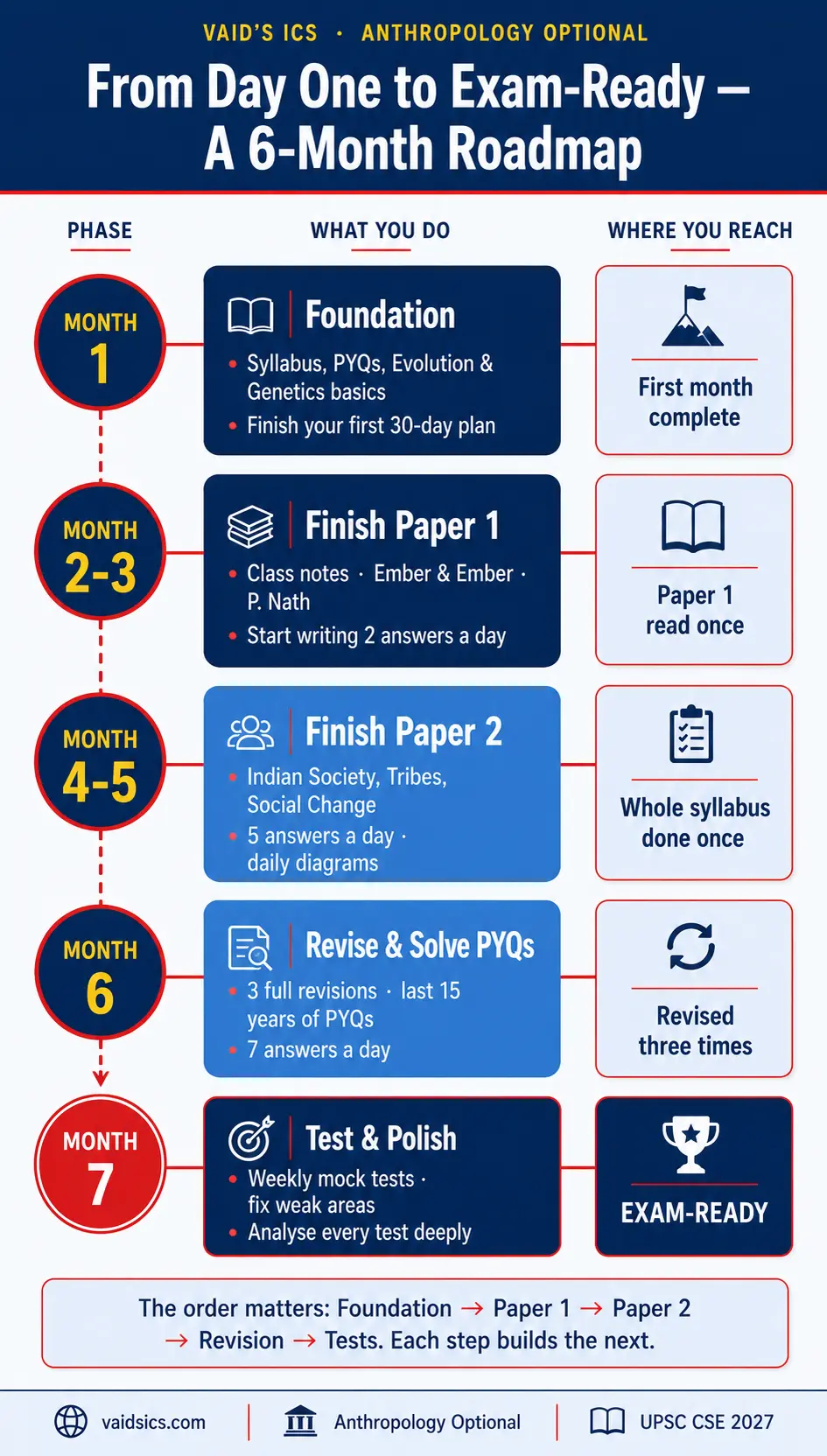
The roadmap above is a framework, not a rigid timetable. What it establishes is the correct sequence — foundation before content, Paper 1 before Paper 2, syllabus completion before intensive revision, revision before full test practice. The pace within each phase adjusts to individual circumstances.
Month 1 is orientation. Its purpose is not content coverage — it is to understand the subject well enough to study it intelligently. Syllabus reading, PYQ scanning, and the first 30-day plan form the entirety of this phase.
Months 2 and 3 are the Paper 1 phase. The sequence within Paper 1 matters: begin with Physical Anthropology and Evolution, then Genetics, then Archaeology, then Cultural Anthropology and major theories. Each area informs the next. Answer writing begins here at two per day, focused on topics already covered.
Months 4 and 5 are the Paper 2 phase. With Paper 1 vocabulary in place, Paper 2 can be studied analytically rather than descriptively. Increase answer writing to five per day. Begin diagram practice as a daily habit — twenty to thirty minutes separate from main study. Paper 2 has fewer diagrams than Paper 1, but those that exist — tribal settlement patterns, kinship diagrams in Indian tribal context, social change models — are high-value inclusions in answers.
Month 6 is revision — not fresh reading. Three passes: full revision of both papers in the first two weeks, focused revision of high-weightage topics in the third week, rapid refresh in the fourth. Solve the last fifteen years of PYQs in full this month — writing complete answers, not just scanning.
Month 7 is test preparation. One full mock per week under exam conditions. Spend as much time analysing each mock as writing it — identify gaps, return to relevant material, write targeted answers. This month converts existing knowledge into exam performance.
On Diagrams: What Beginners Underestimate
One preparation element the roadmap above does not fully capture is diagram practice — it runs across every month and deserves separate treatment.
Anthropology is not a diagram-light subject. Physical Anthropology, Genetics, and Archaeology have visual components intrinsic to the subject matter. Kinship systems, tribal social organisation, and models of social change all have structural forms that a well-drawn diagram communicates more efficiently than prose alone.
The diagrams that matter most in UPSC Anthropology answers include: evolutionary trees and phylogenetic diagrams, DNA structure and replication schematics, geological time scales for human evolution, Mendelian inheritance charts, kinship diagrams and descent systems, settlement pattern representations for Indian tribes, models of social change such as Westernisation and Sanskritisation, and the diagrammatic representation of anthropological field methods.
Draw each diagram while studying the topic, not after. When you read about DNA structure, draw it. When you read about a kinship system, map it. When you read about a tribal settlement pattern, sketch it. This simultaneous drawing reinforces the concept, embeds the diagram in memory, and prepares the exact answer component you will use in the exam.
From Month 2, maintain a separate diagram practice notebook. Set aside twenty to thirty minutes daily — separate from your main study session — specifically for drawing and revising diagrams. By Month 4, you should have a personal library covering the major visual concepts of the subject, reproducible quickly and accurately without consulting notes.
How Vaid Sir Approaches Anthropology Preparation
Over the years, Vaid Sir has worked with a large number of Anthropology optional candidates — from first-time beginners to aspirants revisiting the optional after earlier attempts. A few consistent principles emerge from how he approaches beginner preparation.
🎓 Vaid Sir’s Observations
Syllabus familiarity before resources. Before a student is advised to open any book, they are expected to have read the syllabus carefully enough to understand what each section is asking for. In practice, most beginners give this step twenty minutes. Genuine syllabus familiarity — the kind where a student can look at any topic heading and describe what kind of questions it generates — changes how every subsequent resource is read.
PYQ engagement from Day 1. Not as a testing mechanism, but as a lens. A student who scans ten years of Anthropology questions before opening their first book studies the subject with a fundamentally different set of priorities than one who does not.
Conceptual clarity over resource volume. Two or three sources studied carefully and thoroughly will produce better answers than eight sources read partially. The depth of engagement with fewer sources builds the kind of understanding that generates original analysis in answers rather than reproduced descriptions.
Answer writing before the syllabus is complete. Beginning after approximately one-third of the syllabus, not after completion. The habit of writing, the comfort with diagrams in answers, and the ability to identify one’s own gaps through writing are things that develop only through practice — and the longer that practice is delayed, the more compressed and pressured it becomes.
👉 Read how recent Anthropology toppers structured their preparation: Toppers Talk
👉 Explore Vaid Sir’s complete Anthropology optional resources: VAIDS ICS
A Note Before You Begin
Anthropology rewards consistency more than prior knowledge.
The candidates who do well with this optional are not usually those with the most resources or the most impressive academic backgrounds. They are the ones who followed a clear sequence, wrote answers regularly, practised diagrams consistently, and revised systematically.
The subject is accessible. The syllabus is manageable. What it asks for, above all, is a structured beginning — and you now have one.
Vaid Sir & VAIDS ICS
VAIDS ICS is a specialist Anthropology optional institute for UPSC CSE, mentoring aspirants from first-time beginners to repeat attempters. This guide is part of the VAIDS ICS Anthropology Content Hub.
Part of the VAIDS ICS Anthropology Content Hub.
Related reading:
- Why UPSC Aspirants Are Choosing Anthropology Optional
- Is Anthropology a Good Optional for UPSC?
- Anthropology Syllabus Explained
- Anthropology Booklist (coming soon)
- Anthropology PYQ Analysis
- Anthropology Answer Writing Strategy (coming soon)