
Polygenic Inheritance — 2023 Paper I
Polygenic Inheritance
Model Answer
VAID ICSIntroduction Polygenic inheritance (or Quantitative Inheritance) occurs when a single phenotypic trait is controlled by two or more pairs of genes located on different chromosomes. First synthesized by R.A. Fisher (1918), it explains how Mendelian genetics can produce continuous, graded variation in a population, unlike the discrete traits (e.g., tall vs. dwarf) studied by Mendel.
Key Features of Polygenic Inheritance
- Multiple Loci & Additive Effect: The trait is governed by multiple genes. Each dominant allele contributes a small, equal, and additive share to the final phenotype. There is no absolute dominance or recessiveness.
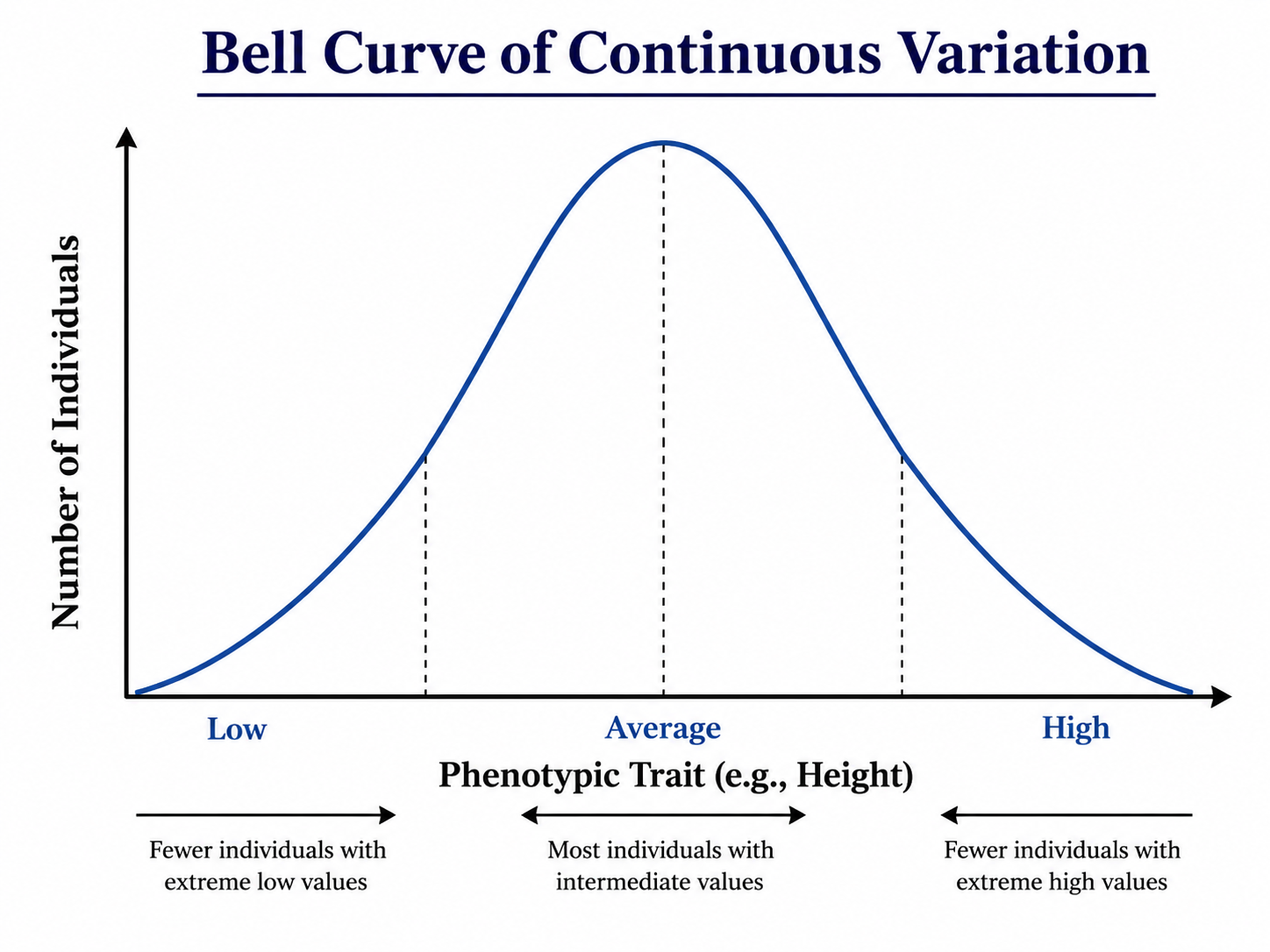
- Continuous Variation: Phenotypes do not fall into distinct categories. Instead, they form a gradient or continuous spectrum.
- Bell-Shaped Curve (Normal Distribution): In any population, the majority of individuals exhibit an intermediate phenotype (heterozygous), while extreme phenotypes (fully dominant or fully recessive) are rare.
Classic Anthropological Examples
- Human Skin Color: Studied by C.B. Davenport in Jamaica. He proposed that skin pigmentation is controlled by 3 to 4 gene pairs (e.g., A, B, C). A genotype of AABBCC produces very dark skin, aabbcc produces very light skin, and AaBbCc produces an intermediate (mulatto) shade.
- Human Stature (Height): Controlled by over 400 genes, alongside environmental factors.
- Dermatoglyphics: Total Finger Ridge Count (TFRC) is a classic polygenic trait minimally affected by the environment.
Polygenic vs. Multifactorial When a polygenic trait is significantly influenced by environmental factors (nutrition, climate, disease), it is termed Multifactorial Inheritance. For instance, genetic potential dictates maximum height, but childhood nutrition determines the actual height achieved.
Anthropological Significance Understanding polygenic inheritance is crucial for physical anthropology because it dismantles the biological concept of "Race." It proves that human traits vary in a continuous gradient (clines) across geographical regions, adapting to local environments, rather than existing in bounded, typological racial categories.
Want feedback on your answer?
Join the Anthropology workshop or get structured answer-writing guidance from VAID ICS.