Ancient Rock Art Reveals Shamans Spiritually Transforming into Animals
Source: Journal of Anthropological Archaeology | December 11, 2024
The Discovery
Recent research published in the Journal of Anthropological Archaeology documents a remarkable concentration of ancient rock art in the Serranía de la Lindosa, a 12-mile-long sandstone outcrop located in Colombia’s Guaviare department.
The site contains thousands of red ochre paintings, many of which are believed to date back over 11,000 years, placing them in the Late Pleistocene–Early Holocene transition.

Beyond Visual Art: A Spiritual Landscape
Unlike earlier interpretations that viewed Paleolithic rock art as symbolic or decorative, this study highlights a deep spiritual and ritual dimension embedded within the paintings.
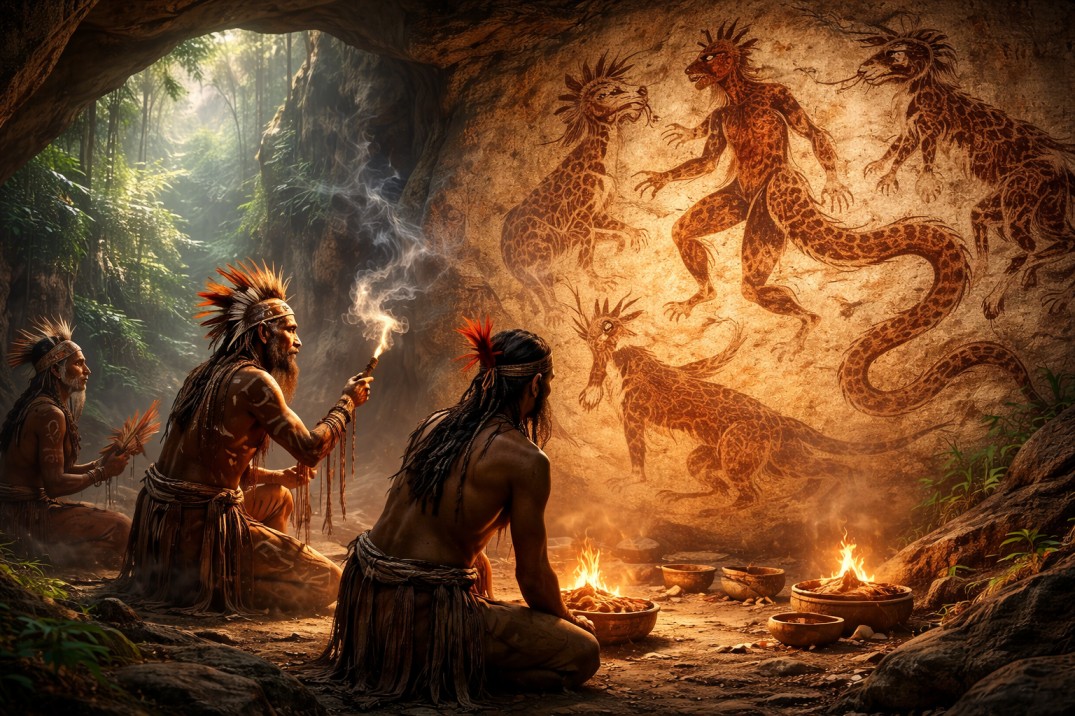
Researchers argue that the rock art represents shamanic cosmologies, where ritual specialists navigate between human and non-human worlds.
Role of Indigenous Knowledge
A key contribution of this research lies in its ethnoarchaeological approach.
For the first time in this region of the Amazon, archaeologists systematically incorporated the perspectives of Indigenous elders from communities such as the Tukano, Desana, Matapí, Nukak, and Jiw.
According to these communities, the rock paintings depict ancestral shamans who spiritually transformed into animals as part of ritual journeys.
This marks a methodological shift from outsider interpretation to community-informed archaeological analysis.
Therianthropy in Paleolithic Art
The study identifies multiple scenes featuring therianthropic figures—beings that combine human and animal characteristics.
These include depictions of humans transforming into:
• Snakes
• Jaguars
• Birds
Such imagery supports long-standing anthropological interpretations that Paleolithic art was closely linked to shamanism, trance states, and altered consciousness.
Anthropological Significance
From an anthropological perspective, the findings reinforce several key ideas:
• Paleolithic art functioned as a ritual medium, not mere representation
• Shamanism played a central role in early human societies
• Human–animal boundaries were fluid within prehistoric cosmologies
The study also demonstrates the value of ethnoarchaeology in interpreting prehistoric material culture.
Why This Matters for UPSC Aspirants
This research is directly relevant for understanding:
• Interpretation of Paleolithic art
• Shamanism and ritual in early societies
• Human–animal relationships in prehistoric thought
• Ethnoarchaeological methods in Anthropology
It provides contemporary academic backing to classic theories proposed by scholars like Lewis-Williams, while grounding them in Indigenous perspectives.
Relevant UPSC Anthropology PYQs
1. Mesolithic rock art in the Indian subcontinent. 10 Marks | 2022
2. Elucidate Mesolithic culture and associated rock art with examples from India. 15 Marks | 2019



-10052026-113117pm.png)