

How to Cover Current Affairs for the UPSC Civil Services Examination
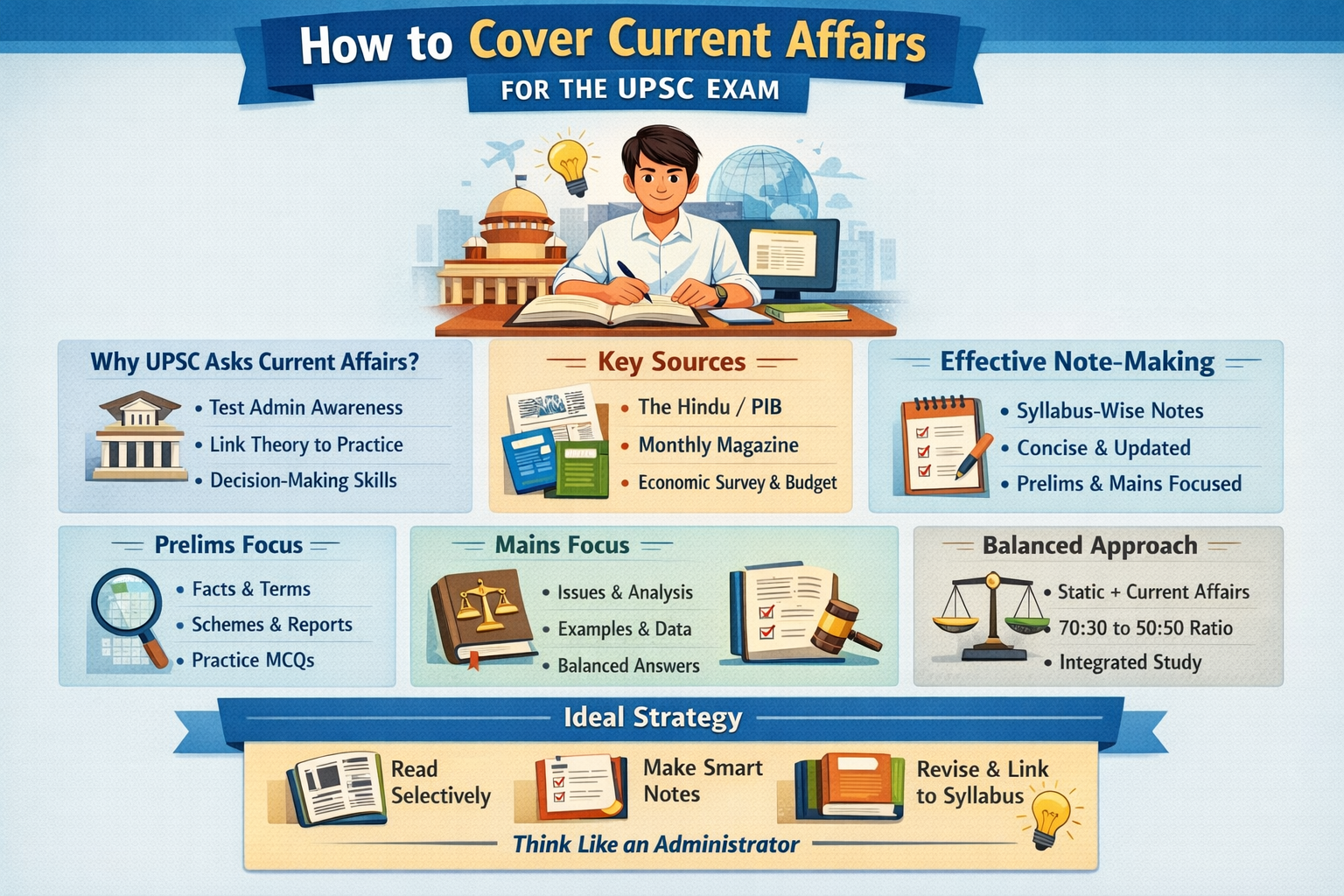
Why Does UPSC Ask Current Affairs?
UPSC is not conducting a quiz competition or a journalism entrance test. It asks current affairs because civil servants do not work in a static world. Policies are framed, laws are interpreted, and administrative decisions are taken in response to live and evolving situations. By asking questions rooted in current affairs, UPSC checks whether a candidate can understand contemporary problems and apply constitutional values, laws, ethics, and policy tools to them.
Current affairs help UPSC move away from rote learning. Anyone can memorise facts from a book, but not everyone can analyse farm protests, climate negotiations, digital privacy issues, or federal disputes with maturity and balance. Through current affairs, UPSC assesses whether a candidate has the temperament of a public administrator—aware, informed, analytical, and grounded in democratic values.
In simple terms, current affairs tell the examiner one thing very clearly: Can this person think like a future administrator, or only like a student?

Understanding the Role of Current Affairs in the Exam
Current affairs are not a separate section of the UPSC syllabus, yet they quietly dominate the entire examination. In Prelims, they are often hidden behind static concepts. In Mains, they shape the content, examples, arguments, and relevance of almost every answer.
When UPSC asks about Parliament, federalism, agriculture, internal security, environment, or international relations, it expects answers rooted in present realities, not textbook definitions alone. A candidate who understands only theory but cannot relate it to current issues appears disconnected from governance.
This is why reading current affairs casually—like general news consumption—does not help. UPSC expects aspirants to process the news, not just consume it. Every relevant news item should quietly answer: What does this mean for governance, society, economy, or ethics?
Sources: Why Fewer Sources Work Better
One of the earliest mistakes aspirants make is believing that more sources mean better preparation. In reality, multiple sources often dilute understanding and destroy revision efficiency. UPSC does not reward the number of newspapers read; it rewards clarity, recall, and relevance.
A single standard newspaper is enough if read properly. It introduces issues, debates, data points, and official responses. PIB complements this by providing the government’s perspective—useful for understanding policy intent and official language, especially for GS-II and GS-III.
Monthly magazines should not replace newspapers. Their real value lies in revision and consolidation, especially when something important was missed during daily reading. Similarly, Economic Survey and Budget are not meant to be memorised. They are meant to help you understand the direction of policy thinking, reform priorities, and data-backed arguments.
• One newspaper for daily issue awareness
• PIB for schemes, bills, and official explanations
• One monthly magazine for revision
• Economic Survey and Budget for analytical depth
More than this usually leads to confusion, not competence.
Note-Making: Where Serious Preparation Begins
Current affairs preparation becomes meaningful only when information is converted into usable notes. Without note-making, revision becomes impossible, and answer writing remains shallow.
Good notes are not detailed summaries of articles. They are compressed thinking tools. They capture the essence of an issue in a form that can be recalled under exam pressure. This is why notes should always be syllabus-oriented. A newspaper article may be relevant today, but the syllabus remains relevant every year.
Instead of writing notes date-wise, notes should be organised topic-wise—federalism, climate change, agriculture reforms, internal security, social justice, and so on. Each time the issue appears again in the news, the same note should be updated.
• Notes should focus on issues, not events
• One issue, preferably one page
• Clear separation of prelims facts and mains analysis
• Emphasis on causes, impacts, challenges, and solutions
If a note cannot help you structure a mains answer quickly, it is not serving its purpose.
Integrating Current Affairs for Prelims and Mains
Many aspirants treat Prelims and Mains current affairs as two different things. In reality, they are the same content seen from two different angles.
In Prelims, current affairs are used to test awareness and conceptual clarity. A question on a scheme, report, or institution usually checks whether you understand its basic purpose, structure, and linkage with static concepts. Most so-called “current” prelims questions can be solved if static fundamentals are clear.
In Mains, current affairs give life to answers. They provide contemporary examples, data, committee references, and policy debates. An answer on federalism without recent Centre–State issues or an answer on environment without ongoing climate discussions feels incomplete.
• Prelims lens: definitions, features, institutions, factual clarity
• Mains lens: issues, arguments, dimensions, solutions
The content remains the same; only the depth and framing change.
Static and Current Affairs Balance
Static and current affairs should never be studied in isolation. Static subjects give structure to your understanding, while current affairs provide relevance and application. One without the other leads to poor answers.
Aspirants who ignore static struggle to understand news. Aspirants who ignore current affairs write outdated, generic answers. The balance evolves with preparation stages.
In the early months, static subjects deserve more attention so that current events make sense. As preparation matures, current affairs naturally integrate with static knowledge.
• Early stage: strong focus on static basics
• Middle stage: equal emphasis and integration
• Final stage: revision and answer writing using both
A simple test helps: if a news item cannot be linked to a syllabus topic, it is probably not worth deep study.
How Much Current Affairs Is Enough?
UPSC does not expect candidates to remember everything from the past. It values awareness of ongoing and evolving issues.
For Prelims, the last one year of current affairs is usually sufficient, with special attention to the most recent six months. For Mains, a slightly longer window—around 18 months—helps in understanding how issues have developed over time.
What matters more than timelines is continuity. Issues that recur—such as federal disputes, climate policy, social justice, or economic reforms—are far more important than one-time events.
Ideal Daily Approach to Studying Current Affairs
An effective routine is one that can be sustained for months without burnout. Long hours of unfocused reading rarely help.
A good daily approach involves reading the newspaper with intent, identifying what is relevant, and briefly noting it down or tagging it digitally. Linking the issue with a static topic immediately strengthens understanding and recall.
• Read selectively, not compulsively
• Pause to think and classify
• Connect news with syllabus and concepts
Passive reading creates the illusion of preparation. Active engagement creates actual competence.
Common Mistakes That Hurt Aspirants
Many aspirants work hard on current affairs but still fail to convert effort into marks because of avoidable mistakes.
• Treating newspapers like general reading material
• Making bulky notes that are never revised
• Ignoring static subjects while chasing daily news
• Memorising opinions instead of developing arguments
• Depending entirely on monthly magazines
UPSC rewards clarity, balance, and relevance—not information overload.
Developing the Examiner’s Mindset
The most important shift in current affairs preparation is mental. Aspirants must start thinking like examiners and administrators, not like news readers.
For every issue, ask yourself:
• Why does this matter for governance?
• Which GS paper and syllabus area does it belong to?
• What are the constitutional, ethical, social, and economic angles?
• What would be a balanced and realistic way forward?
When these questions become automatic, current affairs preparation becomes natural and efficient.
Conclusion
UPSC asks current affairs to test whether a candidate can apply knowledge to reality. With limited sources, syllabus-based note-making, and integrated preparation for Prelims and Mains, current affairs stop being overwhelming. They become a strength that enriches answers, sharpens judgment, and reflects administrative maturity.
The objective is not to know everything that happens, but to understand what matters, why it matters, and how to articulate it clearly in the exam.
FAQs on Current Affairs Preparation for UPSC
1. Why are current affairs so important for UPSC?
Ans. Because UPSC tests applied understanding of governance, not rote knowledge. Current affairs show whether you can connect theory with real-world issues.
2. Is reading the newspaper daily compulsory?
Ans. Yes, but selectively. The goal is relevance to the syllabus, not reading every news item.
3. Which newspaper is best for UPSC current affairs?
Ans. One standard newspaper like The Hindu or Indian Express is sufficient if read properly.
4. Are monthly current affairs magazines enough on their own?
Ans. No. They are meant for revision and consolidation, not as a replacement for daily newspaper reading.
5. How should I make current affairs notes?
Ans. Make syllabus-wise, issue-based notes focusing on causes, impacts, challenges, and way forward.
6. Should Prelims and Mains current affairs be prepared separately?
Ans. No. Prepare them together; only the depth and focus change for Prelims and Mains.
7. How much current affairs should I cover for Prelims?
Ans. Generally, the last 12 months are enough, with higher priority to the most recent 6 months.
8. How much current affairs is required for Mains?
Ans. Around 18 months is ideal to understand issue evolution and continuity.
9. What is the right balance between static and current affairs?
Ans. Static provides the base; current affairs provide application. Both must be studied in integration.
10. What is the biggest mistake aspirants make in current affairs?
Ans. Consuming too many sources and making bulky notes that cannot be revised before the exam.

-10052026-113117pm.png)



Roy Abhijit
8 months agoThank you
Reply