Odisha ST List Gets Two New Entrants, Bringing Relief to Over 50 Sub-Tribes
Source: The Hindu | February 09, 2024
The Recent Development
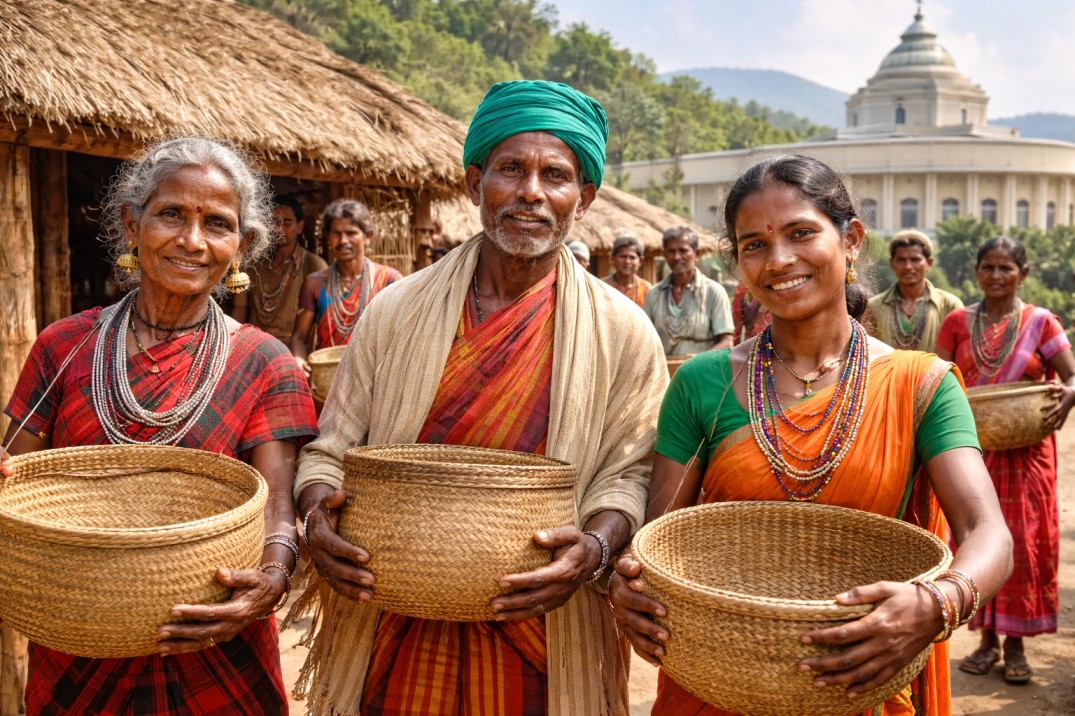
The Scheduled Tribe (ST) list of Odisha has been expanded with the inclusion of Tamadia and Tamudia communities.
These groups were earlier classified as Scheduled Castes (SCs) but will now be included under the Bhumij tribal group in the ST list.
This move is expected to bring relief to at least 50 sub-tribes by correcting long-standing classification anomalies in tribal administration.

Why the Change Was Necessary
The reclassification aims to ensure uniform access to constitutional safeguards and welfare benefits available to Scheduled Tribes.
Inclusion in the ST list enables communities to access targeted provisions related to:
• Education
• Employment
• Political representation
• Tribal welfare schemes
Such corrections help align administrative categories with anthropological realities.
Issue of Inter-State Disparities
Noted tribal researcher and anthropologist A.B. Ota highlighted the problem of inconsistent tribal recognition across States.
• The Konda Reddy community is recognised as a Scheduled Tribe in Andhra Pradesh, but was treated as a Socially and Educationally Backward Class (SEBC) in Odisha’s Malkangiri district.
• Similarly, the Muka Dora community is regarded as tribal in Andhra Pradesh but was excluded from the ST list in Odisha.
Such inconsistencies have historically deprived tribal groups of rightful benefits depending on State boundaries rather than social reality.
Anthropological Significance
From an anthropological perspective, tribal identity is based on shared culture, ecology, livelihood patterns, and social organisation, not merely administrative labels.
The inclusion of Tamadia and Tamudia reflects a corrective approach, acknowledging:
• Cultural continuity across regions
• Ethnographic evidence
• Ground-level social conditions
Ota described the inclusion as long overdue, underlining the need for periodic review of tribal classifications.
Relevant UPSC Anthropology PYQs
1. Critically examine the concept of the tribe–caste continuum and its relevance in contemporary India. 15 Marks | 2015
2. Explain the significance of the tribe–caste continuum in the present context. 15 Marks | 2018
3. Examine the anthropological contributions dealing with tribes and Indian civilization. 20 Marks | 2013


-10052026-113117pm.png)