

Union Budget 2026–27 Explained: Kartavya-Based Growth Strategy, Key Highlights & UPSC Analysis
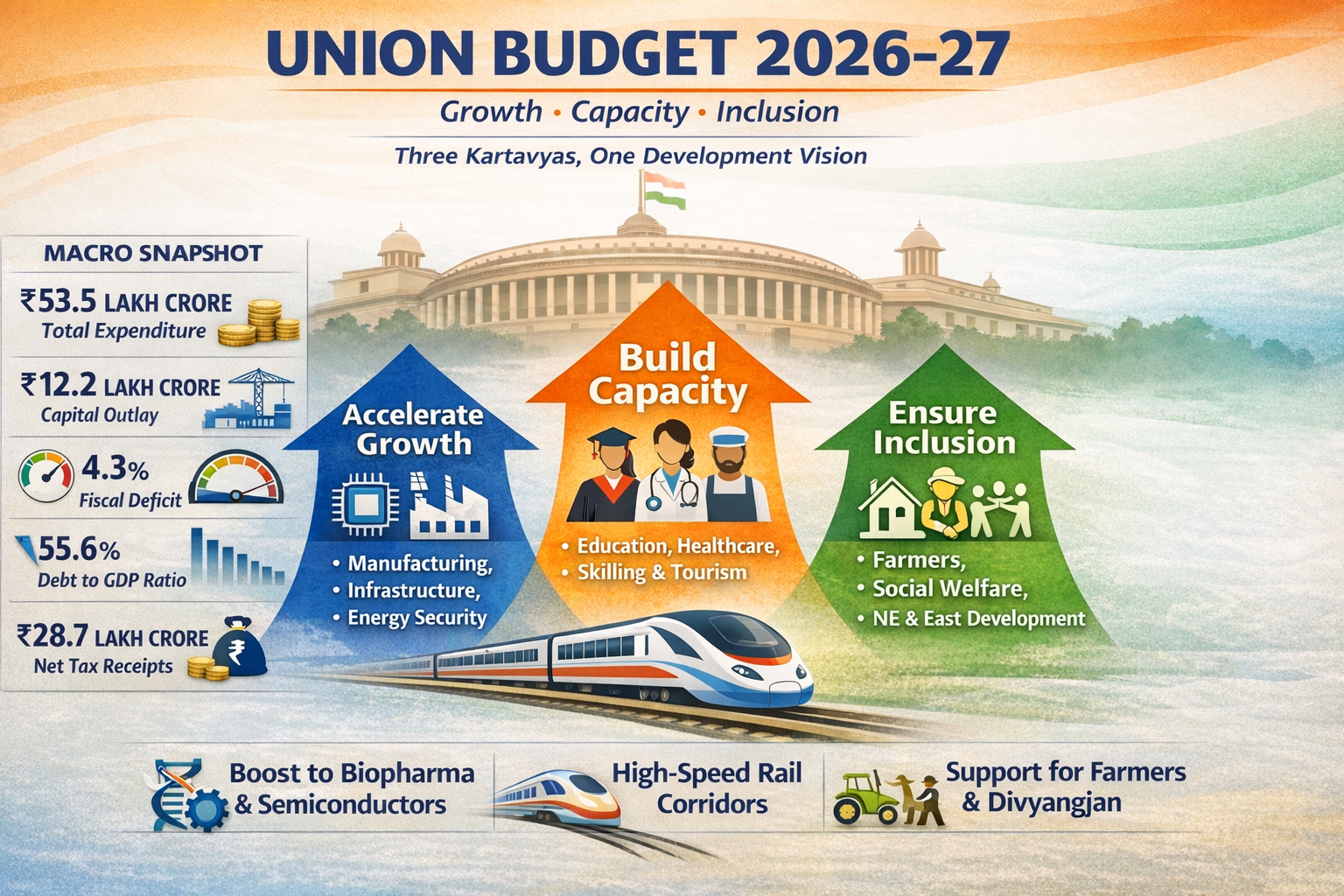
Union Budget 2026–27: A Kartavya-Centric Blueprint for India’s Next Growth Phase
The Union Budget 2026–27 marks a clear evolution in India’s fiscal and governance philosophy. Presented at a time of global economic uncertainty, geopolitical fragmentation, and climate stress, the Budget consciously shifts the narrative from short-term stimulus to duty-based long-term nation building, anchored in the idea of Kartavya. Rather than focusing only on sectoral allocations, it frames development as a shared responsibility of the State, markets, and citizens.
Macro-Fiscal Position: Growth with Discipline
The Budget estimates total expenditure at ₹53.5 lakh crore, with non-debt receipts of ₹36.5 lakh crore and net tax receipts of ₹28.7 lakh crore. The fiscal deficit for FY 2026–27 is projected at 4.3% of GDP, improving marginally from 4.4% in the revised estimates of the previous year. This reflects a calibrated approach where fiscal consolidation is pursued without undermining public investment.
Capital expenditure remains the central growth lever. With public capex rising to about ₹12.2 lakh crore, the government continues its strategy of using infrastructure spending to crowd in private investment, enhance productivity, and create durable assets. The gradual reduction in the debt-to-GDP ratio to 55.6% reinforces medium-term fiscal credibility.

The Three Kartavyas: Reframing the Role of the State
A defining feature of Budget 2026–27 is its articulation around three Kartavyas. This is not merely rhetorical. It represents a governance shift where economic policy is linked with moral and constitutional responsibility.
• Accelerating and sustaining economic growth
• Fulfilling aspirations and building human capacity
• Ensuring Sabka Sath, Sabka Vikas through targeted inclusion
First Kartavya: Accelerating and Sustaining Economic Growth
Strategic Manufacturing and Industrial Deepening
The Budget significantly expands India’s manufacturing ambitions by targeting seven strategic and frontier sectors. Unlike earlier phases that focused largely on assembly and scale, the emphasis now is on technology depth, domestic IP creation, and supply-chain resilience.
Biopharma SHAKTI, with an outlay of ₹10,000 crore over five years, aims to position India as a global biopharma manufacturing hub. This is complemented by expansion of pharmaceutical education and clinical trial infrastructure, indicating a full ecosystem approach rather than isolated incentives.
The launch of India Semiconductor Mission 2.0 signals a decisive move beyond chip assembly into equipment manufacturing, materials, and full-stack design. This reflects learning from global supply chain disruptions and aligns with India’s strategic autonomy goals.
Other notable measures include expansion of electronics component manufacturing, establishment of rare earth corridors in mineral-rich states, and cluster-based chemical parks using a plug-and-play model.
Key points:
• Focus on strategic autonomy, not just exports
• Manufacturing linked with skills and R&D
• Shift from PLI-only incentives to ecosystem building
Capital Goods, Logistics and Industrial Efficiency
Recognising capital goods as the backbone of industrial competitiveness, the Budget announces hi-tech tool rooms, schemes for construction and infrastructure equipment, and a container manufacturing ecosystem with a five-year outlay exceeding ₹10,000 crore. These measures aim to reduce import dependence in high-value equipment and logistics inputs.
This approach directly addresses one of India’s chronic structural weaknesses—high logistics and capital costs—which often erode export competitiveness despite low labour costs.
Textiles: Employment with Value Addition
The textile sector receives an integrated programme combining fibre security, cluster modernisation, and technical textile expansion. The National Fibre Scheme aims at self-reliance across natural, man-made, and new-age fibres, while mega textile parks focus on higher value-added segments.
Importantly, the Mahatma Gandhi Gram Swaraj initiative attempts to integrate khadi, handloom, and handicrafts into global value chains through branding, skilling, and market access rather than treating them as subsistence sectors.

Infrastructure Push and Private Confidence
Public capital expenditure is raised to ₹12.2 lakh crore, reinforcing infrastructure as the principal growth engine. However, the more significant reform lies in institutional innovation.
The proposed Infrastructure Risk Guarantee Fund addresses a long-standing issue of private sector hesitation due to construction-phase risks. Asset recycling through REITs, expansion of freight corridors, inland waterways, coastal shipping, and seaplane connectivity together signal a comprehensive multimodal logistics strategy.
Key points:
• Shift from asset creation to asset monetisation
• Multimodal transport to reduce logistics costs
• Infrastructure designed to crowd in private capital
Energy Security and Climate Technology
An allocation of ₹20,000 crore for Carbon Capture Utilisation and Storage (CCUS) reflects India’s pragmatic climate strategy. Rather than abrupt fossil fuel exit, the focus is on technology-led transition compatible with development needs. This aligns well with India’s climate commitments while safeguarding energy security.
City Economic Regions and Urban Finance
The introduction of City Economic Regions (CERs) with ₹5,000 crore allocation per region over five years marks a move away from fragmented urban planning. High-speed rail corridors are conceptualised as growth connectors, while incentives for large municipal bond issuances strengthen urban fiscal capacity.
This approach integrates transport, land use, and finance—an area often neglected in India’s urban policy.
Second Kartavya: Fulfilling Aspirations and Building Human Capacity
The Budget explicitly recognises that India’s demographic advantage can turn into a liability without employable skills. A High-Powered Education-to-Employment-to-Enterprise Committee is proposed, with a focus on services as a growth engine.
In health, the expansion of allied health professionals, establishment of regional medical hubs, and investment in mental health institutions indicate a broad understanding of health as economic infrastructure. Mental health, often marginal in budgetary discourse, receives institutional attention through NIMHANS-2 and regional apex institutes.
Education and tourism are linked through university townships near industrial corridors, district-level girls’ hostels, heritage site development, and guide upskilling. The Budget also acknowledges the rising importance of the creative economy by promoting AVGC labs in schools and colleges.
Third Kartavya: Sabka Sath, Sabka Vikas through Targeted Inclusion
Rather than broad subsidies, the Budget adopts precision inclusion.
For farmers, the focus shifts to water security, high-value crops, and AI-enabled advisory through Bharat-VISTAAR. This reflects a transition from input subsidies to productivity and income enhancement.
Divyangjan empowerment is approached through skill-linked employment in IT, AVGC, hospitality and services, moving beyond welfare towards economic participation.
Mental health and trauma care receive renewed emphasis, recognising social well-being as a development prerequisite.
The Purvodaya states and North-East receive region-specific interventions through industrial corridors, tourism, Buddhist circuits, and electric mobility, aligning regional development with national growth.
Tax Reforms: Ease, Trust and Competitiveness
The New Income Tax Act, effective from April 2026, aims to simplify compliance and reduce litigation. Decriminalisation of minor offences, rationalisation of penalties, and automated processes reflect a trust-based tax regime.
Support for cooperatives, SMEs, and the IT sector indicates targeted growth facilitation. The treatment of IT services under a unified safe harbour regime enhances certainty, while incentives for data centres, non-resident experts, and bonded manufacturing zones improve India’s global competitiveness.
Indirect tax reforms focus on tariff simplification, critical minerals, energy transition, defence and aviation manufacturing, and ease of living. Customs reforms emphasise digital integration, AI-based risk assessment, and trust-based clearances.
Key points:
• Shift from enforcement to facilitation
• Tax certainty to attract global capital
• Customs as trade enabler, not gatekeeper
Federalism and Finance Commission
The allocation of ₹1.4 lakh crore as Finance Commission grants reinforces fiscal federalism. It also underlines the Centre’s role as a coordinator rather than a monopoliser of fiscal space, crucial for cooperative governance.
Union Budget 2026–27 is neither populist nor minimalist. It is structural, institution-centric, and future-oriented. It integrates growth with responsibility, inclusion with productivity, and reform with stability.
More importantly, it reflects the evolving nature of the Indian state—from a provider to an enabler, partner, and guarantor of long-term national capacity.
FAQs
1. Why is Budget 2026–27 called Kartavya-centric?
Because it frames development around duty and responsibility, linking growth, capacity building and inclusion with constitutional values rather than entitlement-based policy.
2. How does the Budget balance growth and fiscal discipline?
By reducing the fiscal deficit to 4.3% of GDP while increasing capital expenditure to ₹12.2 lakh crore, ensuring consolidation without harming growth.
3. Why is high capital expenditure important in this Budget?
Public capex drives infrastructure creation, crowds in private investment, improves productivity and generates long-term economic multipliers.
4. How does the Budget strengthen manufacturing?
It shifts from assembly-led growth to ecosystem-based manufacturing, focusing on strategic sectors, domestic IP, R&D, and supply-chain resilience.
5. What is the role of infrastructure in Budget 2026–27?
Infrastructure is used as a growth enabler, supported by risk guarantees, asset monetisation, multimodal logistics and high-speed connectivity.
6. How does the Budget address climate change?
Through a technology-led transition, allocating ₹20,000 crore for CCUS while maintaining energy security and development priorities.
7. Why are City Economic Regions important?
They promote region-based urban growth, integrating transport, land use and finance to improve productivity and urban governance.
8. How does the Budget utilise India’s demographic dividend?
By linking education with employable skills, services growth, healthcare expansion and creative industries.
9. What is meant by precision inclusion?
Targeted inclusion through AI-based farm support, skill-linked Divyangjan employment and region-specific development instead of broad subsidies.
10. How does the Budget strengthen federalism?
By providing ₹1.4 lakh crore in Finance Commission grants, reinforcing cooperative fiscal federalism and state-level autonomy.


-10052026-113117pm.png)


Pankesh Singh
8 months agoThank you, please write more such articlles
ReplyPankesh Singh
8 months agoThank you, please write more such articlles
Reply