
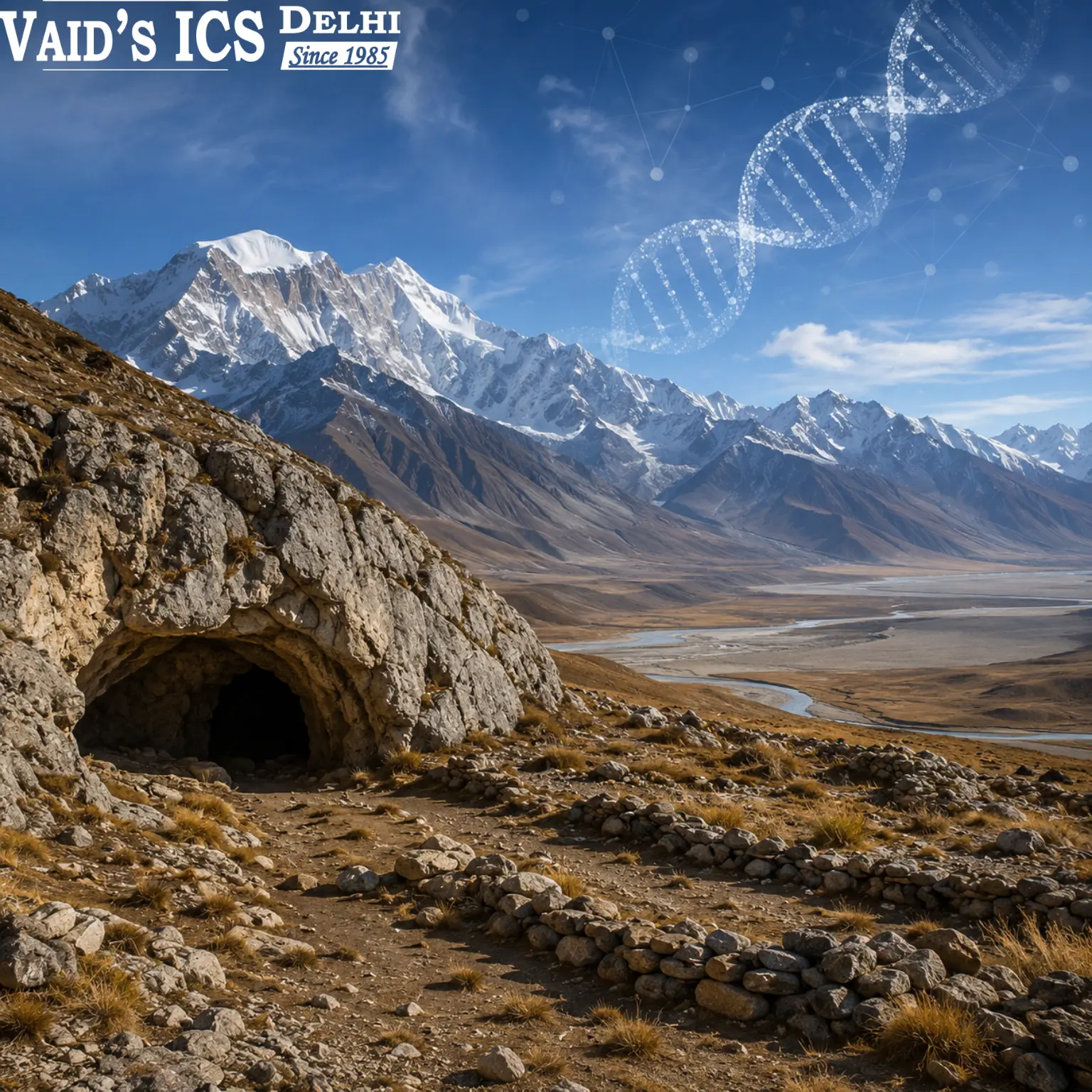
Note: this article covers the Denisovan record on the Tibetan Plateau, drawing on the palaeoproteomic and genetic literature (Chen et al., 2019; Huerta-Sánchez et al., 2014; and later Baishiya finds).
Denisovans on the Tibetan Plateau are one of the most striking discoveries in recent human evolution. First known only from DNA in a Siberian cave, Denisovans turned out to have lived at high altitude in Asia and to have left a genetic legacy that still helps modern Tibetans breathe thin mountain air. For UPSC Anthropology Paper 1, this is a rich case linking hominin diversity, gene flow and human adaptation.
Why this matters: it shows a “ghost” hominin known largely from DNA living at high altitude and shaping modern human adaptation through gene flow.
Syllabus relevance: Anthropology Paper 1 — hominin diversity, human adaptation to high altitude, and molecular methods.
Best use in answers: use it as a textbook example of adaptive introgression and of Denisovans as a distinct human population.
Who were the Denisovans?
Denisovans were first identified in 2010 from a finger bone in Denisova Cave, Siberia — not from anatomy, but from its ancient DNA. They are a sister group to the Neanderthals, and genetics shows they interbred with modern humans. For years they remained a “molecular” population, known mainly from DNA and a handful of teeth and bone fragments.

Denisovans reach the Tibetan Plateau
A major breakthrough came from the Xiahe mandible — a jawbone from Baishiya Karst Cave on the Tibetan Plateau (Gansu, China). In 2019, researchers used ancient proteins (palaeoproteomics) to identify it as Denisovan, dated to at least around 160,000 years ago. This was the first Denisovan fossil found outside Denisova Cave, and it showed Denisovans were already living at high altitude long before modern humans arrived. Later work at Baishiya — including sediment DNA and additional remains — indicates a long Denisovan occupation of the plateau extending into the Late Pleistocene.
Overlap with modern humans
Because Denisovans occupied the plateau over such a long span, their presence overlapped with the later spread of modern humans into the region. Combined with the genetic evidence for interbreeding, this points to contact and gene flow between Denisovans and Homo sapiens in Asia.
High-altitude adaptation: the EPAS1 gene
The most famous legacy is the EPAS1 gene variant. Many present-day Tibetans carry a version of EPAS1 inherited from Denisovans that helps them cope with low oxygen at high altitude without the harmful over-production of red blood cells seen in lowlanders. This is a classic case of adaptive introgression — a beneficial gene passing from an archaic population into modern humans.
Anthropological significance
- Evidence of hominin diversity in Pleistocene Asia beyond Neanderthals.
- A clear example of adaptive introgression shaping modern human biology.
- The power of molecular methods (ancient DNA and proteins) to identify populations from scant fossils.
Why this matters for UPSC Anthropology
It supports Paper 1 discussion of hominin diversity and of human adaptation — map it to the Paper 1 human-evolution syllabus, read it with our note on hominin diversity, and see the complete optional guide.
Use in Answer Writing
Syllabus topic: Hominin diversity and human adaptation to high altitude (Paper 1).
Key concepts to apply: Denisovans; adaptive introgression; EPAS1; palaeoproteomics; gene flow between archaic and modern humans.
How to use it in answers: cite the Xiahe/Baishiya Denisovan and EPAS1 to illustrate adaptive introgression in a human-adaptation or human-evolution answer.
Concepts to apply in answers
- Adaptive introgression (Denisovan EPAS1 in Tibetans)
- Hominin diversity in Pleistocene Asia
- Molecular anthropology — ancient DNA and ancient proteins
\n
\n
FAQ
How do we know Denisovans lived on the Tibetan Plateau?
The Xiahe mandible from Baishiya Karst Cave was identified as Denisovan using ancient proteins and dated to at least ~160,000 years ago.
What is the EPAS1 connection?
Many Tibetans carry a Denisovan-derived EPAS1 variant that aids survival at high altitude — a case of adaptive introgression.
Where is this useful in the syllabus?
Paper 1 — hominin diversity and human adaptation.
Preparing Anthropology Optional for UPSC?
Turn discoveries like the Tibetan Denisovans into sharp Paper 1 answers with VAID SIR at VAID’S ICS.
Explore the Anthropology Optional programme →
VAID’S ICS has mentored Anthropology-optional rankers across years, including AIR 3 (2023) and AIR 1 (2020). See the full results.
Sources
- Chen et al., “A late Middle Pleistocene Denisovan mandible from the Tibetan Plateau,” Nature (2019): nature.com
- Huerta-Sánchez et al., “Altitude adaptation in Tibetans caused by introgression of Denisovan-like DNA,” Nature (2014): nature.com