
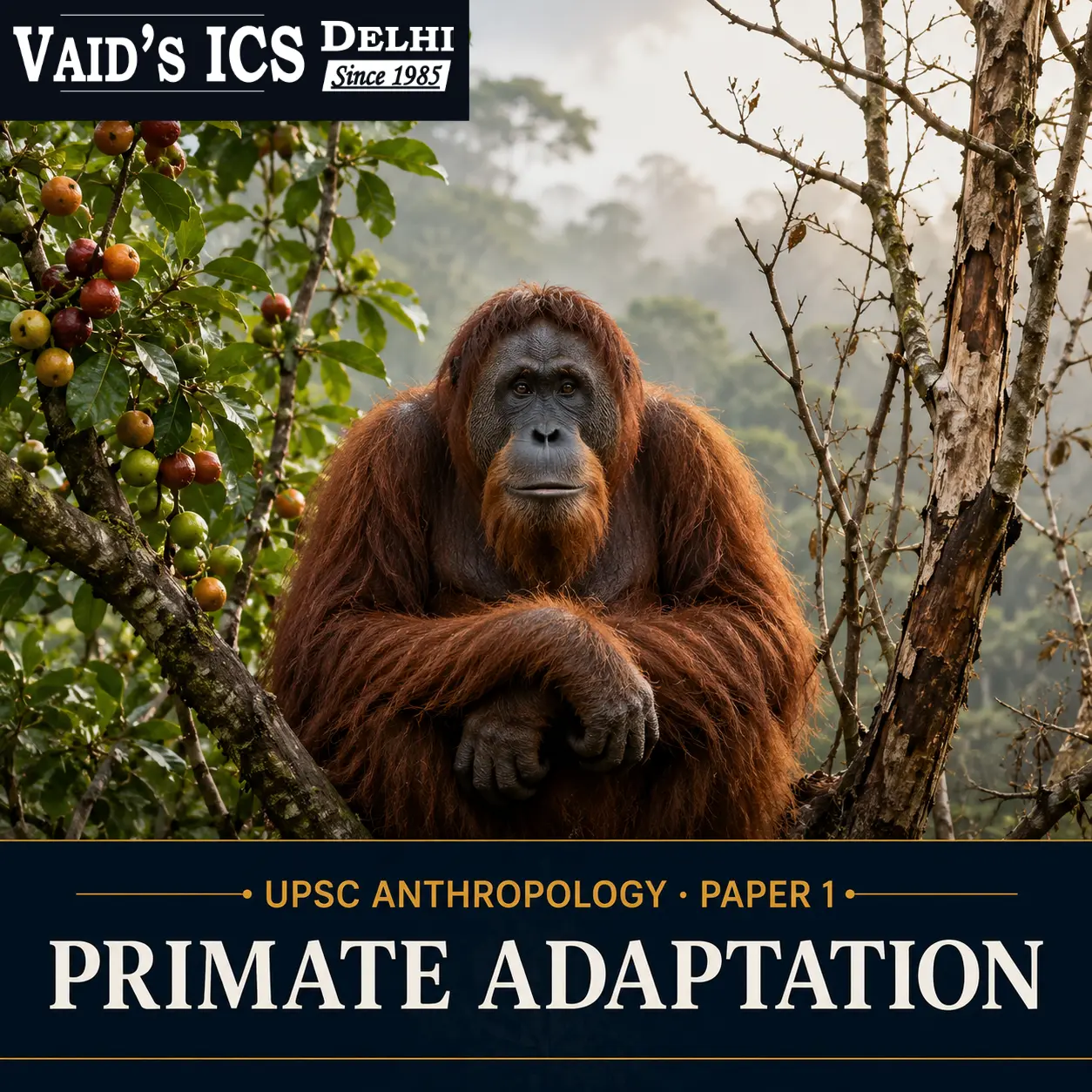
Source: Science Advances | Erin R. Vogel | 27 August 2025.
Primate metabolic adaptation offers a striking window into human health. A recent study on how orangutans regulate diet and metabolism during seasonal food scarcity carries direct lessons for UPSC Anthropology Paper 1 (primate behaviour, bio-cultural adaptation) and for the evolutionary view of modern lifestyle disease.
Why this matters: a living primate shows how diet and metabolism adapt to seasonal scarcity — a vivid Paper 1 example bridging biology and human health.
Syllabus relevance: Anthropology Paper 1 — primate behaviour, primatology and bio-cultural adaptation.
Best use in answers: use as a primate example of metabolic flexibility and an evolutionary lens on modern lifestyle disease.
The study in brief
Published in Science Advances, the study examined how orangutans manage nutrition as forest food availability fluctuates. The finding: orangutans maintain nutritional balance and metabolic flexibility, with implications for both primate adaptation and human health.
Seasonal dietary shifts
Fruit-rich phase
- Orangutans eat high-carbohydrate, energy-rich fruit
- Carbohydrates provide immediate fuel
- Protein intake still stays stable — they do not overconsume sugar, preserving lean muscle mass
Low-fruit phase (scarcity adaptation)
- They shift to leaves, bark and seeds — lower in sugar, higher in protein
- They mobilise stored body fat
- They use muscle protein as fuel
This reflects a real capacity for metabolic adaptation under ecological stress.
Metabolic flexibility: evolutionary significance
Orangutans can switch fuel sources efficiently, avoid chronic metabolic overload, maintain muscle integrity and regulate energy expenditure. This resembles intermittent fasting patterns in humans, where temporary scarcity may lower oxidative stress linked to ageing and chronic disease. Evolutionarily it signals adaptation to fluctuating tropical-forest ecology and energy optimisation in arboreal primates.

Shared biology: humans and orangutans
Humans and orangutans share a common ancestor, so core metabolic pathways are conserved. Both regulate energy by food quality. But modern human diets — heavy in ultra-processed food, sugar and saturated fat, low in nutrient density — interfere with that adaptability, contributing to obesity, diabetes and metabolic syndrome. Deviating from evolutionary dietary patterns undermines health.
Why this matters for UPSC Anthropology
This is a ready-made example for Paper 1 questions on primate behaviour and bio-cultural adaptation, and a bridge to social organisation themes covered in our kinship study guide. For answer-writing strategy, see the complete Anthropology optional guide.
Use in Answer Writing
Syllabus topic: Primate behaviour & bio-cultural adaptation (Paper 1).
Key concepts to apply: Orangutan seasonal diet switching; metabolic flexibility; conserved human–ape metabolic pathways.
How to use it in answers: cite the 2025 Science Advances study to link primatology with human nutrition and adaptation.
Previous Year Questions — UPSC Anthropology
- Discuss different forms of primate social organisation. (15 Marks, 2022)
- Role of Primatology in Anthropological studies. (10 Marks, 2013)
FAQ
What is metabolic flexibility in primates?
The ability to switch efficiently between fuel sources — carbohydrates, fat and protein — as food availability changes.
How does the orangutan study relate to humans?
Shared ancestry means conserved metabolic pathways; the contrast highlights how ultra-processed diets disrupt human metabolic health.
Where is this useful in the Anthropology syllabus?
Paper 1 — primate behaviour, primatology and bio-cultural adaptation.
Preparing Anthropology Optional for UPSC?
Turn primatology research into sharp Paper 1 answers with VAID SIR’s Anthropology programme at VAID’S ICS. Explore the Anthropology Optional programme →
VAID’S ICS has mentored Anthropology-optional rankers across years, including AIR 3 (2023) and AIR 1 (2020). See the full results.
Sources
- Vogel et al., “Integrated behavioral and metabolically flexible responses of wild orangutans to ecologically driven dietary variation,” Science Advances (2025): science.org
- Rutgers University news release (Erin Vogel, Tuanan Research Station, Borneo), 2025: rutgers.edu