
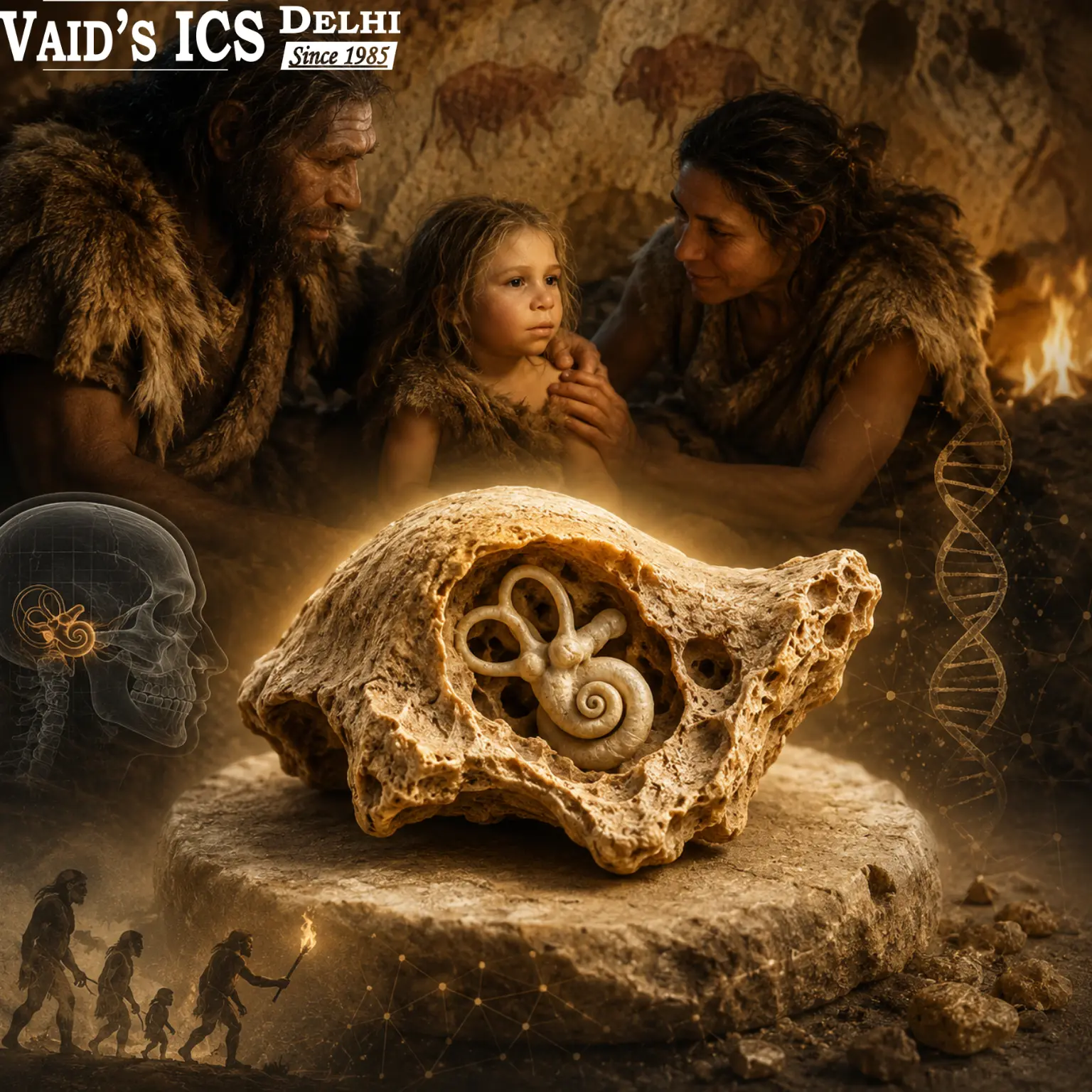
Source: Conde-Valverde et al., Science Advances (2024); fossil from Cova Negra, Valencia, Spain.
Evidence of Neanderthal caregiving is reshaping how we think about the social lives of our closest extinct relatives. A study of a Neanderthal child with Down syndrome — nicknamed “Tina” — suggests that the child’s group provided prolonged care, pointing to compassion and cooperation. For UPSC Anthropology Paper 1, it is a memorable example of Neanderthal social behaviour.
Why this matters: it offers direct fossil evidence for care of a dependent individual, challenging the “primitive brute” image of Neanderthals.
Syllabus relevance: Anthropology Paper 1 — Neanderthals, social organisation, and palaeopathology / evidence of behaviour.
Best use in answers: use it as a concrete case of altruism and social bonds in a non-sapiens hominin.
The fossil and the site
The evidence is a fragment of a child’s temporal bone (which houses the inner ear), first excavated in 1989 at Cova Negra near Xàtiva, Valencia, Spain. Neanderthal remains at the cave date to between roughly 273,000 and 146,000 years ago. The bone was only recently identified among earlier finds.

What the study found
Analysis of the inner-ear structures revealed anomalies consistent with Down syndrome. The researchers concluded the child lived to at least six years of age. This is presented as the first proposed case of Down syndrome in a Neanderthal.
Why caregiving is the key inference
A child with this condition would have needed sustained help — for example with balance and hearing — that a mother alone could not always provide. The survival of the child to age six therefore implies support from other group members. Because the child could give little practical help in return, the care is interpreted as altruistic rather than purely reciprocal.
Anthropological significance
The case strengthens a growing body of evidence that Neanderthals had complex social lives:
- Evidence of caregiving and cooperation within the group.
- Support for the idea of altruistic behaviour beyond immediate self-interest.
- A caution against equating Neanderthals with primitiveness — their behaviour overlaps with modern human social capacities.
Why this matters for UPSC Anthropology
It fits Paper 1 discussion of Neanderthal culture and social behaviour — map it to the Paper 1 human-evolution syllabus, and pair it with our note on Neanderthal symbolic behaviour. See the complete optional guide for answer strategy.
Use in Answer Writing
Syllabus topic: Neanderthals — culture, social organisation and behaviour (Paper 1).
Key concepts to apply: Altruism and caregiving; palaeopathology; social cooperation; Neanderthal behavioural complexity.
How to use it in answers: cite the Cova Negra “Tina” case as fossil evidence of Neanderthal social care, alongside symbolic-behaviour examples.
Concepts to apply in answers
- Altruism and caregiving in hominins
- Palaeopathology as evidence of behaviour
- Neanderthal social organisation and cooperation
\n
\n
FAQ
What condition did the Neanderthal child have?
Inner-ear anomalies consistent with Down syndrome; the child lived to at least six years.
Why does this imply caregiving?
Such a child needed sustained help, so survival to age six implies support from the wider group — interpreted as altruism.
Where is this useful in the exam?
Paper 1 — Neanderthal social behaviour and palaeopathology.
Preparing Anthropology Optional for UPSC?
Build vivid, evidence-based Paper 1 answers on Neanderthal behaviour with VAID SIR’s Anthropology programme at VAID’S ICS.
Explore the Anthropology Optional programme →
VAID’S ICS has mentored Anthropology-optional rankers across years, including AIR 3 (2023) and AIR 1 (2020). See the full results.
Sources
- Conde-Valverde et al., “The child who lived: Down syndrome among Neanderthals?,” Science Advances (2024): science.org