
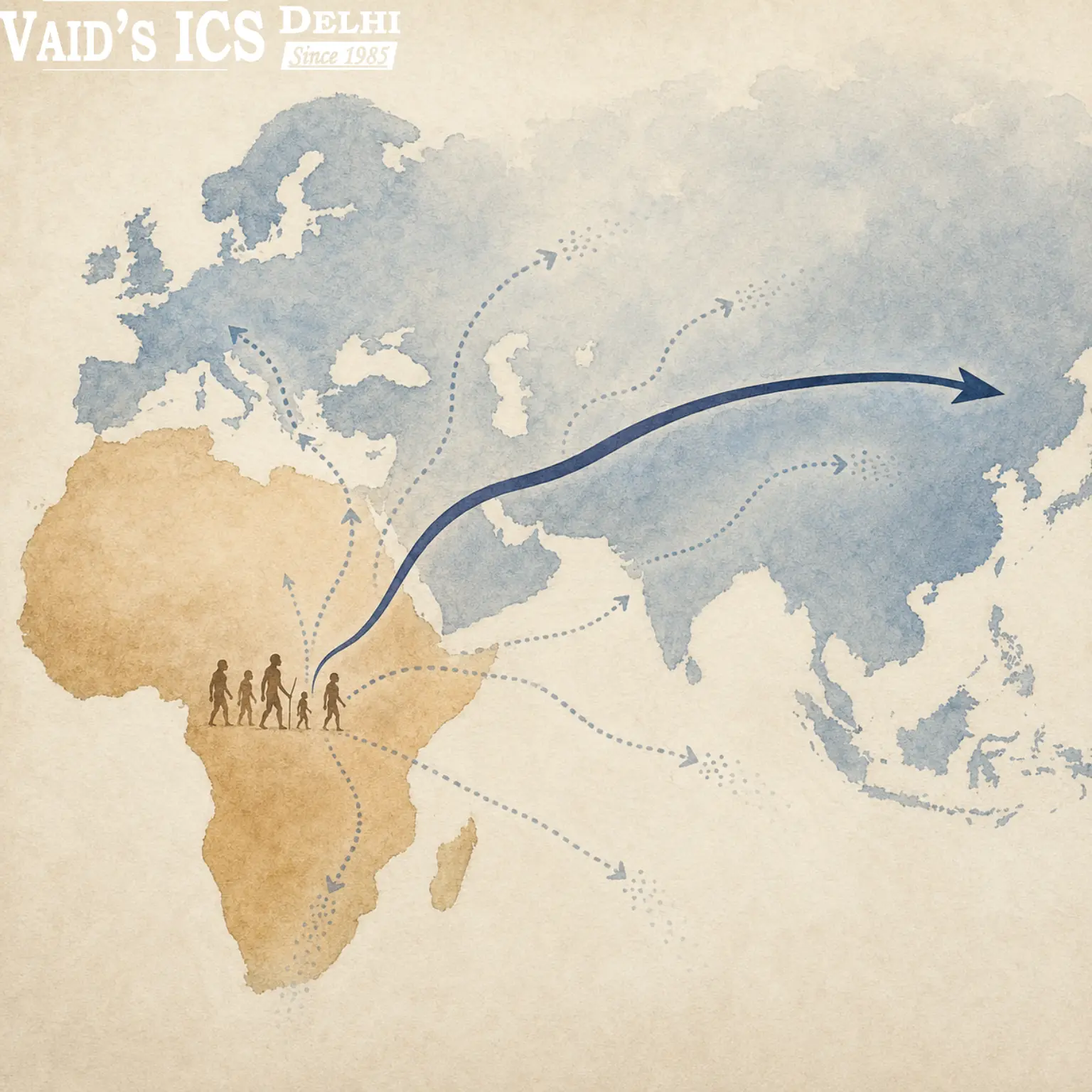
Source: Hallett, Scerri & Manica et al., Nature (18 June 2025).
The Out of Africa dispersal of modern humans is one of the central themes of human evolution — but it was not a single, clean event. Several earlier movements out of Africa left little lasting trace, while one later wave succeeded spectacularly. A 2025 study argues the difference lay less in tools or genes and more in ecological flexibility. For UPSC Anthropology Paper 1, it is a sharp, current example on human dispersal.
Why this matters: it reframes human dispersal as multiple waves with variable survival, and highlights ecological adaptability as a key to lasting success.
Syllabus relevance: Anthropology Paper 1 — dispersal of modern Homo sapiens, human migration and adaptation.
Best use in answers: use it to move beyond a single-cause story and discuss demography, environment, interbreeding and behavioural flexibility together.
Many dispersals, few that lasted
Fossils and genetics show that populations moved out of Africa on more than one occasion — for example well before 100,000 years ago in the Levant. Most of these earlier groups, however, contributed little or no ancestry to living non-Africans. The major dispersal that populated Eurasia is dated to roughly 50,000 years ago. So the real question is not simply why humans left, but why some dispersals persisted while others faded.

What the 2025 study found
The researchers argue that, from around 70,000 years ago, human groups in Africa began broadening their ecological niche — living successfully across very different habitats, from dense forests to arid deserts. This growing ability to thrive in varied and difficult environments, they suggest, prepared populations for the climatic and ecological challenges they would face beyond Africa.
Why earlier waves mostly did not persist
On this view, earlier dispersing groups were more ecologically restricted and vulnerable to changing conditions, small population sizes and isolation. Some interbred with other hominins (for example Neanderthals), yet this did not guarantee lasting survival. The picture is therefore one of trial and error: repeated attempts, variable success, and eventual persistence rather than a one-off triumph.
Not just tools or genes
Importantly, the study finds no clear technological leap neatly coinciding with the successful dispersal, and it downplays immunity gained purely from admixture as the decisive factor. Instead, it points to behavioural flexibility and social learning within Africa — groups sharing skills and widening their adaptive range — as central to later success.
Anthropological perspective
- Cultural ecology (Julian Steward): human groups adapt to environmental diversity through cultural innovation, not biology alone.
- Evolutionary anthropology: mastering diverse African environments acted as a “training ground” for survival across continents.
Why this matters for UPSC Anthropology
It directly serves Paper 1 questions on the emergence and dispersal of modern humans — map it to the Paper 1 human-evolution syllabus, read it with our note on hominin diversity, and see the complete optional guide for strategy.
Use in Answer Writing
Syllabus topic: Dispersal of modern Homo sapiens; human migration and adaptation (Paper 1).
Key concepts to apply: Multiple dispersal waves; ecological niche expansion; cultural ecology (Steward); admixture; behavioural flexibility.
How to use it in answers: present dispersal as multi-causal — climate windows, demography, interbreeding and ecological flexibility — rather than a single failed-migration story.
Previous Year Questions — UPSC Anthropology
- Critically evaluate the contesting theories of the emergence and dispersal of modern Homo sapiens. (2020)
- (Also useful for Palaeolithic cultural-evolution and human-adaptation questions.)
\n
FAQ
Did humans leave Africa only once?
No. There were several dispersals; most earlier ones left little lasting ancestry, while the major wave about 50,000 years ago succeeded.
What made the later dispersal succeed?
The 2025 study links it to an earlier expansion of the human ecological niche within Africa, not simply to new tools or genes.
Where is this useful in the exam?
Paper 1 — emergence and dispersal of modern Homo sapiens.
Preparing Anthropology Optional for UPSC?
Learn to build multi-causal, evidence-based Paper 1 answers on human dispersal with VAID SIR at VAID’S ICS.
Explore the Anthropology Optional programme →
VAID’S ICS has mentored Anthropology-optional rankers across years, including AIR 3 (2023) and AIR 1 (2020). See the full results.
Sources
- Hallett, Scerri, Manica et al., “Major expansion in the human niche preceded out-of-Africa dispersal,” Nature (2025): nature.com