
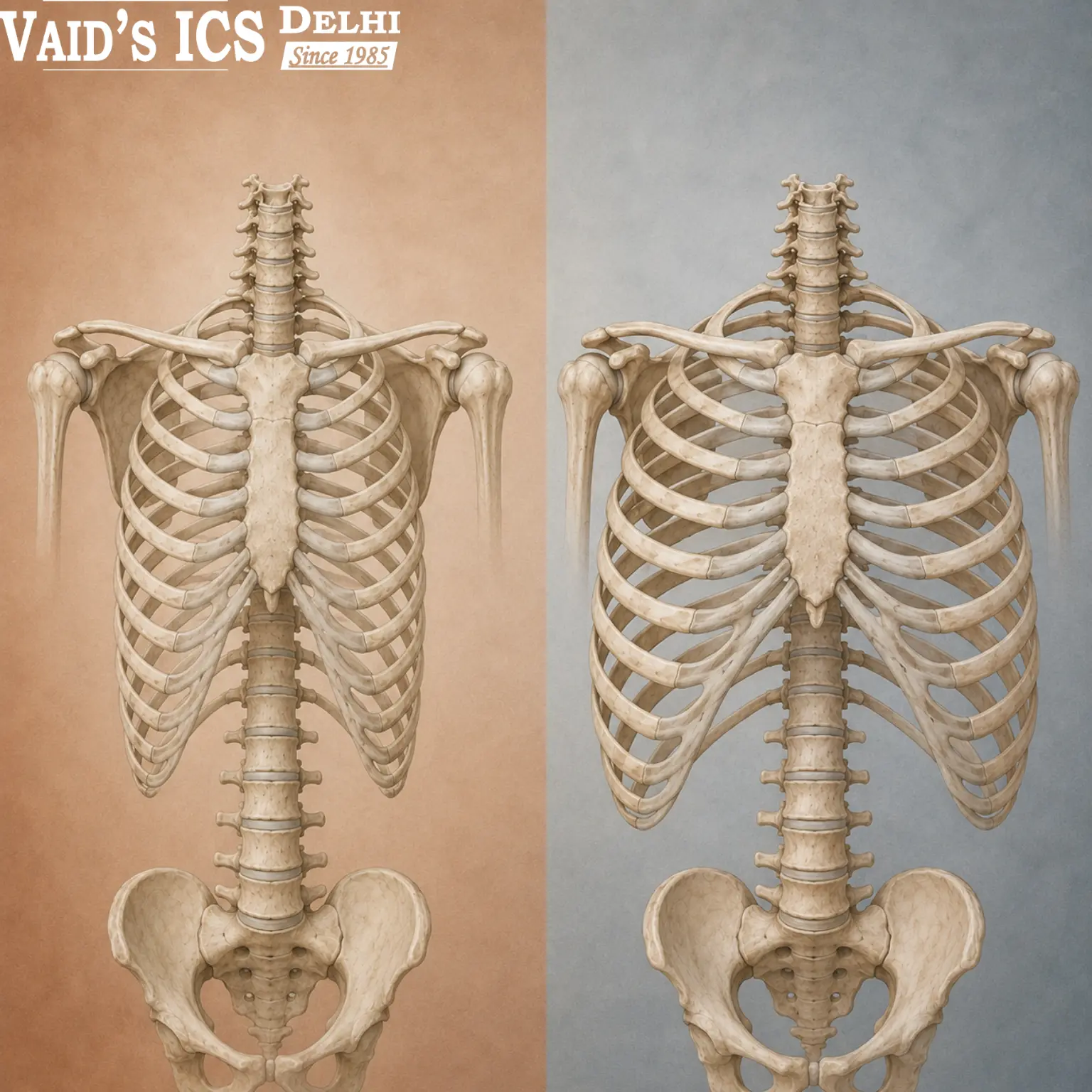
Source: José M. López-Rey et al., Communications Biology (10 July 2025).
Human ribcage climate adaptation is a neat illustration of how the environment shapes the human body. A 2025 study of early modern-human skeletons finds that thoracic (chest) shape tracks climate — a pattern that echoes classic ecological rules. For UPSC Anthropology Paper 1, it is a strong, current example of human adaptation.
Why this matters: it links a specific skeletal feature (the ribcage) to climate, giving a fresh, examinable case of morphological adaptation.
Syllabus relevance: Anthropology Paper 1 — human adaptation, skeletal morphology, Bergmann’s and Allen’s rules.
Best use in answers: use it to update standard Bergmann/Allen answers with a recent fossil example.
The fossils studied
The researchers examined three early modern-human skeletons from different climates:
- Nazlet Khater 2 — about 30,000 years old, Egypt (warm).
- Ohalo II H2 — about 19,000 years old, Israel (warm–moderate).
- Dolní Věstonice 13 — about 30,000 years old, Czech Republic (cold).
What the bones show
All three had the rounded, globular ribcage typical of modern humans, showing this shape has deep roots. But there were differences consistent with climate:
- Individuals from warmer climates tended to have narrower ribcages — better for shedding body heat.
- The individual from a colder climate had a broader, larger chest — better for retaining heat.
A twist in the story
The cold-climate Czech fossil, Dolní Věstonice 13, had a ribcage nearly as large as a Neanderthal’s and broad like Homo erectus. This challenges the idea that Homo sapiens were always slim and lightly built, and suggests early modern humans were more variable and flexible than once assumed.

How to read this carefully
Climate is clearly a major factor in body shape — but not the only one. Genetics, body size, activity levels and population history also affect thoracic morphology, and this study rests on a small sample of three individuals. The safest framing is that climate is one important influence, consistent with Bergmann’s and Allen’s rules, rather than the sole cause.
Why this matters for UPSC Anthropology
It directly serves Paper 1 human-adaptation questions — map it to the Paper 1 human-adaptation syllabus, and review recurring patterns in the Anthropology PYQ analysis. See the complete optional guide for strategy.
Use in Answer Writing
Syllabus topic: Human adaptation and skeletal morphology (Paper 1).
Key concepts to apply: Bergmann’s and Allen’s rules; thoracic (ribcage) morphology; heat retention vs dissipation; morphological variability; small-sample caution.
How to use it in answers: pair this fossil evidence with Bergmann/Allen rules in heat/cold-adaptation answers, noting climate as a major but not sole factor.
Previous Year Questions — UPSC Anthropology
- Do Allen’s Rule and Bergmann’s Rule hold for human populations? Explain with examples. (15 Marks, 2018)
- Elaborate upon major human adaptations to heat and cold. (15 Marks, 2013)
- Describe the biocultural responses to extreme climatic events. (15 Marks, 2020)
\n
\n
FAQ
Does climate fully explain ribcage shape?
No. Climate is a major factor, but genetics, body size, activity and population history also matter; the study used only three skeletons.
Which rules does this relate to?
Bergmann’s and Allen’s rules on body size/shape and heat exchange in different climates.
Where is this useful in the exam?
Paper 1 — human adaptation to heat and cold, skeletal morphology.
Preparing Anthropology Optional for UPSC?
Update your Bergmann/Allen answers with fresh fossil evidence, guided by VAID SIR at VAID’S ICS.
Explore the Anthropology Optional programme →
VAID’S ICS has mentored Anthropology-optional rankers across years, including AIR 3 (2023) and AIR 1 (2020). See the full results.
Sources
- López-Rey et al., climate and human thoracic morphology, Communications Biology (2025).