
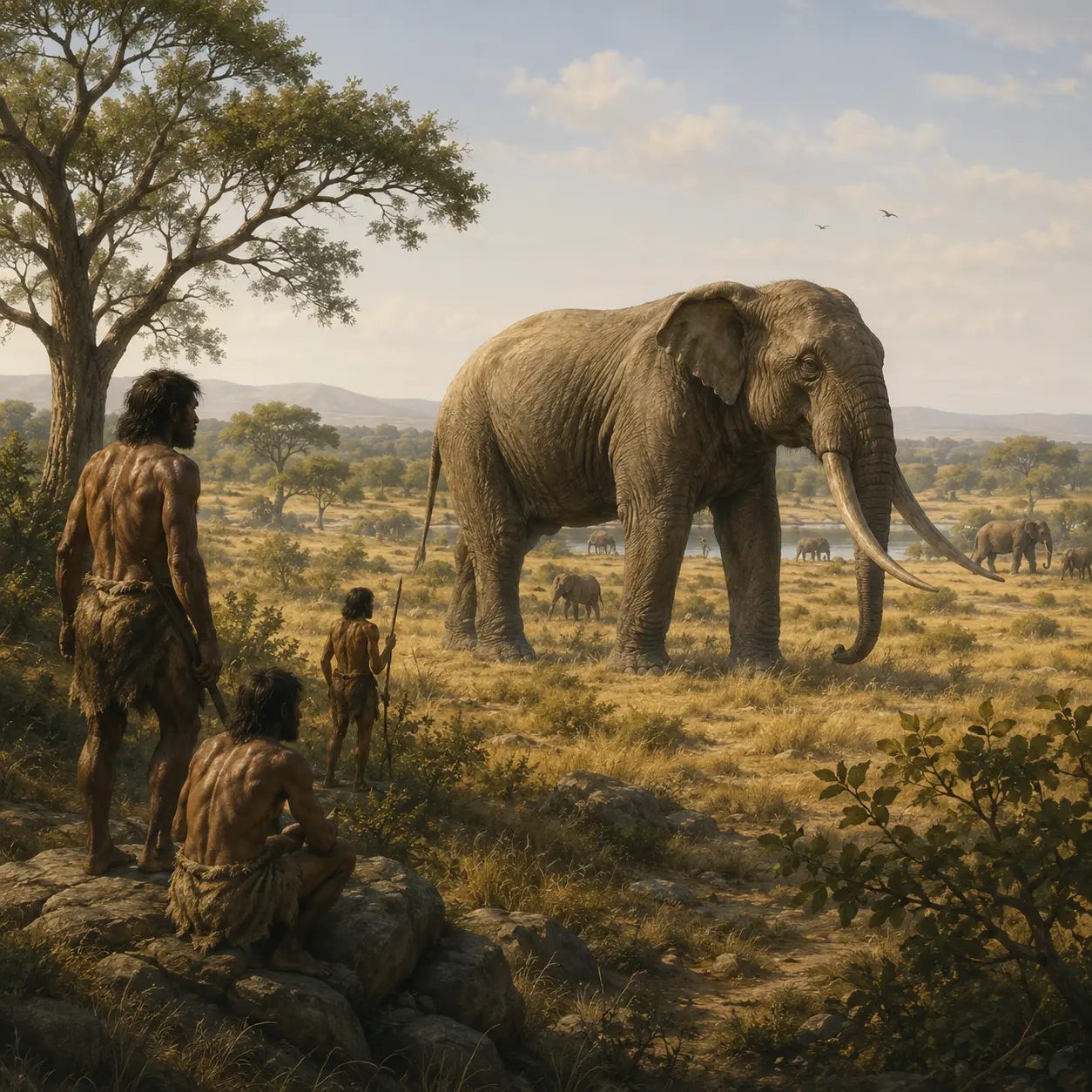
Source: New Scientist (24 July 2024), reporting on research into proboscidean macroevolution.
How early did humans start reshaping ecosystems? Research on early humans and megafauna suggests that the spread of Homo erectus around 1.8 million years ago coincided with a sharp rise in extinctions of proboscideans (elephants and their relatives). Moreover, this is a valuable Paper 1 case on early human–environment interaction — but, as this note stresses, it should be framed with care.
Why this matters: it points to very early human impact on large animals, extending the human–environment story deep into the Pleistocene.
Syllabus relevance: Anthropology Paper 1 — geographical distribution of Homo erectus, subsistence, and human–environment relationships.
Best use in answers: use it cautiously as early evidence of human ecological impact, not proof that humans alone caused extinctions.
The research finding
Studies of proboscidean evolution report that, around 1.8 million years ago, the extinction rate of proboscideans rose sharply (reported as roughly a fivefold increase). Furthermore, this timing overlaps with the geographical expansion of Homo erectus and growing contact between humans and large herbivores.
Proboscideans before humans
In addition, around 1.8 million years ago there were many proboscidean species across Africa and Eurasia, and the group had been diversifying successfully for millions of years. So the later rise in their extinction rate marks a genuine change in their fortunes.

Why Homo erectus is implicated
Homo erectus had traits that could make it an effective large-game predator or scavenger:
- Improved stone tool technology.
- Likely cooperative foraging.
- Greater mobility and ecological adaptability.
How to read this carefully
Moreover, the evidence is a correlation in time, not proof of a single cause. Similarly, it is safer to say that early humans may have contributed to proboscidean decline through hunting and scavenging pressure and a widening dietary niche, alongside other drivers such as climate and habitat change. Saying that humans “wiped out” elephant relatives on their own overstates what the evidence supports.
Anthropological significance: early humans and megafauna
- Possible early evidence of human ecological impact, long before the Holocene.
- Insight into Homo erectus subsistence and dispersal.
- The start of a long human–megafauna relationship.
Why this matters for UPSC Anthropology
Furthermore, it supports Paper 1 answers on Homo erectus and on early subsistence — map it to the Paper 1 human-evolution syllabus, and see the complete optional guide for strategy.
Use in Answer Writing
Syllabus topic: Homo erectus — characteristics, distribution and subsistence (Paper 1).
Key concepts to apply: Human–environment interaction; megafaunal decline; hunting/scavenging pressure; dietary niche; multi-causal explanation (humans + climate).
How to use it in answers: cite the Homo erectus–proboscidean overlap as early human ecological impact, while noting climate and other factors.
Previous Year Questions — UPSC Anthropology
- Describe the salient characteristics and geographical distribution of Homo erectus. (15 Marks, 2015)
- What are the physical and cultural characteristics of Homo erectus? Discuss its phylogenetic status. (20 Marks, 2021)
\n
FAQ
Did Homo erectus wipe out elephant relatives?
Not on its own. Their expansion coincided with rising proboscidean extinctions; humans likely contributed alongside climate and habitat change.
When did this happen?
Around 1.8 million years ago, overlapping the spread of Homo erectus.
Where is this useful in the exam?
Paper 1 — Homo erectus, subsistence and human–environment relationships.
Preparing Anthropology Optional for UPSC?
Learn to frame causation carefully in Paper 1 answers with VAID SIR at VAID’S ICS.
Explore the Anthropology Optional programme →
VAID’S ICS has mentored Anthropology-optional rankers across years, including AIR 3 (2023) and AIR 1 (2020). See the full results.
Sources
- New Scientist (2024), reporting on proboscidean extinction dynamics and early human impact.