
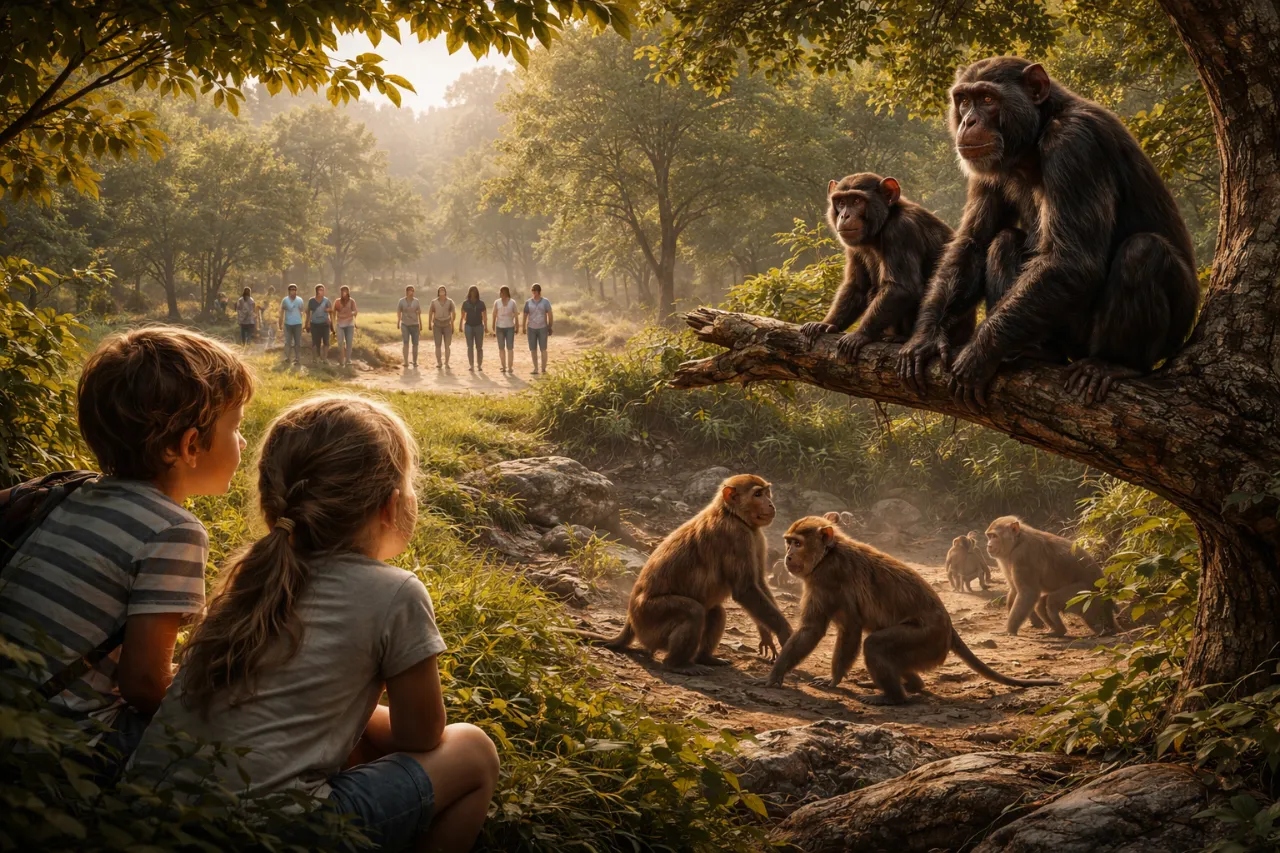
Source: Laura Lewis et al., Proceedings of the Royal Society B (4 June 2025), and Liesbeth Sterck et al., Animal Cognition (June 2025).
Primate social attention — the pull to watch what others are doing — turns out to be far older than culture. New studies show that humans, chimpanzees and macaques all prefer to observe social interaction, sometimes at a cost to themselves. For UPSC Anthropology Paper 1, this is a clean, current example of primate social organisation, dominance hierarchy and social learning.
Why this matters: it shows that “people watching” is an evolved, adaptive trait rooted in primate biology, not merely a modern habit.
Syllabus relevance: Anthropology Paper 1 — Primate social organisation and behaviour; social learning; primatology.
Best use in answers: use it to link social attention with hierarchy, reputation and cultural transmission in comparative primate questions.
A shared drive to watch others
Researchers Laura Lewis and Liesbeth Sterck found that social curiosity runs across the anthropoids. In one experiment, children aged four to six and adult chimpanzees watched videos of either social interactions or solitary individuals. Notably, both groups preferred the social scenes, and both were willing to give up small rewards to keep watching. In other words, attention to social life is intrinsically rewarding.

Macaques and the pull of conflict
A separate study on long-tailed macaques sharpened the picture. Both males and females paid more attention to aggressive encounters than to peaceful grooming, and they watched familiar individuals most closely. Similarly, humans are drawn to conflict-driven news and to the lives of people they know.
Why hierarchy is worth watching
This interest in aggression is not idle. For group-living primates, tracking who is dominant helps an individual avoid threats, position itself strategically and cooperate wisely. Therefore primate social attention is really a tool for reading dominance hierarchies.
Reputation and the cost of being ignored
According to Gillian Forrester, attention also maintains reputation. In ancestral primate and human groups, reputational damage could mean losing access to food, fewer mating opportunities, and even ostracism. Consequently, watching others carefully had real survival value.
From social attention to culture
Taken together, these findings suggest that observing others evolved to monitor group dynamics, sustain bonds, detect threats and, crucially, support social learning and cultural transmission. The distance between a macaque watching a rival and a human following the news is smaller than it looks.
Use in answer writing: pair this with classic accounts of primate social organisation to argue that social cognition is deeply conserved across anthropoids.
Paper 1 link: Primate social organisation and behaviour; social learning and the roots of culture; primatology.
Relevant PYQs
• Discuss different forms of primate social organisation. (15M / 2022)
• Role of Primatology in anthropological studies. (10M / 2013)
Also read
• Orangutans & Metabolic Flexibility: Primate Diet and Adaptation
• The Diet That Shaped Human Evolution
• Anthropology PYQ Analysis
FAQ
Does this prove animals gossip like humans? No. It shows a shared, evolved interest in social information; human gossip is a cultural elaboration of that older tendency.
Why do primates watch aggression more than grooming? Because tracking conflict and dominance helps them avoid danger and navigate the group safely.
Building your Paper 1 primatology base?
Comparative primate behaviour is a reliable source of marks. See our complete Anthropology Optional guide for how to turn studies like this into structured answers. Mentored by Vaid Sir; Anthropology specialists since 1985.
References
Lewis, L. et al. (2025), Proceedings of the Royal Society B; Sterck, L. et al. (2025), Animal Cognition.